

Vitiligo on Hands Treatment: Options, Expectations and Care
Hand vitiligo can be harder to repigment than facial patches, so a treatment that helps one area may bring less change to fingers, knuckles, or palms. If patches are visible during everyday tasks, it’s understandable to want practical answers about vitiligo on hands treatment without being promised a cure.
Results vary, and repigmentation can take months. A clinician can help you assess appropriate medical options and set realistic goals. Sun protection and camouflage can support day-to-day care, while protecting depigmented skin matters because it can burn more easily in the sun.
This guide explains why hands may respond differently, compares clinician-directed treatments with supportive skin care and camouflage, and outlines practical next steps. It also explains how to think about VENSIA Anti Vitiligo Cream: it is a skincare product, not a proven medical treatment or a substitute for clinician-directed care.
Key Takeaways
- Hand patches may respond differently from patches elsewhere, so set realistic goals for vitiligo on hands treatment.
- Understand how clinician-guided medicines and light-based treatments differ from camouflage and supportive skin care.
- Treatment suitability depends on factors such as diagnosis, disease activity, affected area, and medical history.
- Build a practical routine with sun protection and gentle skin care, following product directions and clinical guidance.
- VENSIA Anti Vitiligo Cream is a skincare product, not a substitute for diagnosis or clinician-directed treatment.
Vitiligo on the hands: what it is and why treatment can feel different
Because hands are often visible, patches may draw attention during ordinary moments, from greeting someone to handling everyday tasks. That visibility can bring practical questions or self-consciousness, but it doesn’t define a person’s health or identity. Understanding what may cause a change in skin colour is a useful first step in deciding what care, if any, feels right.
Vitiligo is a condition in which skin loses pigment, forming lighter patches. It can affect different areas, including the hands, and its pattern and progression vary from person to person. A pale patch alone doesn’t confirm vitiligo. This overview of vitiligo symptoms and treatment approaches provides general background, but a clinician’s assessment is needed to identify the cause of an individual patch.
What makes hand vitiligo distinct?
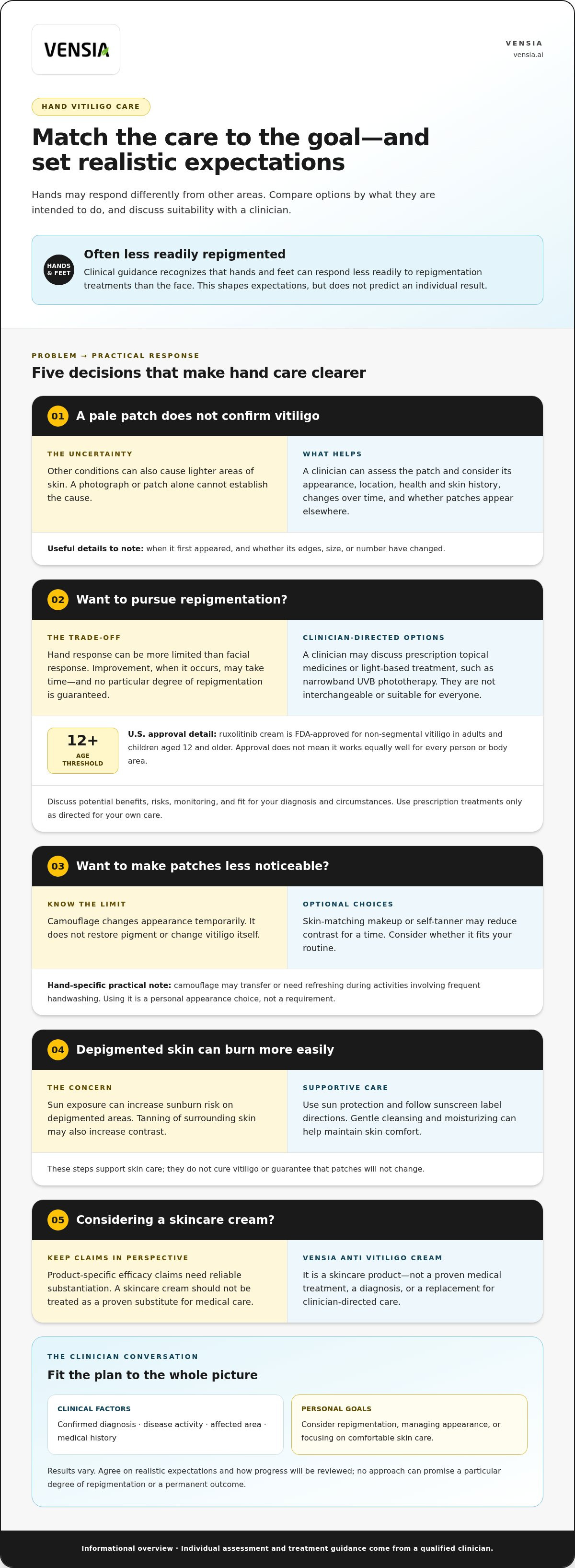
Hands are frequently exposed, so patches may be more noticeable in daily interactions than areas usually covered by clothing. Location also matters when considering treatment: clinical guidance recognizes that hands and feet, known as acral areas, often respond less readily to repigmentation treatments than the face. This can shape expectations, but it doesn’t predict an individual result or mean treatment cannot be considered.
Treatment goals may include encouraging repigmentation, addressing changes in disease activity, or managing appearance with camouflage. Which goals make sense depends on personal preferences and clinical factors. A patch’s location alone can’t establish how vitiligo will progress or identify the most appropriate approach. Consider vitiligo on hands treatment in the context of the whole picture, not just where a patch appears.
How clinicians assess white patches on the hands
A clinician typically considers a patch’s appearance and location, relevant health and skin history, and whether it has changed over time. They may also look for patches elsewhere. Note when a patch first appeared and whether its edges, size, or number have changed. These details can make an assessment more informative.
Other conditions can also cause lighter areas of skin, and different causes may call for different care. Don’t diagnose yourself from a photograph or assume every white patch is vitiligo. If you’re uncertain about a new or changing patch, a qualified clinician can assess it and explain whether further evaluation is appropriate. A guide to causes of white patches on skin can offer general context, but it can’t replace an individual assessment.
Once the cause is clearer, the discussion can turn to treatment suitability. Disease activity, the area affected, medical history, and personal goals all matter. For hands, agree on realistic expectations and how progress will be reviewed. Treatment response varies, and no approach can promise a particular degree of repigmentation or a permanent outcome.
Vitiligo on hands treatment options: what the evidence and clinical guidance say
There isn’t one approach that suits every person or every patch. Start by separating treatments intended to influence pigment from options that temporarily change how patches look. The right discussion depends on confirming the diagnosis, whether patches are changing, how much skin is affected, medical history, and local clinical guidance. Your goals matter too: you may want to pursue repigmentation, make patches less noticeable, or focus on comfortable skin care.
Clinician-directed treatments and hand-specific expectations
A clinician may discuss prescription topical medicines or light-based treatment, such as narrowband UVB phototherapy. These approaches aim to affect the condition or encourage repigmentation; they aren’t interchangeable, and neither is suitable for everyone. In the United States, ruxolitinib cream is FDA-approved for non-segmental vitiligo in adults and children aged 12 and older. Its approval doesn’t mean it will work equally well for every person or body area.
Response on hands can be more limited than on the face, and improvement, when it occurs, may take time. A clinician can explain potential benefits, risks, monitoring, and whether a treatment fits your diagnosis and circumstances. The American Academy of Dermatology outlines diagnosis and approaches such as topical medicines and light therapy in its Vitiligo Treatment Options and Diagnosis resource. Use prescription treatments only as directed for your own care, not by copying another person’s routine.
Camouflage and supportive skin care
Camouflage products, including skin-matching makeup or self-tanner, can reduce contrast between patches and surrounding skin for a time. They don’t restore pigment or change vitiligo itself. For hands, consider how the product fits your routine: it may transfer or need refreshing during activities that involve frequent handwashing. Camouflage is an optional appearance choice, not a treatment requirement.
Supportive care serves a different purpose. Gentle cleansing and moisturizing can help maintain skin comfort, while sun protection helps reduce sunburn risk on depigmented areas. It can also limit tanning of surrounding skin that may increase contrast. These steps support skin care; they don’t cure vitiligo or guarantee that patches won’t change. Follow sunscreen label directions and current clinical guidance.
For broader context, read the VENSIA Anti Vitiligo Cream repigmentation guide with clear expectations: product-specific efficacy claims need reliable substantiation. A skincare cream shouldn’t be treated as a proven substitute for diagnosis or clinician-directed care. If you’re building a simple skincare routine alongside medical guidance, you can learn about VENSIA’s targeted skincare.
A practical way to compare your options
For a grounded conversation about vitiligo on hands treatment, name your main goal, note whether patches are changing, and ask how progress and possible side effects will be assessed. Compare options by purpose: clinician-directed treatment may target pigment or disease activity; camouflage changes appearance temporarily; supportive skin care helps protect comfort and reduce sun exposure risks. These options can meet different needs, and choosing one doesn’t require rejecting the others.
Comparing hand vitiligo treatments: goals, limits, and trade-offs
Different approaches serve different purposes, so compare them by what you want help with rather than ranking them. The table is educational, not a personalized recommendation. A clinician can help assess medical options for your situation; camouflage and supportive care can also be considered according to your preferences.
| Approach | Main goal | Appearance or pigmentation | Time and supervision | Key limit |
|---|---|---|---|---|
| Clinician-directed treatment | Address vitiligo activity or encourage repigmentation | Intended to affect the condition or pigment, not simply cover a patch | May involve an ongoing plan, follow-up, and monitoring; requirements depend on the treatment | Response varies, and hands may respond differently from other sites. Benefits and risks need individual discussion. |
| Camouflage | Reduce contrast for appearance-related comfort | Changes how patches look temporarily; does not restore pigment | Applied as needed, without medical supervision | May need refreshing and may not suit every activity or personal preference. |
| Supportive skin care | Protect skin and support comfort | Does not repigment or cover patches | Can be part of a regular routine; follow product directions and sun-protection guidance | Supports skin care, but doesn’t treat vitiligo itself. |
A cream marketed for vitiligo isn’t automatically a clinically proven repigmentation treatment. A product name or marketing language alone doesn’t establish that a cream has been tested in robust clinical studies or shown to restore pigment. Consider the evidence behind any claim, and don’t treat a skincare product as a replacement for diagnosis or clinician-directed care.
Match the approach to the goal
Start by naming your priority: pursuing repigmentation, reducing visible contrast, protecting exposed skin, or feeling more comfortable day to day. One option may not meet every goal. Some people discuss medical treatment alongside camouflage and sun care; others choose not to pursue repigmentation. Each is a personal choice, not a measure of how seriously someone takes their health.
Questions to discuss before starting treatment
Before beginning a medical plan, ask what evidence supports it, what benefits are realistic for hands, what adverse effects to watch for, and how progress will be monitored. Clarify how long the plan may continue, what to do if patches change, and when to review the approach. For more context on evaluating topical options, see this guide to topical creams for vitiligo and how to choose.
These questions make vitiligo on hands treatment decisions more practical: you can compare the intended benefit with the time, care, and follow-up involved. Keep the discussion focused on your diagnosis, medical history, and priorities. No table or general guide can predict an individual outcome, but a clear plan can explain what each option is meant to do and where its limits lie.
A practical hand-care plan while considering vitiligo treatment
A steady routine can help protect your hands and make treatment easier to manage, even though skin care itself doesn’t restore pigment. Keep the steps simple, and follow any plan agreed with your clinician rather than adding products or changing treatment based on day-to-day appearance.
- Protect exposed hands. Depigmented skin can be more vulnerable to sunburn. Use sunscreen according to its label and current clinical guidance, and consider shade or protective clothing when practical. Reapply as directed, especially if your day includes handwashing or time outdoors.
- Keep skin care gentle. Choose cleansing and moisturizing steps that feel comfortable, and avoid rubbing or irritating affected skin. Follow the directions for every topical product, including any prescribed treatment. If a product causes a concerning reaction, stop and seek advice from a qualified clinician.
- Follow the agreed treatment plan. Use clinician-directed treatments only as instructed. Keep track of how and when you use them, and raise questions about side effects or changes rather than adjusting the plan on your own.
- Choose appearance support if you want it. Camouflage makeup or self-tanner may temporarily reduce contrast. Choose an approach that fits your routine and preferences, and remember that camouflage changes appearance, not vitiligo.
Protect and care for depigmented hands
Hands meet sunlight during everyday activities, including driving, walking, and working outdoors near windows. Make sun protection part of a routine that suits your day, and follow sunscreen directions rather than relying on a one-time application. Gentle care can support comfort, but creams and moisturizers shouldn’t be described as restoring pigment unless reliable evidence supports that specific claim.
Be cautious about adding multiple topical products at once. Doing so can make it harder to tell what is causing irritation or whether a prescribed routine is being followed correctly. If you’re using a clinician-directed medicine, keep its instructions distinct from general skincare directions. For a complementary overview of daily care, explore this vitiligo skincare routine guide.
Track changes without expecting a fixed timeline
Keep brief notes on when you first noticed a patch, where it appears, and whether you’ve seen changes. You can also take occasional photos from a similar angle and in similar lighting. Record treatments and new skincare products too. These details can help you describe what you’ve noticed at a follow-up without having to judge progress every day.
Appearance can seem different with lighting, temperature, or tanning of surrounding skin. A short-term visual difference doesn’t necessarily show that vitiligo has progressed or that treatment is working. Response and progression vary, so there’s no single results deadline that applies to everyone. Ask your clinician when and how to review your particular plan.
For a simple skincare routine alongside your care plan, explore VENSIA’s targeted skincare. Products are not a substitute for diagnosis or clinician-directed treatment. Keeping vitiligo on hands treatment decisions grounded in professional guidance, gentle care, and realistic tracking can make the process more manageable.
Considering VENSIA Anti Vitiligo Cream: a transparent next step
Skincare products can be part of a personal routine, but a product name alone can’t show whether it treats vitiligo or restores pigment. VENSIA Anti Vitiligo Cream is a skincare product for people exploring targeted skincare. It is not a proven medical treatment or a substitute for diagnosis and clinician-directed care. Claims about clinical efficacy need reliable supporting evidence.
That distinction matters when considering vitiligo on hands treatment. A skincare product may have a place in someone’s routine, while medical treatment decisions depend on an assessment of the condition and individual circumstances. Don’t delay getting a new or changing patch assessed while trying a topical product. A qualified clinician can help clarify the cause and discuss options based on your goals.
How to assess a topical product responsibly
Before applying any topical product, read its label, intended use, and directions. Make sure you understand how it should be used, and don’t assume a product is suitable for a particular skin concern just because its name refers to vitiligo. Cosmetic skincare language and claims to treat vitiligo or restore pigment are not the same; treatment claims need reliable supporting evidence.
Use products only as directed. If you notice a concerning reaction, stop using the product and seek appropriate medical advice. If you’re already following a clinician-directed plan, keep product use separate from prescribed instructions unless your clinician advises otherwise. Avoid changing or stopping a treatment plan based on a product claim or a short-term change in appearance.
Choose an informed next step
Take a measured approach: seek an assessment if the cause of a patch is uncertain, discuss your goals and treatment options with a qualified clinician, protect exposed hands, and consider camouflage if reducing contrast would help you feel more comfortable. You can also choose not to pursue repigmentation treatment. These choices are personal, and none needs to be justified by how visible a patch is.
For any option you’re considering, ask what it is intended to do, what evidence supports that purpose, what limitations or risks apply, and how you’ll know whether to continue. Keep notes on changes and products used, and bring them to a clinical discussion. This helps separate a cosmetic effect from a treatment outcome and keeps expectations realistic, especially when response can vary by body area.
VENSIA focuses on targeted skincare and simple daily routines. If you’d like to explore VENSIA Anti Vitiligo Cream as a skincare option, Explore VENSIA Anti Vitiligo Cream. Consider it separately from diagnosis or a medical treatment plan, and make choices that feel appropriate for your skin, comfort, and goals.
Take your next step with confidence
Your next step doesn’t need to answer every question at once. Decide what matters most right now: understanding a new patch, exploring clinician-guided care, protecting your hands, or feeling more comfortable with their appearance. If you’re unsure about a patch or notice changes, seek an assessment rather than relying on a skincare product to explain or treat it. Choosing not to pursue repigmentation is also a valid personal decision.
For vitiligo on hands treatment, let your goals and qualified clinical guidance shape the plan. Skincare can support a simple routine, but it shouldn’t be mistaken for proven medical care. VENSIA offers targeted skincare products, including VENSIA Anti Vitiligo Cream, for people who want to explore that category with realistic expectations.
Explore VENSIA Anti Vitiligo Cream as a skincare option, while keeping diagnosis and treatment decisions grounded in appropriate clinical guidance. Move forward one informed choice at a time, in a way that feels right for you.
Frequently Asked Questions
Is vitiligo on the hands treatable?
Yes, treatment may be considered, though results vary and hand patches can be more difficult to repigment than facial patches. A qualified clinician can discuss whether options such as prescription topical medicine or phototherapy suit your diagnosis and health history. For vitiligo on hands treatment, ask what the plan is intended to achieve and how progress will be reviewed. Camouflage is another option if your goal is to reduce visible contrast.
Is vitiligo on the hands contagious?
No. Vitiligo doesn’t spread from one person to another through touch, sharing towels, or everyday contact. You can’t catch it by shaking hands or working alongside someone who has it. If someone asks, a simple explanation that vitiligo affects skin pigment, not contagiousness, may help. The condition can change on a person’s own skin, but that’s different from transmitting it to another person.
Can white patches on hands be something other than vitiligo?
Yes. Lighter areas can have causes other than vitiligo, including changes after skin inflammation or injury, certain infections, or other skin conditions. Their appearance can overlap, so a photo or online description can’t reliably identify the cause. Note whether the area is itchy, scaly, follows a rash, or appeared after an injury, then share those details with a clinician for assessment.
Can sunlight restore pigment in vitiligo patches on the hands?
No, sunlight shouldn’t be used as a do-it-yourself method to restore pigment. Depigmented skin can burn more easily, and intentional tanning may darken surrounding skin, making the contrast more noticeable. Protect exposed hands with sunscreen used according to its label and current clinical guidance. If you’re considering light-based treatment, discuss medically supervised options with a qualified clinician rather than increasing sun exposure yourself.
Can vitiligo affect fingernails as well as the skin?
It can, although nail changes aren’t present in everyone with vitiligo. Some people may notice features such as small indentations, ridges, or changes in nail colour. These signs aren’t specific to vitiligo and can have other causes, including everyday nail trauma or separate nail conditions. Mention persistent or new nail changes during a clinical assessment, particularly if they occur alongside patches on the fingers.
Does diet cure vitiligo on the hands?
No specific diet has been established as a cure for vitiligo or a reliable way to repigment hand patches. Eating a varied, balanced diet can support general health, but restrictive eating or supplements shouldn’t replace assessment or clinician-guided care. If you suspect a nutritional deficiency or are considering supplements, discuss it with a qualified health professional, especially if you take medication or have another health condition.
Can vitiligo patches on the hands spread?
They can change over time, but the pattern and pace differ from person to person, and some patches may remain stable. New areas can appear elsewhere, while existing patches may change in size or shape. Keep a dated note or photo if you notice a clear change, using similar lighting for comparison. If changes are rapid or concerning, arrange an assessment rather than trying to predict the course from appearance alone.


