

Non steroid vitiligo cream: How often to apply and where
There’s no single application schedule for every non-steroid vitiligo cream. How often to apply it and where depends on the specific product’s directions, so don’t assume that instructions for one cream apply to another.
It’s understandable to want clear guidance before adding a cream to your routine, especially when treating visible patches and trying to avoid unnecessary irritation. The treatment type, areas involved, and way results are assessed all shape what to expect.
This article explains how application frequency and treatment areas are determined, summarizes clinical findings reported for non-medicated creams, and outlines common reactions to consider. It also explains how to distinguish general information from product-specific instructions, helping you make a more informed decision about skin care.
Key Takeaways
- Learn why application instructions for prescribed treatments shouldn’t be assumed to apply to every non steroid vitiligo cream.
- See what clinical studies reported about facial repigmentation, and how to interpret those findings.
- Understand why delicate areas, including skin around the eyes, call for careful attention to topical-use directions.
- Find out which skin reactions are discussed and what differences matter when comparing topical treatment types.
- Explore practical ways to protect depigmented skin, including expert sunscreen and UV protection recommendations.
Treatment application frequency and body-surface-area limit
There is no single schedule for every non-steroid vitiligo cream. Application frequency and areas depend on the product’s directions; don’t transfer a prescription schedule to another formula. Vitiligo causes patches of pigment loss, and nonsegmental vitiligo is its most common form.
For comparison, UK guidance describes prescription topical steroids for nonsegmental vitiligo when less than 10% of the body is affected. An adult may be offered this option if they want further treatment, aren’t pregnant, and accept possible side effects. A GP usually advises applying the prescribed cream or ointment once a day. That schedule applies to prescribed steroids, not automatically to non-steroid creams or light therapy. Light therapy is a separate treatment approach, and this schedule doesn’t compare its effectiveness with creams.
Apply a topical product only to the areas and at the frequency stated in its directions. For a prescribed steroid, the amount can be estimated using a fingertip unit, or FTU: the amount squeezed along an adult fingertip. One FTU covers an area twice the size of an adult’s hand. This measurement applies to topical steroids, not as a universal dose for other creams.
The UK’s 10% body-surface threshold also helps explain when treatment may need further assessment. A GP may refer someone to a dermatologist if vitiligo affects more than 10% of their body. This threshold describes referral guidance, not a general maximum area for every non-steroid product. For a cream, follow its stated application limits rather than using the steroid threshold as a substitute.
Children may use pimecrolimus or tacrolimus to help restore pigment; UK guidance includes both adults and children. These treatments are unlicensed for vitiligo in the UK. A child’s age and the medicine’s directions matter, so don’t assume an adult’s application amount or schedule applies to a child.
Track treatment consistently. Record the product, application dates, treated patches, and any change in skin comfort or appearance. A dated photo of the same area can help compare progress. In the UK, a GP may arrange follow-up after 1 month of topical steroid treatment to assess its effects and side effects, then assess improvement after another month or 2.
Patient notes can make treatment reviews more useful: record missed applications, new patches, and any irritation. An over-the-counter label or supplement claim alone doesn’t establish that pigment will return. Keep supplements separate from topical treatment instructions, and don’t use them as a substitute for a cream’s directions. Record the product, treated area, and application schedule.
Vitiligo camouflage creams are another option for appearance, rather than a schedule for pigment-restoring treatment. In the UK, vitiligo camouflage creams can last up to 4 days on the body, so their directions should guide when to reapply and where to use them.
If sun exposure is limited, the NHS advises considering a daily vitamin D supplement containing 10 micrograms (mcg). This is separate from applying a topical treatment; keep supplement use distinct from expectations about whether a cream will restore pigment.
Clinical repigmentation results
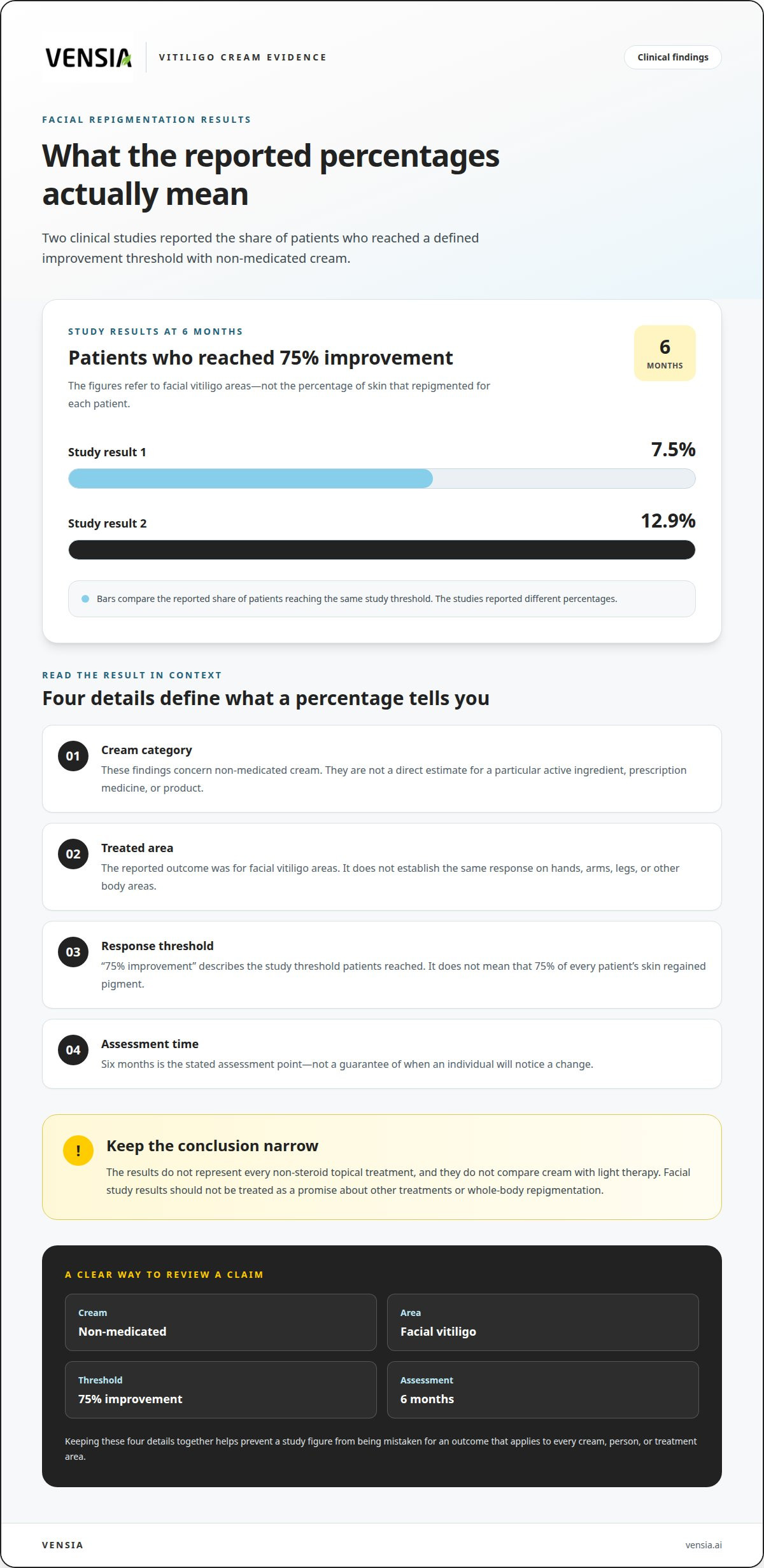
Clinical results need careful reading: the cream type, measured area, response threshold, and assessment time all shape what a percentage means. Two clinical studies reported results for non-medicated cream. At 6 months, 7.5% and 12.9% of patients achieved 75% improvement in vitiligo areas on the face.
Those figures describe the share of patients who reached a defined level of facial improvement. They don’t mean every treated person experienced 75% repigmentation, or that 75% of each patient’s skin regained pigment. The studies’ reported percentages also differ, so presenting one as a universal outcome would obscure the results’ range.
The distinction between a non-medicated cream and a medicine matters. These findings concern non-medicated cream, not every non-steroid topical treatment. They aren’t a direct estimate for a particular active ingredient, prescription medicine, or product, and they don’t compare cream with light therapy. Evidence needs to match the treatment’s formula and method.
The measured site matters, too. The reported outcome concerns vitiligo areas on the face. It doesn’t establish the same response for patches on hands, arms, legs, or other body areas. Facial results shouldn’t be generalized to whole-body repigmentation without supporting data. Likewise, 6 months is the stated assessment point, not a guarantee of when an individual will notice change.
For a useful personal record, choose one visible patch and document it consistently. Note the date, body location, and treatment used. Take photographs in similar lighting and from a similar distance. Compare the same patch over time, rather than relying on memory or comparing different areas. This doesn’t replace clinical assessment, but it can make changes easier to describe.
Keep the outcome measure clear. “75% improvement” is a study threshold, while “some pigment has returned” describes a different observation. Neither phrase alone explains whether a patch has fully repigmented. Record what you see, such as pigment appearing near the patch’s edge or within its center, without treating one visible change as proof of a study-level response.
When reviewing a claim, look for four details: the cream category, the treated body area, the response threshold, and the assessment time. The two studies provide a specific example: non-medicated cream, facial vitiligo areas, 75% improvement, and 6 months. Keeping those details together makes the results clearer and prevents a facial study figure from being mistaken for a promise about every cream or treatment area.
Use around the eyes and topical-use restrictions
Skin around the eyes is facial skin, but that doesn’t make every cream suitable for the eyelids. Identify the patch you intend to treat and read the product’s directions for approved application areas. Don’t assume “non-steroid” means unrestricted use, or that directions for a cheek patch also cover the eyelids. The formula and its stated directions determine where it should be applied.
Before applying a topical product near an eye, use this practical check: identify the exact treatment area, read the label’s application instructions, and keep the cream to the skin areas those instructions cover. A direction naming facial skin, for example, doesn’t automatically include the eyelid or skin immediately beside the eye. Never apply a product inside the eye. If the directions exclude the eye area, follow that restriction.
Prescription medicines also have distinct rules. In the UK, pimecrolimus and tacrolimus are unlicensed for treating vitiligo, though they may be used to help restore pigment in adults and children. That status doesn’t mean they share application directions with an over-the-counter cream or are automatically appropriate around the eyes. Keep the medicine name, treated area, and instructions together when following a treatment plan.
Topical steroids involve a different consideration: in the UK, they can cause skin thinning, while pimecrolimus and tacrolimus don’t. This distinction helps explain why treatments aren’t interchangeable, but it doesn’t mean any product can be applied near the eye. A steroid’s once-a-day schedule, for example, applies to the prescribed steroid regimen, not another cream. Follow the directions for the exact product and area.
Apply precisely. Use clean hands, treat only the directed skin patch, and avoid spreading cream onto nearby areas outside the treatment plan. If the patch is near an eyelid, note its location and the product name in your treatment record. This helps distinguish use on the face from use around the eyes during a follow-up discussion.
Product directions set the practical boundaries for topical use. Don’t substitute a general facial routine, another cream’s instructions, or a prescription schedule for the label of the product you’re using. Treat any stated area restriction as part of the directions. For a prescribed treatment, follow the instructions for the named medicine, not assumptions based on its non-steroid status.
One FTU of topical steroid covers an area twice the size of an adult’s hand. This measurement helps estimate the amount, but it doesn’t change the skin area covered by the prescription directions. Use the steroid only on the directed patch; the amount appropriate for that patch isn’t permission to extend application toward the eye.
Keep the product name, treated area, and instructions together when checking the amount. Don’t use this measurement as guidance for a different cream.
Common adverse reactions
Adverse effects differ by treatment type, so “non-steroid” doesn’t describe one uniform safety profile. In the UK, topical steroids can cause skin thinning. Pimecrolimus and tacrolimus don’t cause skin thinning, according to the stated treatment information. This distinction is useful, but it doesn’t mean every non-steroid cream has the same ingredients or effects.
Keep the treatment name in view. Information about skin thinning concerns topical steroids, while the comparison names pimecrolimus and tacrolimus. Don’t apply it to every cream without checking the formulation. A reaction associated with one prescribed medicine, for example, doesn’t establish that an unrelated non-steroid product causes the same reaction.
JAK inhibitors require a separate distinction. The reported elevated risks concern people taking JAK inhibitors by mouth, not topical creams as a whole. People aged 50 years and older with at least one cardiovascular risk factor who take oral JAK inhibitors have had an increased risk of death and major cardiovascular events. Serious infections, mortality, malignancy, major adverse cardiovascular events, and thrombosis have also been observed in patients treated with JAK inhibitors for inflammatory conditions.
Don’t transfer findings about oral JAK inhibitors to all topical products. The route and medicine matter. A cream’s label identifies its ingredients and directions; a medicine’s prescribing information describes that medicine. Keep the packaging available when recording an effect so the product name and formulation remain clear.
Use a simple monitoring routine for any topical treatment. Record the date, product, and area where you applied it. If you notice a change, note what you observed and whether it followed an application. Write “new skin change on treated cheek,” for example, rather than assuming the product caused it. This creates a clearer record of timing and location.
- Record: the treatment name, application date, and treated patch.
- Describe: the visible or felt change in plain language.
- Compare: whether the change is limited to the application area or appears elsewhere.
- Review: the product directions and the treatment plan during follow-up.
For prescribed topical steroids, follow-up can assess both effect and side effects. In the UK, a GP may review treatment after 1 month, then assess improvement after another month or 2. A treatment record helps connect observations with those review points. Don’t use a steroid’s schedule or side-effect profile to predict how a different cream will behave.
These distinctions help clarify safety information: first identify the medicine, route, and treated area. Skin thinning is a recognized concern with topical steroids, while the stated comparison differs for pimecrolimus and tacrolimus. Risks associated with oral JAK inhibitors belong to a separate treatment context.
Facial repigmentation outcomes
Interpret facial outcomes in light of the treatment type, location, and assessment method. The clinical studies discussed earlier measured non-medicated cream on facial vitiligo areas. Their findings don’t establish the same outcome for every cream, prescription treatment, or body site. Keep the treatment and specific facial area in view when considering what an observed change means.
The face includes distinct areas, such as the cheeks, forehead, and hairline. For a useful visual record, choose one patch and photograph it consistently. Use similar lighting, framing, and distance, then note the date and exact location. Don’t casually compare a cheek patch photographed in bright daylight with a hairline patch photographed indoors.
Cosmetic coverage is different from pigment returning. In the UK, vitiligo camouflage creams can last 12 to 18 hours on the face. That duration describes camouflage, not repigmentation. If you photograph a patch after applying coverage, record that detail so the image isn’t mistaken for a change in the skin’s pigment.
Separate changes in appearance from changes in pigmentation. Note, for example, whether a patch looks less visible because of cosmetic coverage, lighting, or a visible change within the patch itself. A consistent record can make these differences clearer without treating one photograph as proof of a clinical result.
A focused facial record can include:
- Location: identify the cheek, forehead, hairline, or another specific area.
- Date: label each image so observations stay in order.
- Conditions: note lighting and whether camouflage was used.
- Observation: describe visible pigment changes without estimating a study percentage.
This approach separates cosmetic coverage from treatment assessment. Evidence from facial areas shouldn’t automatically be applied to the hands, arms, or other locations. Similarly, results for non-medicated cream don’t establish outcomes for another formula. Comparisons are more meaningful when the treatment, location, and observation method match.
If your concern is dark spots or uneven skin tone rather than vitiligo repigmentation, VENSIA Anti Pigmentation Cream is positioned for those concerns. It’s a separate skincare option, not evidence of pigment restoration in vitiligo patches. Explore VENSIA’s pigmentation cream for that distinct skincare need.
VENSIA: VENSIA Anti Vitiligo Cream
VENSIA Anti Vitiligo Cream is a targeted skincare option for readers exploring care focused on vitiligo-affected skin. The clinical findings discussed above concern non-medicated creams and shouldn’t be treated as evidence of this product’s results. Keep that distinction clear when comparing products with clinical study outcomes.
Before use, read the product’s directions and follow its application guidance. Don’t assume a schedule or treatment area based on prescription medicines or research on another cream. For concerns such as dark spots and uneven skin tone, VENSIA Anti-Pigmentation Cream is a skincare option distinct from vitiligo treatment.
For product information, visit VENSIA online.
Make your next skincare step an informed one
Choosing a non-steroid vitiligo cream is one part of a thoughtful skin-care routine. Start by identifying the concern you want to address, understanding the product’s intended use, and keeping its directions close as you decide how it fits your routine. Distinguish pigment restoration from cosmetic coverage and care for other skin concerns. This gives each product a clear purpose and helps you assess your choices with confidence.
VENSIA offers targeted skincare options, including VENSIA Anti Vitiligo Cream. The right option depends on the concern you’re addressing and the product’s intended use. If you’d like information about VENSIA’s offerings, contact VENSIA for support. Take your next step with care and confidence.
Frequently Asked Questions
What are the side effects and safety warnings for non-steroid vitiligo creams?
Side effects and warnings depend on a product’s ingredients, so follow the directions for the specific cream. Use VENSIA Anti-Vitiligo Scar Removal Cream externally only; don’t apply it to broken skin, eyes, or mucous membranes. If you have known sensitivities, perform a patch test first. Keep the packaging available and record the product and application area if you notice a skin change, so you can describe it accurately.
Are topical calcineurin inhibitors such as tacrolimus or pimecrolimus used for vitiligo?
Yes. In the UK, tacrolimus and pimecrolimus may be used to help restore pigment in adults and children, although they’re unlicensed for vitiligo. They’re prescription treatments, distinct from cosmetic creams. The UK information states that these medicines don’t cause skin thinning, unlike topical steroids. Their use for vitiligo and their application directions are specific to these medicines, so don’t apply their instructions to another product.


