

Vitiligo treatment for dark skin: Understand causes, visibility and care
A striking contrast in skin tone doesn’t mean a more dangerous condition. Vitiligo is a skin condition that causes areas to lose pigment, creating lighter patches that can be more visible on dark skin. It isn’t contagious or life-threatening, and vitiligo treatment for dark skin may include topical treatments or light therapy to address pigment changes.
If vitiligo patches feel especially noticeable, that experience is understandable. Learning what causes vitiligo and how it appears across different skin tones can make the condition easier to understand and help you explore relevant care options.
This article explains how vitiligo develops, what light therapy involves, and what to consider when discussing care with a dermatologist experienced with skin of color. You’ll also learn how treatment approaches differ and why understanding the condition is a useful first step toward informed care.
Key Takeaways
- Learn why pigment loss can create a stronger contrast on darker skin and what changes may help distinguish vitiligo patches.
- Understand how light therapy works, which areas may respond differently, and why treatment often takes sustained care.
- Explore how melanocyte loss and immune activity may contribute to vitiligo, while recognizing that causes can vary.
- Compare treatment approaches and the factors that influence which options may suit different skin areas and patterns of change.
- Find out what to look for in a dermatologist experienced with skin of color so you can discuss care with greater confidence.
What does vitiligo look like on black skin?
Vitiligo causes areas of skin to lose pigment, leaving lighter patches. On black skin, those patches may contrast strongly with surrounding skin. They can appear on the face, hands, arms, or elsewhere, with shapes and distribution that vary. The visible contrast describes appearance, not how severe the condition is.
Patch patterns can change over time. A clinical assessment considers where patches appear, whether they expand, and whether new areas develop. Keep a simple record of changes, including when a pale patch first appeared and whether its edges have shifted. These details help you describe what’s happening and support a focused discussion about care.
Depigmentation differs from treatments that aim to restore pigment to lighter patches. It uses cream to remove remaining natural pigment from darker skin, with the aim of blending its tone with existing vitiligo areas. The goal is an overall lighter appearance, not repigmentation. UC Davis Health describes depigmentation as permanent and extensive, often a last resort.
UC Davis Health says depigmentation may be considered when vitiligo affects a significant portion of the body and other treatments haven’t worked. The decision involves a lasting change to naturally pigmented skin. Be clear about the goal: this approach reduces contrast by lightening remaining pigment rather than restoring color to affected patches.
Depigmentation to blend skin tone takes time. Removing the remaining pigment can take 1 to 4 years, and blending is a years-long process. UC Davis Health says the desired effect may take up to a year. The area treated and remaining pigment influence the process, so these timelines describe different aspects rather than a single expected schedule.
In the United States, treatment costs depend on the method and area treated. Some insurance plans may deny coverage because they consider vitiligo cosmetic rather than medical. Results also vary by approach: about 10% to 20% of people with vitiligo fully regain their skin color. Depigmentation has a different aim and doesn’t restore pigment.
Risks depend on the treatment used. Treatments that affect pigment can change skin color, while light-based approaches require careful clinical planning. Vitiligo-affected skin can sunburn, so protecting exposed areas matters. Discuss possible side effects and monitoring for the specific therapy being considered rather than assuming every treatment carries the same risks.
Depigmentation and micropigmentation have opposite aims. Depigmentation removes natural pigment from selected areas; micropigmentation adds pigment to imitate skin color. Neither prevents vitiligo from appearing elsewhere. Before choosing, discuss each option’s purpose, permanence, treated areas, and maintenance needs with a dermatologist experienced in skin of color.
Light therapy
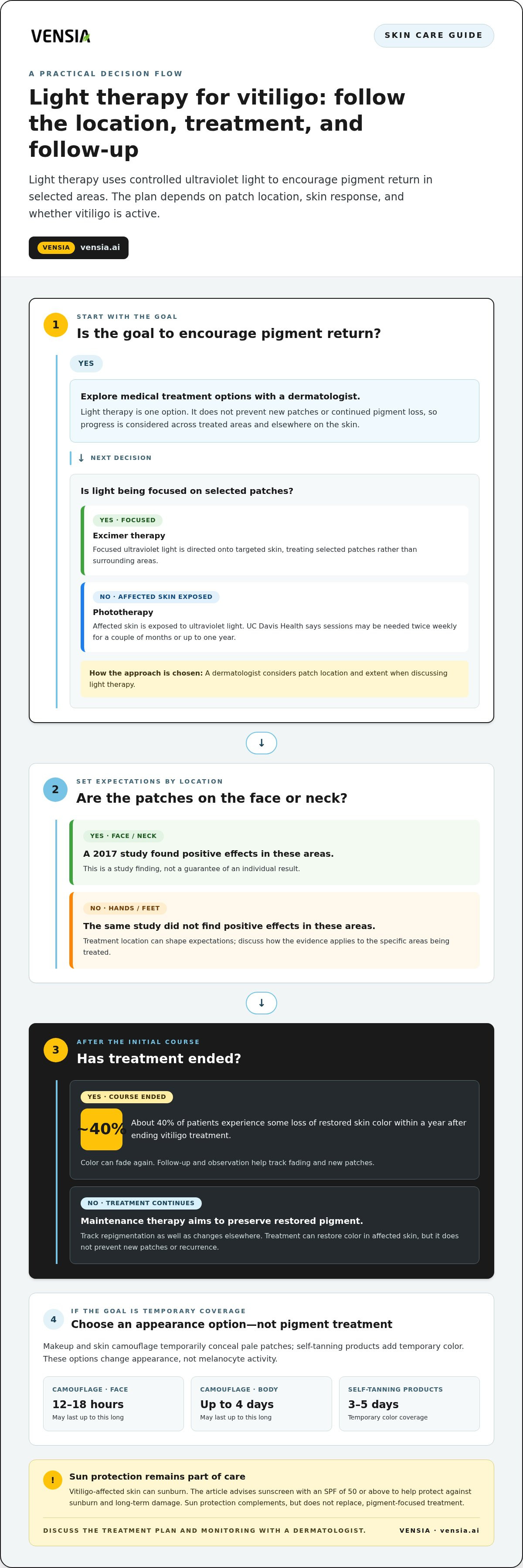
Light therapy uses controlled ultraviolet light to encourage pigment return in selected areas. Treatment plans vary depending on the location of patches, skin response, and whether vitiligo is active.
Light and Excimer Laser Therapy
Phototherapy exposes affected skin to ultraviolet light, while excimer therapy focuses light on specific patches. UC Davis Health says phototherapy may require sessions twice weekly for a couple of months or up to one year. A 2017 study found positive effects on the face and neck, but not the hands and feet. Treatment location can shape expectations.
UC Davis Health describes excimer laser therapy as focused ultraviolet light directed onto targeted skin. It can treat selected patches rather than the surrounding areas. A dermatologist considers patch location and extent when choosing light therapy. For facial patches, for example, focused treatment differs from exposing larger areas to light.
Maintenance Therapy and Recurrence
Maintenance therapy aims to preserve pigment restored during an initial treatment course. Color can fade again after treatment ends. About 40% of patients experience some loss of restored skin color within a year after ending vitiligo treatment. That figure makes follow-up and ongoing observation relevant, especially when a patient notices pigment fading or new patches.
Treatment can restore color in affected skin, but it doesn’t prevent continued pigment loss or recurrence. New patches may develop even after some areas improve. A treatment plan therefore tracks both repigmentation and changes elsewhere, rather than judging progress by one patch alone.
Makeup and skin camouflage can temporarily conceal pale patches, while self-tanning products add temporary color. Camouflage creams can last up to 12 to 18 hours on the face and up to 4 days on the body. Self-tanning products can provide coverage for 3 to 5 days.
These options change appearance, not melanocyte activity. Choose a shade that blends with nearby skin and test it on a small area first. You might use camouflage for a specific event while medical therapy addresses pigment changes over time.
Light therapy is one option among treatments for vitiligo; it isn’t a way to stop new patches from appearing. Topical ruxolitinib, a Janus kinase inhibitor, targets part of the immune system involved in vitiligo and is used for facial vitiligo in people aged 12 and over. Treatment choice depends on patch location and pattern.
Sunscreen supports care for depigmented areas by reducing sunburn risk. The Cleveland Clinic advises sunscreen with an SPF of 30 or higher to help hide vitiligo. People with vitiligo should use sunscreen with an SPF of 50 or above to help protect against sunburn and long-term damage. Sun protection complements, rather than replaces, pigment-focused treatment.
For a complementary approach to everyday skin care, explore skin-care options for pigment concerns.
Melanocyte loss and proposed causes
Melanocytes produce melanin, the pigment that gives skin its color. In vitiligo, pigment loss creates lighter areas; genetics and immune activity may help explain why the condition develops.
Melanocyte Loss
Melanocyte loss means fewer functioning pigment-producing cells in affected skin. As melanin decreases, pale patches appear against a person’s usual skin tone. On darker skin, the difference may be especially noticeable, even when patches are small. Patterns vary, so note where changes appear and whether they grow or spread.
Vitiligo symptoms involve changes in pigment, not in the skin’s basic structure. One person may develop a patch in a single area, while another develops several. Compare a lighter area with the surrounding skin and record changes over time. This concrete record helps describe the pattern clearly during a clinical assessment.
Autoimmune Causes and Risk Factors
Autoimmune activity is one proposed explanation for melanocyte loss. In this model, immune activity disrupts the cells that produce pigment. Vitiligo can also occur alongside other autoimmune diseases, but that association doesn’t mean every person with vitiligo has another condition. Between 15-25% of people with vitiligo have at least one other autoimmune disease.
Family history can offer another clue, though it doesn’t determine whether someone will develop vitiligo. About 20% of people with vitiligo have at least one close relative with the condition. A sibling has a 6% risk, while an identical twin has a 23% chance. These figures show a relationship, not a certainty for an individual family.
Genes may influence susceptibility. More than 30 genes can increase a person’s risk of developing vitiligo, and about 30% of cases are genetic. These figures describe possible inherited contributions, not a single gene that explains every case. A person can develop patches without a known family history, while a relative’s diagnosis does not predict an identical outcome.
Proposed causes of vitiligo involve more than one risk factor. Researchers identify genetic susceptibility and autoimmune activity as possible contributors, rather than one confirmed trigger for every patient. A relative’s vitiligo or another autoimmune condition can provide context, but neither detail alone explains why patches appear.
For a practical history, note when pigment changes first appeared, where they began, and whether relatives have vitiligo or autoimmune diseases. Record examples, such as a new pale patch or a change in an existing area. These observations won’t establish a cause, but they help a dermatologist understand the pattern alongside family history and other health details.
Skin tone affects how noticeable pigment loss appears, not its proposed biological causes. Two people with similar melanocyte loss may see different levels of contrast because their surrounding skin tones differ. Keeping those ideas separate helps explain why visible changes vary, even when pigment-producing cells are affected in both cases.
Vitiligo prevalence and visibility on darker skin
Vitiligo affects people across skin tones, but the visible contrast can differ. Separating how common the condition is from how noticeable its patches appear helps make sense of what you see.
Prevalence Across Skin Tones
Vitiligo affects an estimated 0.5 to 1% of the worldwide population. That estimate describes overall prevalence, not how often each skin tone is affected. A 2020 study included 1,487 participants with vitiligo; 46.7% were white. That study figure describes its participants, not the worldwide distribution of vitiligo across skin tones.
Prevalence and visibility answer different questions. Prevalence concerns how many people have the condition; visibility concerns the contrast between affected and surrounding skin. Two people can have comparable pigment loss yet notice different visual contrast because their natural skin tones differ. Contrast doesn’t indicate how common vitiligo is.
The type of vitiligo also shapes the pattern a person sees. Segmental vitiligo may present quickly, then typically remain stable for 6 months to 2 years. This timeline describes its course, not how visible it will be. A person can track whether patches stay in one area or appear elsewhere, then describe that pattern during a clinical assessment.
Visibility on Brown or Black Skin
Vitiligo is more visible in people with darker skin tones. When affected patches lose melanin, they can look lighter against surrounding brown or Black skin. The difference may be noticeable on exposed areas, such as the face or hands, and covered areas, such as the torso. Location and contrast vary from person to person.
The same pigment change can create different visual impressions across skin tones. On lighter skin, a pale patch may contrast less with nearby skin; on darker skin, its boundary may stand out more. This is a difference in appearance, not evidence that the condition affects one group more severely. A mirror or consistent photographs can help you track changes in patch shape and location.
Lighting and surrounding skin can also affect how a patch looks in a photo. Compare the same area in similar lighting rather than judging change from images taken under different conditions. Note whether the patch appears lighter, its edges shift, or new areas develop. These observations give a dermatologist clearer information than a general description such as “more noticeable.”
Visible contrast doesn’t identify the type of vitiligo or explain its cause. A clinical assessment considers the pattern, location, and changes over time. For example, a patch that remains localized differs from a pattern developing across multiple areas. Recording these differences helps communicate what has changed without treating skin tone itself as a measure of severity.
What vitiligo treatments work best for dark skin tones?
The best vitiligo treatment for dark skin depends on the affected areas, the pattern of change, and the goal of care. Some treatments aim to restore pigment; others may slow its loss or reduce contrast. Skin tone alone doesn’t determine the choice. A dermatologist considers whether patches are localized or widespread and whether new ones are appearing.
Topical treatments may be considered when vitiligo first appears. UC Davis Health says topical medications may restore skin color and are most effective for small patches on the face and neck. Topical ruxolitinib is a Janus kinase inhibitor that targets part of the immune system involved in vitiligo. It is used for facial vitiligo in people aged 12 and over.
Light-based treatment is another option. A 2017 study found phototherapy had positive effects on facial and neck vitiligo, but wasn’t effective on the hands and feet. UC Davis Health describes excimer laser therapy as focused ultraviolet light directed onto specific areas. These differences matter when patches affect several locations, since one approach may not suit every area equally.
For extensive pigment loss, depigmentation has a different purpose: it lightens remaining pigmented skin rather than restoring color to pale patches. UC Davis Health says it may be considered when vitiligo affects a significant portion of the body and other treatments haven’t worked. The change is permanent and extensive, making this a distinct goal from repigmentation.
Surgery may be considered for selected, stable patches. Skin grafts may be an option for adults when no new white patches have appeared in the past 12 months. UC Davis Health explains that miniature punch grafting transfers pigmented skin tissue into vitiligo patches; it doesn’t stimulate pigment production. Stability and the location of affected areas therefore matter in considering this approach.
Choosing vitiligo treatment for dark skin means weighing treatment goals against patch location and recent changes. Treatment may restore color, but it doesn’t prevent continued pigment loss or recurrence. About 40% of patients experience some loss of restored color within a year after treatment ends. Tracking changes across different areas can help make treatment discussions more specific.
A dermatologist experienced with skin of color can assess the pattern and discuss clinical options. For vitiligo treatment for dark skin, bring notes on where patches have changed and what outcome matters most to you. If you’re also considering a topical skincare product, view a vitiligo-focused cream as a separate option from prescription or clinic-based treatments.
VENSIA: VENSIA Anti Vitiligo Cream
VENSIA Anti Vitiligo Cream is a topical skincare option for people exploring care for vitiligo-affected skin. It is a skincare product, not a substitute for clinical treatments such as prescribed medication or light therapy.
Consider your main goal before choosing a skincare product. If you’re managing pigment changes, keep track of affected areas and discuss new or changing patches with a dermatologist experienced in skin of color. A dermatologist can help distinguish cosmetic skincare from treatments intended to address vitiligo itself.
Explore the product details and decide whether this option suits your skincare routine. For more information, visit VENSIA online.
Choose a next step that fits your skin goals
Your next step can be a focused conversation about what matters most to you: managing visible pigment changes, caring for uneven tone, or supporting dry, rough skin. A dermatologist experienced with skin of color can guide clinical decisions. Skincare products have a different role, so keep those goals distinct as you consider vitiligo treatment for dark skin.
VENSIA offers Anti Vitiligo Cream as a targeted skincare option. Its Anti Pigmentation Cream is described for dark spots, fine lines, wrinkles, and age spots, while its Niacinamide Marshmallow Body Lotion supports moisturization and care for dry or rough skin. These products address different skincare concerns; they don’t replace dermatologist-directed treatment for vitiligo.
For questions about VENSIA’s skincare offerings, contact VENSIA. Take the next step at a pace that feels right, with clear goals and informed support.
Frequently Asked Questions
What is vitiligo?
Vitiligo causes areas of skin to lose pigment, forming lighter patches. It isn’t contagious or life-threatening. Patches may appear in different places and change over time. Note where a patch first appeared and whether its edges or shape change. This record can help a dermatologist understand the pattern and distinguish it from other causes of uneven skin color.
How is it treated?
Treatment may aim to restore pigment, slow color loss, or reduce contrast. Options include topical or systemic medicines, light therapies, and, in selected cases, surgery or depigmentation. The choice depends on where patches appear, how extensive they are, whether they’re changing, and the person’s goals. Treatment for a small facial area, for example, may differ from an approach for widespread pigment loss.
How do topical corticosteroids and tacrolimus treat vitiligo, and what are their risks?
Topical corticosteroids and tacrolimus are medicines used on affected skin in some vitiligo treatment plans. Their suitability depends on the body area, extent of pigment loss, and treatment duration. Side effects and monitoring needs also depend on the medicine and application site. Follow the prescribed directions and report unwanted skin changes so the treatment plan can be reviewed.
Is narrowband UVB phototherapy effective for vitiligo on dark skin?
Narrowband UVB phototherapy may help restore pigment, but its effects can differ by body area. A 2017 study found positive effects for facial and neck vitiligo, but not for the hands and feet. UC Davis Health says phototherapy may involve sessions twice weekly for a couple of months or up to one year. The treatment area is important when setting expectations.
When is excimer laser used for vitiligo, and how does it compare with phototherapy?
According to UC Davis Health, excimer laser therapy directs focused ultraviolet light onto targeted patches. Phototherapy is another light-based approach that can treat affected skin over repeated sessions. Excimer treatment focuses on selected areas, while phototherapy may address broader areas. Patch locations and extent help determine which approach is appropriate to discuss with a dermatologist.
When should someone with vitiligo see a dermatologist, and how is treatment chosen?
See a dermatologist if patches are new or changing, affect your daily life, or prompt questions about available treatments. A dermatologist considers patch location, extent, progression, and your goals, such as restoring pigment or reducing contrast. Changing facial patches, for example, may call for a different discussion than stable patches elsewhere. Experience with skin of color can help address differences in visibility and care.
How much do vitiligo treatments cost in the United States, and does insurance cover them?
Costs depend on the treatment method and area treated. Some insurance plans may deny coverage because they consider vitiligo cosmetic rather than medical.


