

Vitiligo Before and After Cream: What Results Can Photos Really Show?
A dramatic before-and-after photo can show a change in appearance, but it can’t prove that a cream caused vitiligo repigmentation. When comparing vitiligo before and after cream images, look for differences in lighting, skin tone, makeup, and cosmetic blending. Any of these can make a result look more striking than it is.
It’s understandable to want clear evidence before trying a product. Photos can offer clues, but without consistent conditions and enough time between images, they can’t establish what changed or why. Cosmetic coverage and changes in pigmentation are not the same thing.
This article explains how to assess images, distinguish skincare claims from medical treatment evidence, and set realistic expectations. VENSIA Anti Vitiligo Cream is a skincare product, not an FDA-approved vitiligo drug. Learn what to look for in a credible comparison and how to make a thoughtful next step in your skincare or treatment decisions.
Key Takeaways
- Use vitiligo before-and-after cream photos as visual clues, not proof that a cream caused a change.
- Compare lighting, distance, framing, and signs of editing before drawing conclusions.
- Check whether a cream claim names the product, gives a clear timeframe, and explains where the images came from.
- Keep a consistent photo log with dates and notes about skincare or other treatment changes to track appearance over time.
- Consider VENSIA Anti Vitiligo Cream as a skincare product, and distinguish skincare claims from evidence about medical treatment or repigmentation.
Why Vitiligo Before-and-After Cream Photos Need Context
Looking for visible evidence before placing hope in a cream is understandable. A before-and-after comparison can feel more personal than a product description because it appears to show what changed on someone’s skin. But a pair of images records appearance at two points in time. On its own, it can’t show what caused a difference, whether the person used one cream or several treatments, or whether the change lasted.
That distinction matters when reviewing vitiligo before and after cream photos. A patch may look different for reasons unrelated to a cream, including changes in surrounding skin tone or in how the image was taken. Even when a visible change is genuine, one person’s experience doesn’t establish a general product effect. Look for clear context and broader evidence rather than treating a striking image as a promise.
Can a photo show whether a patch is vitiligo?
No. A lighter patch can have causes other than vitiligo, and appearance alone can’t confirm its cause. Other skin conditions or changes after inflammation may also affect pigmentation. An online gallery may help someone notice a change, but it can’t diagnose the person in the image or the viewer. A clinical assessment is the appropriate way to identify what’s causing a patch and discuss suitable next steps.
For a general overview of the condition, Vitiligo on Wikipedia summarizes its features and treatment approaches. Use general information as background, not as a way to match your skin to an online photo and self-diagnose.
Why one person's results do not predict another's
Vitiligo can look and progress differently from person to person, and responses to treatment can vary. The location and extent of patches, how long they’ve been present, and the treatment used all provide context that a single photo may leave out. Someone else’s visible change is an individual experience, not a prediction of what will happen in your case.
To assess a broader claim, look beyond a single testimonial. Check whether the images represent a documented experience, whether the product and timeframe are identified, and whether evidence beyond an individual comparison is provided. These questions help distinguish a personal story from evidence supporting a general effect. For more context on factors involved in vitiligo progression, see this guide to stopping vitiligo from spreading.
Keep expectations grounded. A dramatic image may invite hope, but it shouldn’t be treated as a forecast or a substitute for understanding the condition. Diagnosis and treatment decisions depend on the individual, not on how closely their skin seems to resemble someone else’s photograph. With that context in mind, you can assess cream claims more carefully and identify what remains unclear.
What Vitiligo Cream Before-and-After Photos Can, and Cannot, Show
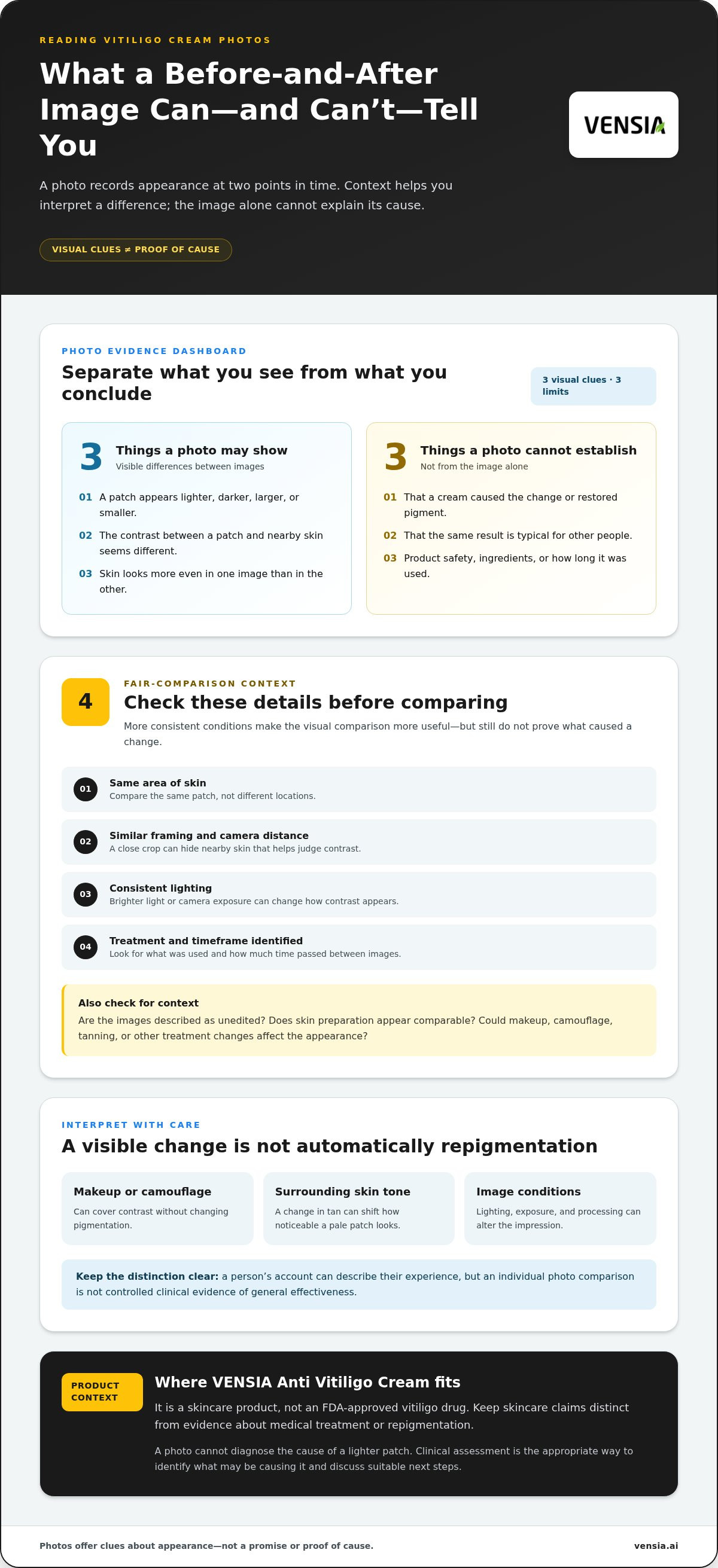
A comparison can help you notice that an area looks different, but the image needs context before you can interpret that difference. A lighter patch may appear more or less pronounced because of lighting, camera distance, surrounding skin tone, or image processing. A close crop can hide nearby skin that would help you judge the change. Separate what you can observe from what you might be tempted to conclude.
Before-and-after photos document appearance, not proof of cause or typical results. This distinction is especially useful when reviewing vitiligo before and after cream claims, where captions may not explain what else happened between the two images.
What a fair before-and-after comparison includes
Give more weight to comparisons that explain how the images were made. Look for the same area of skin, similar framing and camera distance, and consistent lighting. Captions should identify the treatment and the time between photos rather than relying on a vague “after” label. Check whether the images are described as unedited and whether skin preparation appears comparable. These details don’t prove a treatment caused a change, but they make the visual comparison more useful.
Small differences can affect the impression. Brighter light or adjusted camera exposure can make surrounding skin look darker, increasing contrast with a pale patch. A change in tan can shift that contrast too. If the images weren’t taken under comparable conditions, interpret apparent improvement or worsening cautiously.
What the image may show
- A patch appears lighter, darker, larger, or smaller in the photograph.
- The visible contrast between a patch and surrounding skin seems different.
- Skin looks more even in one image than in the other.
What the image cannot establish by itself
- That a cream caused the appearance change or restored pigment.
- That the same result is typical for other people.
- That a product is safe, or what ingredients and treatment duration were involved.
A change in appearance isn’t automatically repigmentation. Makeup or camouflage can cover contrast without changing pigmentation. Tanning the surrounding skin may make a pale patch look more noticeable, while different lighting can make it seem less distinct. A photograph alone generally can’t distinguish these possibilities with confidence. The American Academy of Dermatology on Vitiligo Treatment offers context on treatment approaches and their limitations; a gallery image is not a substitute for that kind of evidence.
What a photo cannot prove about a cream
A person’s account can describe their own experience, but it isn’t controlled clinical evidence of general effectiveness. A photo also can’t establish safety, identify ingredients, or confirm how long a product was used. Those details require reliable supporting information, not visual guesswork. When reviewing VENSIA Anti Vitiligo Cream, consider its skincare information separately from any conclusion you might draw from a photograph.
How to Evaluate a Vitiligo Cream Claim Without Overreading Results
A useful cream claim should be specific enough to assess. Before relying on a testimonial or comparison, identify exactly what the product is said to do. “Helps skin look more even” describes appearance; “restores pigment in vitiligo” is a treatment claim that calls for relevant product-specific evidence. Cosmetic positioning and medical outcomes aren’t interchangeable.
A dramatic image is not a substitute for product-specific evidence. A photo may support someone’s account of their experience, but it can’t establish that a cream caused the change or that other people should expect the same outcome.
Questions to ask when a cream promises visible change
Use this checklist to assess a claim before relying on it:
- Is the exact product named? A broad label such as “vitiligo cream” doesn’t tell you which product was used.
- Is the claimed outcome clear? Look for a distinction between improved appearance, concealment, and pigment restoration.
- Are image conditions and timing explained? Check for comparable photos, a stated observation period, and context about the person’s routine or other treatments.
- Can you identify the source? A personal testimonial is different from research designed to assess treatment effects.
If key details are missing, treat the claim as incomplete rather than filling gaps with assumptions. The Global Vitiligo Foundation provides broader education about vitiligo and its management, which can help put product claims in context.
Creams, camouflage, and medical treatment are not interchangeable
Camouflage products and makeup can reduce the visible contrast between a patch and surrounding skin. That can change how skin looks without demonstrating repigmentation. Ordinary skincare and topical medicines are also distinct categories: a medical treatment is evaluated for its intended therapeutic effect, while a cosmetic claim should not be read as proof of treating vitiligo.
Ingredients matter, but their presence alone doesn’t prove that a product can restore pigment. Assess whether the exact formula has evidence relevant to the stated outcome, rather than assuming a familiar ingredient or botanical description establishes effectiveness. VENSIA Anti Vitiligo Cream is a skincare product. Assess its skincare information on its own terms, without treating its name or a photo as evidence of a medical outcome.
Readers comparing product categories can use this vitiligo repigmentation cream guide to understand the distinction between skincare and treatment claims. For a product review, examine the information about VENSIA Anti Vitiligo Cream without treating an image as proof of a medical outcome.
Use a consistent standard: named product, defined claim, transparent source, and evidence that matches the outcome being promised. If details are missing, don’t interpret a striking comparison as proof.
How to Document Vitiligo Skin Changes Consistently and Safely
A simple photo log can make personal comparisons more useful by reducing avoidable differences between pictures. It won’t diagnose a skin condition or prove what caused a change, but consistent records can help you describe what you’ve noticed over time. Keep the process comfortable and private. There’s no need to expose your skin to harsh light or change your routine just to create a clearer comparison.
A repeatable photo log for personal comparison
Choose a private place where you can take pictures under stable, even lighting. Use the same angle, distance, and framing each time, and keep the original files so you can review them without filters or edits. Add a short note with each photo: record the date, location of the area, and any relevant changes to skincare or treatment.
- Set up a consistent location. Use the same room and light source when possible. Avoid switching between daylight and indoor lighting, since each can change how skin tones appear.
- Keep the camera position steady. Remember where you stand, how far the camera is from the skin, and the angle used. Frame the same area, including enough surrounding skin to give context.
- Keep camera settings consistent. Use the same device and camera mode. If your camera allows it, keep focus and exposure consistent; don’t apply filters, retouching, or colour adjustments.
- Save the original and date it. Store the unedited file securely and note when it was taken. Avoid relying on memory to establish the order of images.
- Add brief context. Note skincare products started, stopped, or changed, along with relevant treatment information. Record what happened without assuming a product caused a visible difference.
These steps make your photo log more consistent. They don’t turn it into clinical evidence, but they can give you a clearer record to discuss if you have questions about a patch or a change.
Protect skin while tracking visible changes
Don’t deliberately expose depigmented skin to sunlight to make a photo more revealing. Sun exposure can change surrounding skin tone and increase contrast, while sunburn can harm skin. Take pictures in ordinary, safe conditions and follow suitable sun-protection guidance for your skin. A photo should never require tanning or risking a burn.
If a patch is new, changing, or uncertain, don’t rely on a photo log to identify its cause. A qualified clinician can assess it and advise on appropriate next steps. For routine care context, the vitiligo skincare routine guide can help you think through how everyday skincare fits into your records.
If you’re considering skincare as part of your routine, VENSIA Anti Vitiligo Cream is one product to include in your research. Keep its skincare information separate from what your photo log can establish.
Where VENSIA Anti Vitiligo Cream Fits in a Careful Decision
When reviewing a cream claim, separate two questions: what the product information says and what you need to understand about your skin. VENSIA Anti Vitiligo Cream is a skincare option. Review its product information directly, and don’t infer ingredients, directions, clinical evidence, or likely outcomes from its name or a photograph. This keeps your product decision grounded in the information available.
Make an informed choice about a vitiligo skincare product
Use the checklist from earlier in this guide to assess the product’s stated claims. Identify the exact product and the outcome being described, then consider whether the supporting information relates to that outcome. A claim about skin appearance isn’t automatically evidence of pigment restoration. An individual photo can’t establish a result you should expect from using a product.
Keep product choice and medical treatment decisions separate. Skincare information doesn’t diagnose the cause of a pale patch or replace advice about vitiligo care. If you’re unsure what a patch is, or are considering treatment, discuss your concerns with a qualified clinician. Their assessment can inform medical decisions; product information can help you evaluate a skincare option.
A calm next step with VENSIA
Individual experiences with vitiligo and skincare can differ. There’s no responsible way to promise repigmentation, set a timeline, or say that your results will match a particular photograph. Treat product claims as information to assess, not a guarantee. Consider an image’s source and context alongside the product information rather than using it alone to predict what will happen.
A thoughtful next step is to review the product details, note what the claims do and don’t say, and decide whether the product fits your skincare considerations. If you have diagnosis or treatment questions, keep those conversations distinct from choosing a skincare product. This supports informed product research and appropriate medical guidance without confusing one for the other.
To review the product, explore VENSIA Anti Vitiligo Cream.
Choose Your Next Step With Confidence
Your next step doesn’t need to be a fast decision. Define what you want from skincare, what you need to understand about your skin, and which questions deserve medical guidance. That clarity can keep product research useful without asking a cosmetic product to answer every concern about vitiligo.
When considering vitiligo before and after cream claims, let evidence guide your expectations rather than a single compelling comparison. VENSIA Anti Vitiligo Cream is a skincare product to explore as part of your research. Review its product information carefully, and keep any decision about diagnosis or medical treatment separate from your skincare choice.
Ready to learn more? Explore VENSIA Anti Vitiligo Cream and review the product information as you consider your skincare options.
Frequently Asked Questions
Can vitiligo cream restore skin color?
Some treatments are intended to support repigmentation, but “vitiligo cream” can refer to products with different purposes, and individual responses vary. A photo of someone’s skin can’t show whether a cream caused color to return. If you’re considering treatment, first distinguish skincare from medical treatment, then discuss options with a qualified clinician. This helps you make decisions based on your diagnosis and circumstances, not an image that may not reflect your situation.
How long does it take to see results from a vitiligo cream?
There’s no universal timeframe that applies to every cream, person, or outcome. A change in how skin looks may not mean the same thing as repigmentation, and a single comparison can’t establish when a change began. Follow the specific product’s directions rather than increasing use or extending it based on someone else’s timeline. If you’re tracking your skin, date your notes and discuss treatment expectations with a qualified clinician.
Are vitiligo before-and-after photos reliable?
They can be useful records of appearance, but reliability depends on how they were created and described. Check whether both images show the same body area and whether the caption identifies when each was taken. A cropped image without dates or source details offers little context. Even a carefully documented comparison describes one person’s experience; it doesn’t guarantee a similar outcome for you or establish why the appearance changed.
Can I use makeup or camouflage with a vitiligo cream?
Makeup or camouflage may help reduce visible contrast, but that effect is cosmetic and doesn’t establish that pigment has returned. If you use several products, read and follow each product’s directions, and pay attention to discomfort or irritation rather than adding more layers to improve coverage. For questions about using camouflage alongside medical treatment, ask a qualified healthcare professional familiar with your care. You can also note what you applied before taking a comparison photo.
What should I do if a cream irritates my skin?
If irritation occurs, stop and check the product’s directions for guidance on what to do next. Don’t assume a reaction means the cream is working, and don’t apply extra product to try to speed up a change. If symptoms are severe, worsening, persistent, or concerning, seek medical advice promptly. Note when the reaction began and what else you applied; those details can help a qualified clinician assess the situation and advise you.
Can a vitiligo cream prevent new white patches from appearing?
Don’t assume a skincare cream can prevent new patches unless reliable evidence supports that specific claim. Vitiligo may change over time, and a photograph can’t predict what will happen next. Be cautious of promises that a cosmetic product will stop new patches from appearing. If you notice changes, record when and where they occur, and discuss your concerns and treatment options with a qualified clinician rather than relying on product photos or promotional claims.


