

Post-Inflammatory Hyperpigmentation (PIH) Treatment: A Practical Guide
What if fading a dark mark starts with calming your skin, not adding another strong product? When a spot remains after acne, eczema, or irritation has settled, it can be frustrating to wait and hard to tell whether you’re seeing brown pigment, lingering redness, or something else. The right post inflammatory hyperpigmentation (PIH) treatment starts with understanding the mark and preventing further irritation.
It makes sense to be cautious. PIH develops after inflammation, and harsh or unsuitable products can trigger more irritation and deepen discoloration. A steady, gentle approach is often a better starting point than layering multiple active ingredients.
This guide explains why PIH develops, how it differs from redness and other skin changes, and when professional assessment may help. You’ll compare treatment approaches, learn how to build a measured routine with sun protection, and see how VENSIA Anti Pigmentation Cream can fit into appearance-focused skincare, with realistic expectations and no promise of a specific result.
Key Takeaways
- Recognize how inflammation or skin injury can leave excess pigment, and why a lingering mark may need professional assessment if its cause is unclear.
- Choose post inflammatory hyperpigmentation (PIH) treatment by weighing the concern, evidence, irritation risk, and how well an option fits your routine.
- Build a gentle routine around cleansing, moisturizing, daytime broad-spectrum sun protection, and introducing targeted care gradually.
- Understand why managing the original trigger matters and how repeated irritation can make dark marks harder to address.
- Learn how VENSIA Anti Pigmentation Cream fits into appearance-focused skincare, while keeping expectations realistic and avoiding assumptions about PIH-specific results.
What Is Post-Inflammatory Hyperpigmentation, and What Causes It?
A blemish may heal, but the mark it leaves behind can remain visible. Post-inflammatory hyperpigmentation (PIH) is a colour change that appears after skin inflammation or injury. It isn’t a diagnosis on its own; it describes a residual mark and can follow acne, eczema, product irritation, a burn, or a minor injury such as a scratch or insect bite.
PIH is a flat residual mark caused when inflammation prompts excess pigment to remain in the skin after the original irritation or injury heals. Knowing what came before a spot can offer a clue, but it can’t confirm what the mark is. Read What is Post-Inflammatory Hyperpigmentation? for a general overview.
How inflammation can leave a dark mark
Inflammation can stimulate melanocytes, the cells that make melanin, to produce or distribute more pigment in the affected area. As the skin recovers, that extra pigment may show as a mark separate from the original rash, blemish, or injury. The trigger might have settled even while the colour change remains.
Pigment closer to the skin’s surface often looks brown; pigment located deeper can appear grey or blue-grey. Marks look different across skin tones, and their appearance and duration vary from person to person. Sun exposure may make the contrast more noticeable. Avoiding further irritation can help prevent the original concern from creating additional marks.
PIH versus acne scars, redness, and other pigmentation
PIH is usually flat and changes colour rather than skin texture. Acne scars, by contrast, may be raised, indented, or uneven to the touch. A lingering red or purple mark after a spot may reflect post-inflammatory redness, not excess melanin. These colour changes can look similar at a glance, so appearance alone may not identify the cause.
Other pigmentation concerns, including melasma, can also resemble PIH. Melasma often appears as patches of pigment, but don’t assume a mark is melasma or PIH based only on its colour or location. The same caution applies to a spot that appears without a clear preceding irritation.
Seek professional assessment for a spot that is changing, unexplained, painful, or persistent. Assessment is also sensible if you’re unsure whether a mark is pigmentation, redness, scarring, or another skin concern. Getting clarity can help you avoid treating the wrong issue or aggravating skin with products that don’t suit it. That distinction matters before choosing any post inflammatory hyperpigmentation (PIH) treatment.
Which Post-Inflammatory Hyperpigmentation Treatments Can Help?
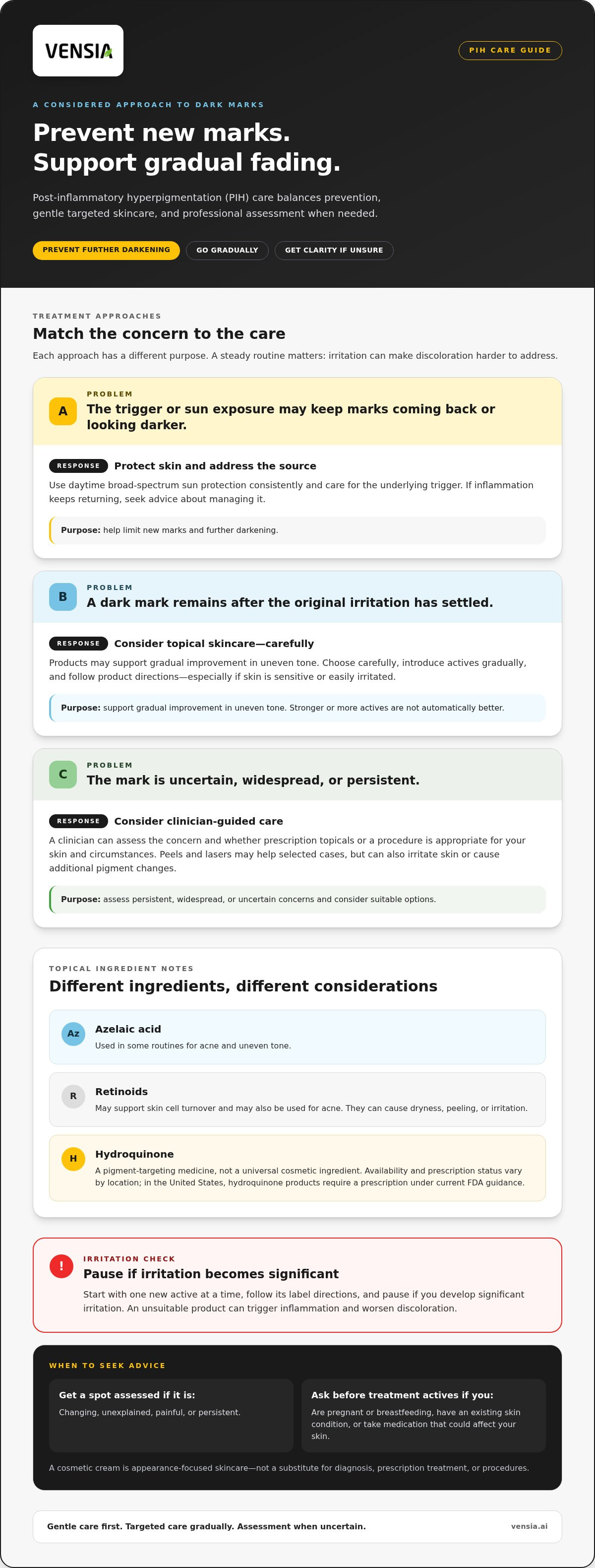
A useful plan has three aims: reduce the inflammation that can create new marks, support gradual fading of existing discoloration, and consider clinician-guided care when needed. Daily sun protection helps limit additional darkening, while pigment-targeting products may be considered as part of a routine. No single option suits everyone, and irritation can set progress back.
The comparison below separates prevention from fading and medical care. For a broader review of topical agents and procedures, see this review of effective PIH treatment options.
| Approach | Main purpose | Considerations and when advice may help |
|---|---|---|
| Sun protection and care for the trigger | Help limit new marks and further darkening | Use consistently; seek advice if the underlying inflammation keeps returning. |
| Topical skincare | Support gradual improvement in uneven tone | Choose products carefully and introduce actives gradually; seek guidance if skin is sensitive or easily irritated. |
| Clinician-guided options | Assess persistent, widespread, or uncertain concerns | Prescription topicals or procedures may be considered; potential irritation and pigment changes need individual assessment. |
Topical ingredients and over-the-counter skincare
Azelaic acid is a topical ingredient used in some routines for acne and uneven tone. Retinoids can support skin cell turnover and may also be used for acne, but they can cause dryness, peeling, or irritation. Hydroquinone is a pigment-targeting medicine, not a universal cosmetic ingredient. Its availability and prescription status vary by location; in the United States, hydroquinone products require a prescription under current FDA guidance.
Start with one new active at a time, follow its label directions, and pause if you develop significant irritation. Inflammation from an unsuitable product may worsen discoloration, so using stronger or more actives isn’t automatically better. Ask a clinician before using treatment actives if you’re pregnant or breastfeeding, have an existing skin condition, or take medication that could affect your skin.
When clinician-guided treatment may be appropriate
Professional assessment can help when the diagnosis is uncertain, marks are widespread, or discoloration persists despite a gentle routine. A clinician can assess whether prescription topicals or a procedure is appropriate for your skin and circumstances. Peels and lasers may help selected cases, but they can also irritate skin or cause additional pigment changes, particularly if treatment is too aggressive or poorly suited to the individual.
Cosmetic creams are appearance-focused skincare, not substitutes for diagnosis, prescription treatment, or procedures. If you’re comparing cosmetic options for dark spots and uneven tone, explore VENSIA’s pigmentation skincare. A cosmetic product should not be assumed to treat PIH specifically or guarantee a result.
How to Compare PIH Treatment Options for Your Skin
A suitable post inflammatory hyperpigmentation (PIH) treatment is not simply the strongest one on the shelf. Compare each option by what it targets, how well it is supported, how likely it is to irritate your skin, and whether you can use it consistently. Prevention and care for the original trigger are the foundation; a pigment-targeting product is an optional addition, not a replacement for them.
Match the approach to the mark and its trigger
First consider whether the inflammation is still active. If acne keeps flaring, dermatitis returns, or a product continues to sting and redden your skin, managing that trigger comes before adding more products aimed at discoloration. Otherwise, new marks may appear while you’re trying to address old ones.
Once the trigger has settled, consider whether your main goal is preventing further darkening or gradually improving uneven tone. Daily sun protection supports prevention. A topical cosmetic may suit an appearance-focused routine, but product claims and evidence differ, and a cosmetic cream isn’t equivalent to a prescription treatment or procedure. If you can’t identify what caused the mark, or its appearance is unusual or changing, seek professional assessment before treating it as PIH.
Weigh tolerance, evidence, and realistic expectations
Look beyond bold claims. Check what concern a product is intended for, whether its ingredients and directions are clearly stated, and whether reliable evidence supports the intended use. Consider convenience too: a routine you can follow without persistent discomfort may be more practical than an aggressive regimen you have to stop.
Darker skin tones may be more prone to visible or persistent PIH, but individual responses vary. Irritation from harsh scrubs, unlabelled bleaching products, or combining several strong actives can add inflammation and potentially worsen discoloration. Introduce one new active at a time, follow its directions, and stop using it if it causes significant irritation. Stronger doesn’t automatically mean more effective or safer.
Expect change to be gradual rather than immediate. Pigment depth, skin response, and ongoing triggers all influence how a mark looks and how long it remains. Compare progress under similar lighting instead of changing products in response to every day-to-day fluctuation. If a routine repeatedly irritates your skin, simplify it and get guidance rather than pushing through discomfort.
For a broader look at how to assess cosmetic options, the 2026 pigmentation removal cream comparison guide can help you consider product claims and selection factors. Use it as context, not as a substitute for an assessment when a mark is uncertain or persistent.
How to Build a Gentle PIH Skincare Routine
A simple routine makes it easier to protect your skin and spot irritation before it becomes a bigger setback. Keep the basics consistent, then add targeted care gradually. Preventing repeated inflammation supports PIH care by reducing the chance of new marks forming while existing ones fade.
Morning and evening routine basics
Use the same gentle foundation each day. In the morning, prioritize sun protection; in the evening, cleanse away sunscreen and daily buildup without scrubbing. Choose a moisturizer that feels comfortable on your skin. If a product stings persistently or leaves your skin feeling raw, simplify your routine rather than pushing through.
- Cleanse gently. Use a mild cleanser and lukewarm water. Avoid rough cloths, harsh scrubs, and repeated washing. Don’t pick at blemishes or scabs, since this can prolong irritation and contribute to further marks.
- Moisturize. Apply a moisturizer suited to your skin and its tolerance. A comfortable, hydrated feel can make a basic routine easier to maintain, especially if other products leave your skin dry.
- Protect skin during the day. Choose a broad-spectrum sunscreen and follow its label directions, including instructions for reapplication. Sunscreen helps protect against UV-related darkening, but it shouldn’t be treated as a guaranteed way to fade marks that are already present.
- Add targeted care gradually. If you decide to try a product for uneven tone, follow its label and introduce it without changing several other products at the same time.
Introduce targeted products without overloading skin
Patch test a new product according to its label, then introduce only one new active at a time. This makes it easier to identify what your skin tolerates and what may be causing a reaction. Avoid layering several strong actives or using an unlabelled product. If significant irritation develops, stop using the product and seek appropriate clinical advice, particularly if symptoms persist or worsen.
Consistency matters more than a complicated shelf of products. Give a routine time to become familiar, and track changes with occasional photos taken in similar lighting and from a similar distance. Daily checking can make subtle changes hard to judge; photos taken at sensible intervals offer a steadier comparison without encouraging constant scrutiny.
For more context on choosing products and building care for uneven tone, explore this guide to dermatological skincare for dark spots. To consider a cosmetic option as part of a measured routine, explore VENSIA’s pigmentation skincare. VENSIA Anti Pigmentation Cream is designed for dark spots and uneven skin tone. It is a cosmetic product, not a diagnosis or a substitute for professional assessment when the cause of a mark is uncertain.
Where VENSIA Anti Pigmentation Cream Fits in a PIH Care Plan
VENSIA Anti Pigmentation Cream is a cosmetic option for people looking for skincare for dark spots and uneven skin tone. It can fit into an appearance-focused routine, but it shouldn’t be treated as a proven post inflammatory hyperpigmentation (PIH) treatment or a substitute for medical care. PIH can have different causes and depths, so a cosmetic product can’t promise a particular result for an individual mark.
Set expectations for a cosmetic pigmentation product
Keep the role of a cosmetic cream clear: it may support a routine focused on the look of uneven tone, but it doesn’t diagnose why a mark appeared or treat the inflammation that caused it. If acne, dermatitis, or irritation is still active, addressing that trigger remains important. Otherwise, new marks may continue to develop while you focus on existing discoloration.
If you choose to try the cream, read and follow its current product label. Use it only if it’s suitable for your skin and you can tolerate it. Avoid adding several new products at once, since that makes it harder to identify what caused irritation. Stop use if you develop a significant reaction, and seek appropriate clinical advice if symptoms persist or worsen.
Cosmetic skincare may support the appearance of uneven tone; clinician-directed treatment is needed to assess or manage medical concerns. Keeping that distinction in mind helps set realistic expectations and makes it easier to choose a suitable next step without relying on claims of guaranteed results.
Choose a steady next step
A careful care plan follows a simple order: address the original trigger, protect your skin from further darkening, then consider gradual targeted care if it suits your needs. Keep the rest of your routine gentle, and follow product directions rather than increasing use in hopes of faster change. Improvement, if it occurs, takes time and varies from person to person; no specific timeline can be promised.
If a spot is unexplained, changing, worsening, or painful, don’t rely on a cosmetic cream to identify or manage it. Seek professional assessment instead. The same applies when you’re unsure whether the mark is PIH or another skin concern. Clarifying the cause can prevent unsuitable self-treatment and guide a more appropriate plan.
For a cosmetic option intended for dark spots and uneven tone, explore VENSIA Anti Pigmentation Cream. Consider it as one possible part of a gentle, consistent skincare routine, not a guaranteed solution or replacement for care directed at the underlying inflammation.
Choose a Steady Next Step for Your Skin
Your next step doesn’t need to be a complete routine overhaul. Choose one manageable change, give your skin time to respond, and avoid adding products simply because a mark hasn’t faded quickly. A thoughtful post inflammatory hyperpigmentation (PIH) treatment plan should feel sustainable, not like a daily test of your skin’s tolerance.
If you’re uncertain about a spot’s cause, or it changes or worsens, pause cosmetic self-treatment and seek professional assessment. For dark spots and uneven skin tone, VENSIA Anti Pigmentation Cream is an appearance-focused skincare option for women and men. Follow the product label and keep expectations realistic: individual results vary, and no specific PIH outcome is promised.
Explore VENSIA Anti Pigmentation Cream as one possible step in a gentle routine. Progress takes patience, and choosing care thoughtfully gives your skin a steadier path forward.
Frequently Asked Questions
Is post-inflammatory hyperpigmentation permanent?
PIH often fades, but it can linger, and fading varies from person to person. Deeper pigment, ongoing inflammation, or repeated sun exposure may make marks last longer. If you’re unsure whether a spot is a flat colour change or a textured scar, note how it feels as well as how it looks. A changing, unexplained, or concerning mark deserves professional assessment rather than guesswork.
How long does PIH treatment take to work?
There’s no single timeline, and fading can take months. Deeper marks or areas that are repeatedly irritated may take longer. Keep a simple record of when you began a routine and take occasional photos under similar lighting, rather than judging progress day by day. If you feel tempted to increase product use because change seems slow, pause: irritation can set back your skin. A clinician can assess marks that persist.
Can sunscreen help with post-inflammatory hyperpigmentation?
Yes. Sun protection can reduce UV-related darkening, though sunscreen alone isn’t a guaranteed way to erase existing pigment. Choose broad-spectrum protection that suits your skin and follow its label for application and reapplication. For extra practical protection during time outdoors, seek shade when possible and use protective clothing, such as a hat. These steps can limit direct exposure while a mark gradually changes.
What is the difference between PIH and post-inflammatory erythema?
PIH is excess pigment that often looks brown or grey, while post-inflammatory erythema is lingering redness or a red-purple mark. The difference can be less obvious on some skin tones, and colour alone may not tell the whole story. Notice whether the area is flat, textured, painful, or changing, but don’t use those observations as a diagnosis. Get professional assessment if you’re uncertain before choosing targeted products.
Can acne cause post-inflammatory hyperpigmentation?
Yes. An inflamed acne spot can leave a flat dark mark after it heals. Picking or repeatedly irritating blemishes can increase skin trauma, and acne marks may appear alongside indented or raised scars. Try to avoid squeezing spots and focus on managing recurring breakouts, rather than treating each leftover mark in isolation. If acne is persistent, severe, or leaving scars, professional advice can help you consider suitable care.
Should I exfoliate PIH to make it fade faster?
No. Scrubbing harder or using exfoliating products more often doesn’t guarantee faster fading, and it can irritate skin. For example, layering an exfoliating toner with a strong treatment cream may cause burning, peeling, or increased sensitivity. Follow each product’s label and avoid introducing several actives together. If significant irritation develops, stop the product and seek appropriate advice instead of trying to exfoliate through the reaction.
When should I see a dermatologist about a dark mark?
Seek professional advice if a spot is unexplained, changing, worsening, painful, or not improving as expected. Assessment is also useful if repeated inflammation makes marks hard to manage safely, or if products trigger irritation. Before an appointment, note when you first noticed the mark and which products you’ve used; this can help explain the pattern. Don’t rely on a cosmetic product to identify an uncertain spot.


