

Melasma Treatment Cream: The 2026 Guide to Fading Stubborn Pigmentation
Did you know that 70% of adults now identify dark spots as their primary aging concern, even more so than fine lines or wrinkles? For those living with the mask of melasma, the search for a reliable melasma treatment cream often feels like an endless cycle of temporary fixes and frustrating rebound pigmentation. You have likely experienced the disappointment of aggressive chemicals that cause more sensitivity than solutions. It is exhausting to feel like your skin is working against you, especially when uneven patches begin to impact your daily self-esteem.
We understand that true skin recovery requires a marathon of regulation rather than a sprint of aggressive peeling. This guide promises to show you how to effectively target pigmentation at home using clinical-grade ingredients and a routine designed for long-term restoration. We will explore the latest 2026 dermatological insights, the power of stabilized botanicals like licorice and turmeric, and the exact steps needed to achieve a visible reduction in dark patches. By focusing on a sustainable, evidence-based approach, you can finally move past the frustration and reclaim a balanced, even skin tone that lasts.
Key Takeaways
- Understand that melasma is a chronic concern triggered by UV and hormones, requiring a long-term strategy rather than a quick fix.
- Learn how tyrosinase inhibitors act as a biological "off switch" to stop excess melanin production at the source.
- Discover why a sustainable melasma treatment cream is often more effective for sensitive skin than aggressive prescription alternatives.
- Master a simple daily routine that prioritizes 365-day sun protection and dedicated evening restoration for lasting results.
- Explore how the VENSIA Anti Pigmentation Cream provides a versatile solution to fade dark spots and refine skin texture simultaneously.
What is Melasma? Understanding the "Mask of Pregnancy" and Stubborn Pigmentation
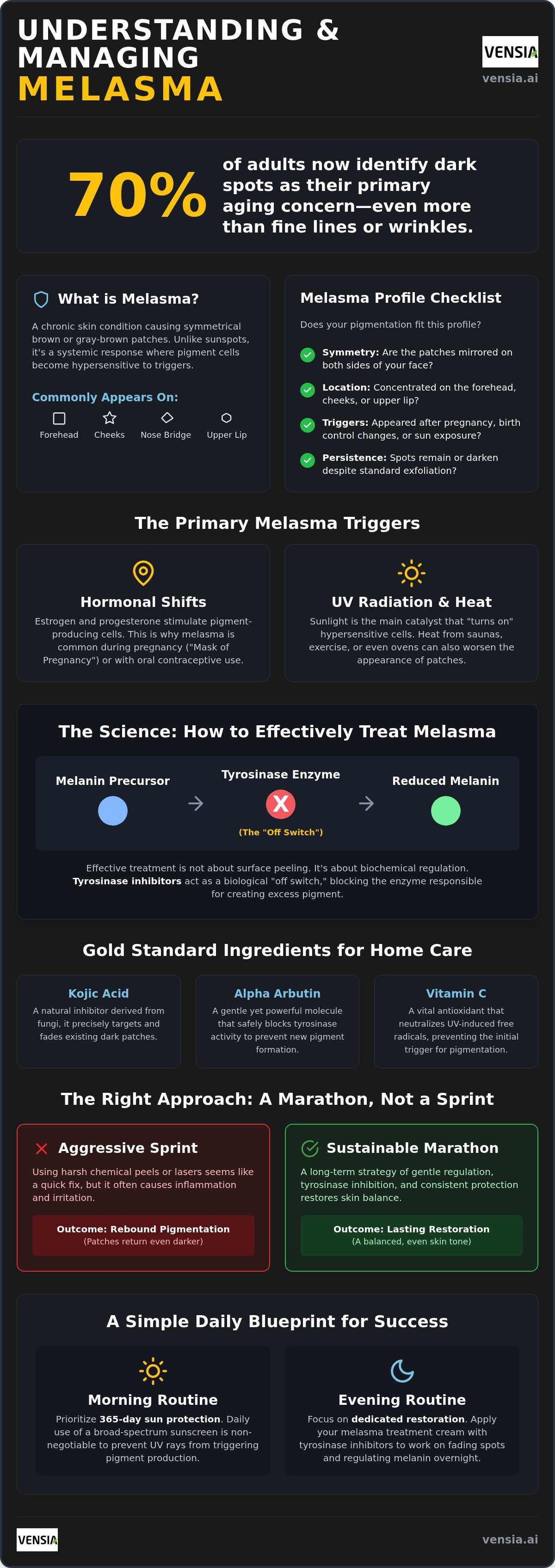
Melasma is a chronic skin condition that presents as symmetrical brown or gray-brown patches, usually on the face. Unlike common sunspots, these patches often appear in a "mask-like" pattern across the cheeks, bridge of the nose, forehead, and upper lip. While it is physically harmless, the psychological impact is significant. Many people report lower self-confidence because the condition is so visible and notoriously difficult to manage. Understanding the root cause is the first step toward choosing an effective melasma treatment cream that actually works.
It's vital to distinguish melasma from other forms of hyperpigmentation. Post-inflammatory hyperpigmentation (PIH) usually follows a specific skin injury, like an acne breakout or a scratch. Solar lentigines, or age spots, are the result of cumulative UV damage over decades. In contrast, What is Melasma? research shows it's a systemic response involving melanocytes that have become hypersensitive to both internal and external triggers. Because it's a chronic condition, management requires a gentle, consistent hand rather than occasional aggressive interventions.
The Role of Hormones and UV Radiation
Hormonal shifts are the primary engine behind this condition. Estrogen and progesterone stimulate the pigment-producing cells, which is why melasma frequently appears during pregnancy or while taking oral contraceptives. Sunlight acts as the catalyst that turns these cells on. Interestingly, light isn't the only trigger; heat from saunas, ovens, or even intense exercise can dilate blood vessels and worsen the appearance of patches. The rebound effect occurs when aggressive chemical peels or harsh lasers cause melanocytes to overreact, leading to darker patches than before.
Who is Most at Risk for Melasma?
While anyone can develop this condition, it's most prevalent in women and individuals with darker skin tones, specifically those categorized as Fitzpatrick scales III through VI. Genetics play a heavy role; if your mother or sister struggled with these patches, you're more likely to experience them too. Identifying the condition early helps you select a melasma treatment cream that focuses on stabilization rather than just surface-level peeling. Early intervention prevents the pigment from settling into the deeper dermal layers where it becomes much harder to fade.
Use this checklist to see if your pigmentation fits the melasma profile:
- Symmetry: Are the patches mirrored on both sides of your face?
- Location: Are they concentrated on the forehead, cheeks, or upper lip?
- Triggers: Did they appear after pregnancy, a change in birth control, or a beach holiday?
- Persistence: Do the spots remain or darken despite using standard exfoliating scrubs?
The Science of Melasma Treatment: Key Ingredients That Deliver Results
Treating melasma is not about scrubbing away surface color; it's about biochemical regulation. The most effective approach involves tyrosinase inhibitors. These act as a biological "off switch" for melanin production by blocking the enzyme responsible for pigment formation. The Science of Melasma Treatment highlights that a multi-pathway strategy is essential for lasting recovery. You need to inhibit new pigment, fade existing patches, and protect the skin from future triggers simultaneously. By 2026, the industry has shifted decisively toward gentler, non-hydroquinone alternatives. This change follows regulatory updates that moved hydroquinone to prescription-only status, sparking a new era of high-performance botanical and synthetic inhibitors that offer results without harsh side effects.
Antioxidants, particularly Vitamin C, are indispensable in this process. They stabilize the formula while neutralizing free radicals generated by UV exposure and environmental heat. This stabilization prevents the initial inflammatory signal that tells your skin to produce excess pigment. When you select a sophisticated melasma treatment cream, you're looking for a synergy of these active agents. They must work in harmony to restore balance rather than overwhelming the skin's natural defenses.
Melanin Inhibitors: Fading the Patches
Ingredients like Kojic acid and Alpha Arbutin are now the gold standards for home-based care. They target overactive melanocytes with surgical precision. This means they address the dark patches without damaging the surrounding healthy skin or causing unwanted "halo" effects. It's a focused approach. While many users are tempted by high concentrations, clinical evidence confirms that consistency is the true driver of success. A steady, daily application of a melasma treatment cream over a full 90-day skin cycle yields far better results than an aggressive, high-strength product used sporadically. This "long game" approach ensures the skin remains calm while the pigment gradually lifts.
Niacinamide and Barrier Support
Niacinamide is a powerhouse for melasma because it interrupts the pigment journey. It prevents the transfer of melanin from the melanocytes to the skin's surface cells. This "stop-gap" measure ensures that even if some pigment is produced, it never becomes a visible patch. Soothing agents like marshmallow or licorice extract are equally vital because they prevent inflammation. Since inflammation is a primary trigger for pigment darkening, keeping the skin cool and calm is non-negotiable. Focusing on improving skin texture through barrier support creates a resilient canvas. If you're ready to start this restorative process, the VENSIA collection offers professional-grade formulations designed for daily, sustainable use.
Prescription vs. Over-the-Counter Melasma Creams: Making the Right Choice
Choosing between a prescription and an over-the-counter (OTC) melasma treatment cream often comes down to the speed of results versus the long-term health of your skin barrier. Prescription formulas typically rely on high concentrations of hydroquinone, a potent bleaching agent. While effective for short-term "blasting" of pigment, this aggressive approach carries specific risks. Long-term use of hydroquinone can lead to exogenous ochronosis, which is a permanent blue-black darkening of the skin that's nearly impossible to reverse. Research in Evidence-Based Treatment for Melasma suggests that while clinical options have their place, the foundation of any successful regimen is daily, sustainable care that doesn't compromise skin integrity.
Many people ask if an OTC melasma treatment cream can truly deliver results on stubborn patches. The answer is a definitive yes, provided the formula targets multiple biological pathways. While a prescription might stop pigment production quickly, it often fails to address the underlying sensitivity or the "rebound" effect that occurs once the medication is stopped. A high-quality OTC cream works by gradually calming the skin and building up its defenses. This ensures that when the pigment fades, it stays gone. Specialized skincare acts as the ideal maintenance phase, keeping melanocytes stable after clinical treatments have ended.
When to Seek a Dermatologist
If your patches are rapidly changing shape, becoming painful, or remaining completely resistant to home care after six months of consistent use, it's time for a medical consultation. Dermatologists may suggest laser treatments or chemical peels. However, proceed with caution. If lasers aren't calibrated specifically for melasma, the heat can trigger a massive inflammatory response, making the mask even darker. Even if you choose clinical procedures, topical creams remain the foundation of your care. They stabilize the melanocytes so that the trauma of a professional procedure doesn't result in new, deeper pigmentation.
The Benefits of OTC Skin Restoration
Modern OTC formulas have evolved significantly by 2026. They provide a balanced, low-risk path to radiance without the "thinning skin" side effects often associated with pharmaceutical steroids or tretinoin. Products like the VENSIA Anti Pigmentation Cream prioritize biological restoration over irritation. Rather than a deep chemical peel that strips the skin and leaves it vulnerable, a gentle, daily approach supports natural cell turnover. This keeps the barrier strong and prevents the inflammation that fuels melasma. It's about achieving a glow through health, not just through aggressive peeling.
How to Use Melasma Creams Safely: A Step-by-Step Daily Routine
Applying a high-quality melasma treatment cream is only half the battle. If you don't commit to the "Golden Rule" of 365-day sun protection, your efforts will likely be neutralized by a single hour of UV exposure. Melasma is a chronic condition that responds to the slightest hint of heat or light. Safety and consistency are your most powerful tools for restoration. Without a protective shield, even the most advanced active ingredients cannot perform their job effectively.
Patience is equally vital. You won't see visible changes in week one. Skin cells follow a biological cycle of roughly 28 days, but deep-seated pigment requires approximately 90 days to lift significantly. This three-month window allows your melanocytes to settle into a new, regulated rhythm. When applying your treatment, remember that more isn't better. A pea-sized amount for the entire face is sufficient. Using more only increases the risk of irritation, which can trigger the very inflammation that causes patches to darken.
Morning: Protect and Prevent
Your morning focus is building a shield. Start with a gentle cleanser that respects your skin's acid mantle; stripping the skin only invites trouble. Next, apply your pigmentation cream to provide a base layer of active inhibitors. The final, most critical step is a broad-spectrum SPF 50+. For melasma, mineral sunscreens containing zinc oxide or titanium dioxide are often superior. Unlike chemical filters that absorb UV rays and convert them to heat, mineral versions reflect light and heat away from the skin surface.
Evening: Treat and Restore
Nighttime is when the real restoration happens. Begin with a double cleanse to thoroughly remove SPF, makeup, and urban pollutants that accumulate during the day. Once your skin is clean, apply the VENSIA Anti Pigmentation Cream directly to the affected areas. This allows the active ingredients to work undisturbed while your body is in its natural repair mode. Finish your routine by locking in moisture with a Niacinamide body lotion or a rich face cream to support barrier health.
Establishing this structure ensures your skin stays calm while the pigment gradually fades. To begin your journey toward a more even skin tone, you can order the VENSIA Anti Pigmentation Cream today and start your 90-day transformation.
Restoring Radiance with VENSIA Anti Pigmentation Cream
VENSIA Anti Pigmentation Cream is engineered as a high-performance melasma treatment cream for all skin types. While many products focus solely on stripping away pigment, our formula prioritizes the restoration of the skin barrier. A compromised barrier often fuels the inflammatory response that keeps melasma active. By reinforcing this natural shield, the cream creates an environment where cells can heal without the constant threat of new discoloration. It targets dark spots, fine lines, and aging spots simultaneously. This comprehensive approach ensures that your skin doesn't just look clearer but behaves in a healthier, more resilient manner.
Our brand philosophy balances clinical confidence with empathetic reassurance. We understand that pigmentation is a personal experience that impacts self-assurance. This melasma treatment cream acts as a knowledgeable guide for your skin, using a sophisticated hybrid of dermatological precision and holistic wellness. It avoids the coldness of traditional pharmaceuticals, opting instead for a supportive voice that acknowledges your journey. By supporting the skin’s natural recovery process, the formula helps return your complexion to its previous state of balance.
Why VENSIA Stands Out
The VENSIA formula utilizes an active voice in skin biology. It addresses the root of the concern rather than offering a temporary cosmetic fix. This cream is uniquely versatile, designed for both men and women. We purposefully break the beauty-only stereotype because skin health is a universal priority. The register of the product is professional and polished. It combines modern research with carefully selected botanical extracts to provide a professional-grade tool. This hybrid approach ensures that the treatment is both effective and gentle enough for daily use. It is about quiet efficiency; it provides exactly what the skin needs to achieve a radiant, even finish.
Real Expectations: The Path to Recovery
True transformation takes time. As established in previous sections, your skin works in specific biological cycles. You should expect a 90-day timeline to see visible repigmentation and fading of stubborn patches. This period allows the active ingredients to regulate melanin production at the source. We encourage you to take before and after photos under consistent lighting every 30 days. These visual markers help you track the subtle, steady progress that often goes unnoticed during daily mirror checks. Consistency is the bridge between frustration and lasting results.
Your journey to a clearer, more confident complexion starts with a single, deliberate choice. Start your journey to even skin tone with VENSIA Anti Pigmentation Cream and experience the power of a routine built for long-term restoration.
Your Path to Lasting Skin Restoration
Managing melasma is a journey that rewards patience and biological precision. We have explored how a consistent 90-day routine, anchored by strict sun protection and tyrosinase inhibitors, can effectively shift the skin from a state of inflammation to one of balance. Moving away from aggressive peeling toward sustainable, barrier-supporting ingredients ensures your results are not just visible but enduring. By understanding the chronic nature of these patches, you can transition from temporary fixes to a routine that truly respects your skin's health.
Choosing a specialized melasma treatment cream is the foundation of this progress. The VENSIA Anti Pigmentation Cream offers a solution-oriented approach that is suitable for all skin types. It purposefully targets dark spots and fine lines simultaneously, providing a professional-grade tool for both men and women. With national shipping available, you can begin your restoration process regardless of your location. We invite you to Shop VENSIA Anti Pigmentation Cream for Radiant Skin and take the first step toward a more even complexion. You have the power to reclaim your confidence and achieve the clear, radiant skin you deserve.
Frequently Asked Questions
How long does it take for melasma treatment cream to work?
Visible results with a melasma treatment cream typically require a full 90-day biological cycle to manifest. While you might notice a subtle brightening of the skin's surface within the first four weeks, deep-seated pigment takes longer to lift. Consistency is the most important factor in this process. Skipping even a few days can reset your progress, as melanocytes remain highly sensitive to UV and hormonal triggers during the recovery phase.
Can melasma be cured permanently with a cream?
Melasma is a chronic skin condition, meaning it cannot be cured permanently, but it can be effectively managed and faded. Even after patches disappear, the underlying melanocytes remain hypersensitive. A high-quality cream helps regulate pigment production and maintain an even tone. Long-term success depends on a maintenance routine that includes daily sun protection and occasional targeted treatments to prevent the mask from returning due to hormonal or UV triggers. Consistency is key to long-term skin health.
Is it safe to use pigmentation cream during pregnancy?
Safety during pregnancy depends entirely on the specific active ingredients in your skincare. You should avoid high-strength retinoids and hydroquinone during this time. Many women find success with gentler, botanical-based formulas that focus on stabilization rather than aggressive peeling. Always consult with your healthcare provider before starting any new treatment while pregnant or breastfeeding. This ensures the ingredients align with your specific health needs and safety profile. We prioritize your well-being through transparent, solution-oriented guidance.
Why does my melasma look darker after I start using a treatment cream?
It's common for patches to appear darker initially as deep-seated pigment begins to rise to the skin's surface during the exfoliation process. This is often a sign that the treatment is working effectively. However, if the darkening is accompanied by redness or burning, it may indicate inflammation. Inflammation is a known trigger for melasma, so it's vital to use a gentle formula that calms the skin while addressing the pigmentation. Patience and observation are essential during this phase.
What ingredients should I avoid if I have melasma?
You should avoid harsh ingredients that cause excessive heat or inflammation, such as high-strength alcohols, synthetic fragrances, and aggressive chemical exfoliants. These can trigger a defensive response from your melanocytes, leading to darker patches. Be cautious with products that cause significant peeling or irritation. A supportive treatment should focus on gentle regulation and barrier repair rather than stripping the skin. This approach ensures your complexion remains calm and resilient against environmental triggers that worsen pigmentation concerns.
Can men use VENSIA Anti Pigmentation Cream?
Yes, men can absolutely use VENSIA Anti Pigmentation Cream. While melasma is often associated with female hormonal changes, men account for approximately 10% of cases and frequently struggle with sun-induced pigmentation. Our formula is designed for all skin types and genders, focusing on biological restoration rather than cosmetic masking. It effectively targets dark spots, fine lines, and uneven texture, providing a straightforward and efficient solution for any man looking to restore his skin's natural radiance.
Do I need to wear sunscreen indoors if I am treating melasma?
You must wear sunscreen indoors if you want to see results. UVA rays can penetrate standard window glass and stimulate pigment-producing cells even on cloudy days. High-energy visible light from digital screens can also worsen melasma in some individuals. Applying a mineral-based SPF every morning ensures your skin remains protected from these subtle but persistent triggers. This protection allows your melasma treatment cream to work without constant interference from environmental light.
What is the difference between melasma and sunspots?
Melasma is characterized by large, symmetrical patches triggered by hormonal shifts and heat, whereas sunspots are small, defined marks caused by cumulative UV damage. Sunspots can appear anywhere the sun hits the skin. Melasma is more complex and systemic, often requiring a multi-pathway approach to regulate overactive melanocytes. While both involve excess pigment, melasma is notoriously more stubborn and requires a more specialized, gentle management strategy to prevent rebound darkening. Understanding this difference helps you choose the right care.


