

Early-Stage Vitiligo Treatment: Options and Next Steps in 2026
Could the first step in early stage vitiligo treatment be confirming what a pale patch is, rather than trying to treat it right away? New light areas can have causes other than vitiligo, so appearance alone can’t confirm a diagnosis. It’s understandable to worry that waiting could let patches spread. A timely assessment can clarify what’s happening, though it can’t predict exactly how the condition will change or guarantee a treatment result.
If vitiligo is confirmed, the right plan depends on factors such as where patches appear, how extensive they are, and whether new areas are developing. Clinician-guided options may include prescription topical treatments, phototherapy, or, in some cases, a topical JAK inhibitor. Suitability and access vary, and results usually take time. Skincare can support a simple routine, but it isn’t a substitute for diagnosis or medical treatment.
This guide explains how clinicians assess early vitiligo, what treatment options may be discussed in 2026, and what each can and can’t do. You’ll also find practical questions to help you take informed next steps toward a personalized plan, without expecting instant or guaranteed change.
Key Takeaways
- New pale patches can have different causes, so accurate assessment is the first step before deciding on care.
- Early stage vitiligo treatment is personalized: a clinician may discuss topical medicines, light-based treatment, or monitoring based on the situation.
- Medical treatments, observation, and cosmetic coverage serve different purposes and shouldn’t be treated as interchangeable options.
- Track changes with consistent photographs and brief notes to make progress easier to discuss during assessment and follow-up.
- Supportive skincare, including VENSIA Anti Vitiligo Cream as an optional skincare product, does not replace diagnosis or clinician-directed treatment.
Early-Stage Vitiligo Treatment: What the First Changes May Mean
Noticing a pale patch can raise immediate questions: Is it vitiligo, and should you act before it changes? Early-stage treatment starts with a timely assessment and, if vitiligo is confirmed, a care plan suited to your circumstances. It isn’t a promise of an early cure. Several skin conditions and changes can cause lighter areas, so a clinician’s assessment matters before deciding what to do.
Vitiligo involves the loss of melanocytes, the cells that produce skin pigment. Its course varies: patches may remain stable, change in size, or appear in new areas. Understanding the condition’s patterns and possible causes can help put new changes in context. The linked Vitiligo Overview offers broader background, but it can’t determine what’s causing an individual patch.
How can you tell whether new pale patches need assessment?
Notice what is changing, but don’t use appearance alone to diagnose yourself. A patch may look lighter than nearby skin, develop a more distinct border, or change in size. You might also notice additional patches or changes in where they appear, such as on the face, hands, or around body openings. These observations are useful to share, but they don’t confirm vitiligo.
A dermatologist may examine the skin and use a Wood’s lamp, which helps assess pigment changes under ultraviolet light. They may ask when the patches first appeared, whether they have changed, and about relevant personal or family medical history. Other causes, including some rashes, infections, or changes after skin irritation, may also be considered. Additional tests can be useful when the clinician thinks they’re appropriate; not everyone needs the same assessment.
What does early-stage vitiligo treatment aim to do?
Once the diagnosis is clear, care can focus on goals that matter to you. These may include managing signs of active change, supporting pigment return in affected areas, or deciding how to monitor the skin. The choice depends on individual factors, including the areas involved and the pattern of vitiligo. A plan may need review over time, since response and disease activity differ from person to person.
Early assessment can help clarify the options, but it doesn’t promise faster or complete repigmentation. Assessment establishes what may be happening; treatment is a separate decision guided by diagnosis, suitability, and personal priorities. Some people discuss clinician-guided treatment; others may prefer observation or cosmetic approaches. Those choices aren’t equivalent, but each can form part of an informed, individualized plan.
Early Vitiligo Treatment Options: What a Dermatologist May Consider
Once vitiligo is diagnosed, the next step is not automatically a particular cream or light treatment. A dermatologist considers whether the condition appears active, which areas are affected, how extensive the patches are, and how they affect you. The aim may be to manage changes, support repigmentation, or both. Suitability, access, and potential risks all shape the discussion.
Treatment selection depends on the diagnosis, location, extent, activity, and individual factors. That’s why two people with pale patches may receive different recommendations, even if their skin changes look similar. Early stage vitiligo treatment is clinician-guided, and no option can promise a specific result.
When might topical medicines be considered?
For selected cases, a clinician may discuss topical corticosteroids or calcineurin inhibitors. These medicines are applied to the skin, but the appropriate choice depends on the affected area and the person’s circumstances. Some topical treatments can cause irritation; corticosteroids may also have other effects, such as skin thinning, depending on use. A clinician should guide where and how long to apply treatment, and whether monitoring or adjustments are needed.
How do light-based and other medical options differ?
Narrowband UVB phototherapy uses controlled ultraviolet light as a course-based treatment. It requires assessment for suitability and follow-up to review the skin’s response and any side effects. The practical commitment can include repeated treatment sessions over time, so the clinician can help weigh this against the areas affected and your preferences. It isn’t the same as cosmetic coverage or an at-home skincare routine.
Other options may be discussed for particular patterns or circumstances, rather than as universal first steps. These can include:
- Topical JAK inhibitors: Certain medicines in this category may be prescribed for eligible people, depending on local approval and clinical guidance.
- Other medical approaches: A clinician may consider additional treatments for selected cases after reviewing the diagnosis, disease activity, and potential benefits and risks.
Eligibility and access vary, and a treatment suitable for one person may not suit another. Ask what the option is intended to do, what follow-up it involves, and when progress will be reviewed. Results can take time, and response varies.
Skincare products have a different role from medical treatment. VENSIA offers VENSIA Anti Vitiligo Cream as a skincare product to consider as part of a routine. Review its product information and directions, and don’t treat it as a substitute for diagnosis or clinician-directed care. Keep decisions about prescription medicines and phototherapy with a qualified clinician.
Vitiligo Cream, Phototherapy, or Observation: Compare the Roles
These options serve different purposes. Clinician-directed treatments are considered to address vitiligo itself, observation means monitoring without starting a medical treatment, and cosmetic coverage changes appearance temporarily. A cream’s label or marketing alone doesn’t establish that it can control vitiligo or restore pigment. Compare options by what each is intended to do, who guides it, and what it asks of you.
| Option | Purpose | Who guides it | Time commitment | Key limitations |
|---|---|---|---|---|
| Clinician-directed topical treatment | May be used to manage vitiligo or support repigmentation, depending on the medicine and treatment plan. | A qualified clinician selects and monitors the medicine. | Regular application and follow-up may be needed over time. | Not suitable for everyone or every area; irritation and other side effects are possible. |
| Phototherapy | Uses controlled light as a medical treatment for selected cases. | A clinician assesses suitability and monitors progress. | Usually involves a course of repeated sessions and follow-up. | Requires ongoing attendance or access to an appropriate treatment setup; response varies. |
| Observation | Tracks changes without starting a medical treatment, when that fits a person’s preferences and plan. | Discussed with a clinician, with review if changes occur. | May involve periodic checks and keeping notes or photographs. | Doesn’t aim to repigment patches or actively treat vitiligo. |
| Cosmetic coverage | Temporarily reduces the visible contrast of lighter patches. | Chosen by the individual; a skincare professional may help with cosmetic techniques. | Applied as needed and may need refreshing. | Doesn’t change vitiligo activity or restore pigment. |
What can a skincare cream reasonably contribute?
Skincare can support comfort and a consistent routine, while cosmetic products may help with appearance. Neither role should be confused with medical treatment intended to affect vitiligo. Before choosing a cream, read its ingredient information, directions, and claims carefully. A product marketed for vitiligo isn’t automatically a proven treatment, and claims of disease control or repigmentation need appropriate product-specific evidence. VENSIA Anti Vitiligo Cream is a skincare option, not a replacement for diagnosis or an individualized medical plan.
Why are treatment results and timelines different?
Response can depend on the area affected, disease activity, treatment chosen, and individual factors. Visible changes may take months and may be incomplete; repigmentation can also be temporary. Side effects and tolerance vary, too. Follow-up gives a clinician a chance to review progress and discuss whether to continue, adjust, or change the plan. Some people may also discuss maintenance to help manage changes over time. No approach is universally best for every person.
For early stage vitiligo treatment, compare medical care with skincare by its purpose, evidence, and level of clinical guidance, not by how confidently a product is promoted.
What to Do After Noticing Possible Early Vitiligo
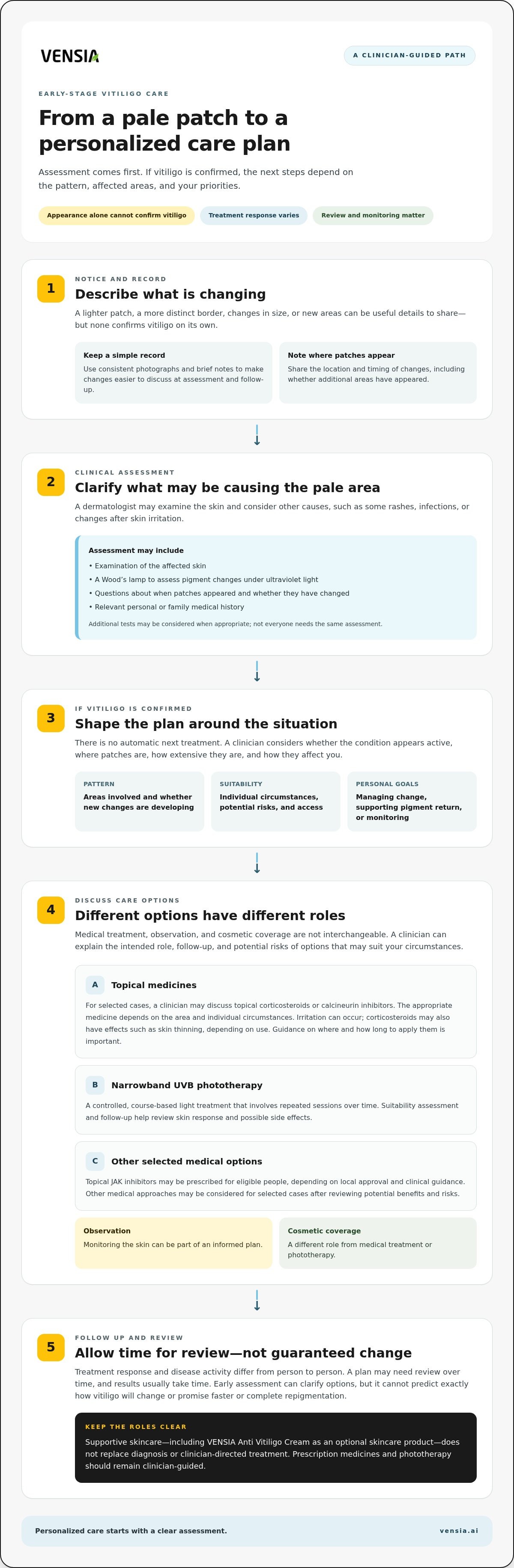
A calm, organized next step can turn uncertainty into useful information. You don’t need to diagnose the patches yourself or decide on treatment before assessment. Use this sequence to prepare, understand your options, and make decisions with a clinician. For additional context on changes in disease activity, see this guide to stopping vitiligo from spreading.
- Document what you notice. Note when the pale areas first appeared, where they are, and whether their size, color, or number seems to change. Take clear photographs in similar lighting so you have a consistent record.
- Arrange an assessment. A dermatologist can assess whether the patches may be vitiligo or another skin condition. Bring your notes and photos, and mention any symptoms or relevant medical history.
- Discuss your goals. Consider what matters to you, such as monitoring change, exploring medical treatment, or reducing the visible contrast. There’s no single goal that fits everyone.
- Choose a care approach together. Review suitable options, their intended purpose, possible risks, time commitment, and follow-up needs before settling on a plan.
- Review progress. Follow the agreed review plan and share photographs, treatment use, and any reactions. The clinician can help decide whether to continue or adjust the approach.
How can you prepare for a dermatology appointment?
Write down when you first noticed each area and where it has appeared. Include any symptoms, relevant health history, and changes you’ve observed. Bring your questions, too: What else could cause these patches? Which options suit my situation, and what benefits or risks should I understand? How much time might care take, and when should we review the plan?
It can also help to ask how progress will be assessed. A clear review plan gives you a shared point of reference, rather than leaving you to interpret every small visual change on your own.
How should you track treatment progress?
Take repeat photographs from a similar distance and in consistent lighting. Keep brief notes about when and where patches change, which treatment you used, and any reactions you noticed. Follow the clinician’s instructions for tracking and review timing. Day-to-day differences in light, angle, or skin appearance aren’t enough on their own to judge whether treatment is working.
Use your follow-up to discuss what you’ve recorded and whether the plan still fits your goals. For supportive skincare alongside clinician-guided care, explore VENSIA Anti Vitiligo Cream as a skincare product, not a substitute for diagnosis or medical treatment.
Supportive Skincare Alongside an Early Vitiligo Treatment Plan
A steady skincare routine can support comfort and everyday skin care, but it doesn’t replace diagnosis or clinician-directed treatment for vitiligo. Keep the routine gentle and manageable. Adding several new products at once can make it harder to tell what’s causing a reaction, so introduce changes thoughtfully and follow each product’s directions.
How can you keep a supportive routine simple?
Use gentle cleansing and avoid unnecessary scrubbing or layering multiple new products. Where pigment is reduced, protect skin from sun exposure with shade, protective clothing, and sunscreen used according to its label. Sun protection is general skin care, not a treatment for vitiligo. If a product causes irritation, stop using it; seek appropriate medical advice for a new or persistent reaction.
During early stage vitiligo treatment, keep supportive skincare distinct from the medical plan. A skincare product may have a place in a personal routine, but it shouldn’t delay assessment or replace a treatment recommended by a clinician. If you’re already using prescription products, ask your clinician how to fit other skincare into your routine.
How should readers evaluate VENSIA Anti Vitiligo Cream?
Consider VENSIA Anti Vitiligo Cream as a skincare product, not a replacement for medical care. Read the product’s directions and available ingredient information, and assess claims carefully. A product name or marketing language alone doesn’t establish that a cream controls vitiligo or restores pigment. Avoid assuming an outcome that hasn’t been supported by product-specific evidence.
For product-focused context, the VENSIA Anti Vitiligo Cream repigmentation guide can help you understand how to consider the product within a skincare routine. Keep decisions about diagnosis and vitiligo treatment with a qualified clinician. Skincare and medical care have different roles, even when both are part of a person’s wider approach to skin health.
Choose a routine you can follow consistently, and change one product at a time when practical. If irritation develops, stop using the product and seek appropriate medical advice, especially if the reaction persists or worsens. To explore VENSIA’s skincare products as part of a simple routine, visit VENSIA skincare.
Take Your Next Step with Clarity
You don’t have to settle every question about your skin at once. Begin with one practical step: arrange an assessment and bring your observations and priorities into the conversation. From there, you can decide whether monitoring, clinician-guided care, or supportive skincare feels right for your circumstances. A thoughtful early stage vitiligo treatment plan leaves room to review decisions as your needs change, without demanding instant results.
For everyday skincare, VENSIA offers targeted products, including VENSIA Anti Vitiligo Cream. Consider it as part of a straightforward routine, not a replacement for diagnosis or medical care. Review product information and directions, and keep treatment decisions clinician-led.
Explore VENSIA Anti Vitiligo Cream and review its product information as you shape a skincare routine that feels manageable. A clear next step can bring greater confidence, one decision at a time.
Frequently Asked Questions
Can early vitiligo be treated successfully?
Treatment can help some people manage vitiligo or encourage pigment to return, but results vary and aren’t guaranteed. “Success” may mean slowing changes, seeing some repigmentation, or feeling more comfortable with your skin. For early stage vitiligo treatment, a clinician can help set realistic goals based on your diagnosis and circumstances. Ask how progress will be judged, since a change in appearance may not mean the condition has fully resolved.
How soon should I see a dermatologist for new white patches?
Arrange an assessment when new pale patches persist, change, or concern you. There’s no need to identify the cause yourself first. When booking, mention whether the areas are spreading or new patches have appeared, and note when you first noticed them. If the skin also develops symptoms such as persistent itching or irritation, include that information. A clinician can assess possible causes and advise whether further evaluation is needed.
Is vitiligo contagious?
No. Vitiligo isn’t contagious, so it can’t spread from one person to another through touch, sharing towels, or spending time together. It’s a pigment condition, not an infection. You don’t need to avoid close contact with someone who has vitiligo, and ordinary social or family activities are safe. If someone expresses concern, a simple explanation that vitiligo isn’t passed between people can help correct the misconception.
Can vitiligo go away on its own without treatment?
Some areas may regain pigment without treatment, but this is unpredictable and shouldn’t be assumed. Changes can vary from person to person, and patches may remain or new ones may appear. If you prefer not to start treatment, you can still have the diagnosis assessed and discuss how to monitor changes. That helps distinguish a considered observation plan from simply waiting without knowing what the patches are.
Can diet or supplements cure early vitiligo?
No diet or supplement is established as a cure for vitiligo. A balanced diet supports general health, but it shouldn’t replace assessment or clinician-directed care. Supplements can also have side effects or interact with medicines, so discuss them with a healthcare professional before starting, especially at high doses. If you suspect a nutrient deficiency or have dietary restrictions, ask whether evaluation is appropriate rather than relying on supplements to restore pigment.
Can children receive treatment for early vitiligo?
Yes, treatment may be considered for children, but the plan should be guided by a clinician familiar with the child’s needs. Suitability depends on factors such as age, affected areas, and the impact of the condition. A caregiver can share observations and discuss practical questions, including how a routine fits school and daily life. Children’s treatment shouldn’t be copied from an adult’s plan or started with someone else’s medication.
What should I do if new patches appear during treatment?
Tell the clinician overseeing treatment and share when and where the new patches appeared. Keep dated notes or photographs, and record how you’ve used the treatment and any reactions. New patches may mean the plan needs review, but don’t increase, stop, or change a prescribed treatment on your own. Ask whether to continue as directed and when your progress should be reassessed. A clinician can help interpret the changes in context.


