

How Long Does Vitiligo Repigmentation Take? Signs and Progress
Phototherapy doesn't cure vitiligo, but it may support repigmentation and help stabilize depigmentation. If you're asking how long vitiligo repigmentation takes, some people notice early signs after 4-8 weeks of narrowband UVB phototherapy, while visible changes may take 3-6 months of consistent treatment. Progress varies, and treatment may continue for a year or two.
It’s natural to want a clear sign that treatment is working, especially when changes happen gradually. How long vitiligo repigmentation takes varies by treatment and body area. This guide explains what early color return can look like, why the face may respond differently from the hands and feet, and how photographs can help you track changes over time. You’ll also learn why progress may be slow and why following your treatment plan matters, even when changes are subtle.
Key Takeaways
- Track subtle changes with photographs taken every few weeks, using consistent lighting and angles for easier comparison.
- Early pigment return may appear as small spots or color along the edges of pale patches; changes can be gradual.
- Facial areas often respond more readily than hands and feet, so progress in one area may not predict progress elsewhere.
- Repigmentation can take months, and continuing treatment may help maintain progress; phototherapy does not cure vitiligo.
- VENSIA Anti Vitiligo Cream is a topical skincare option to consider as part of your approach to vitiligo.
Monitoring progress with photographs
Photographs taken every few weeks can reveal gradual changes that are hard to notice day to day. Compare them with treatment milestones to see whether pigment is returning or patches are changing.
Treatment response milestones
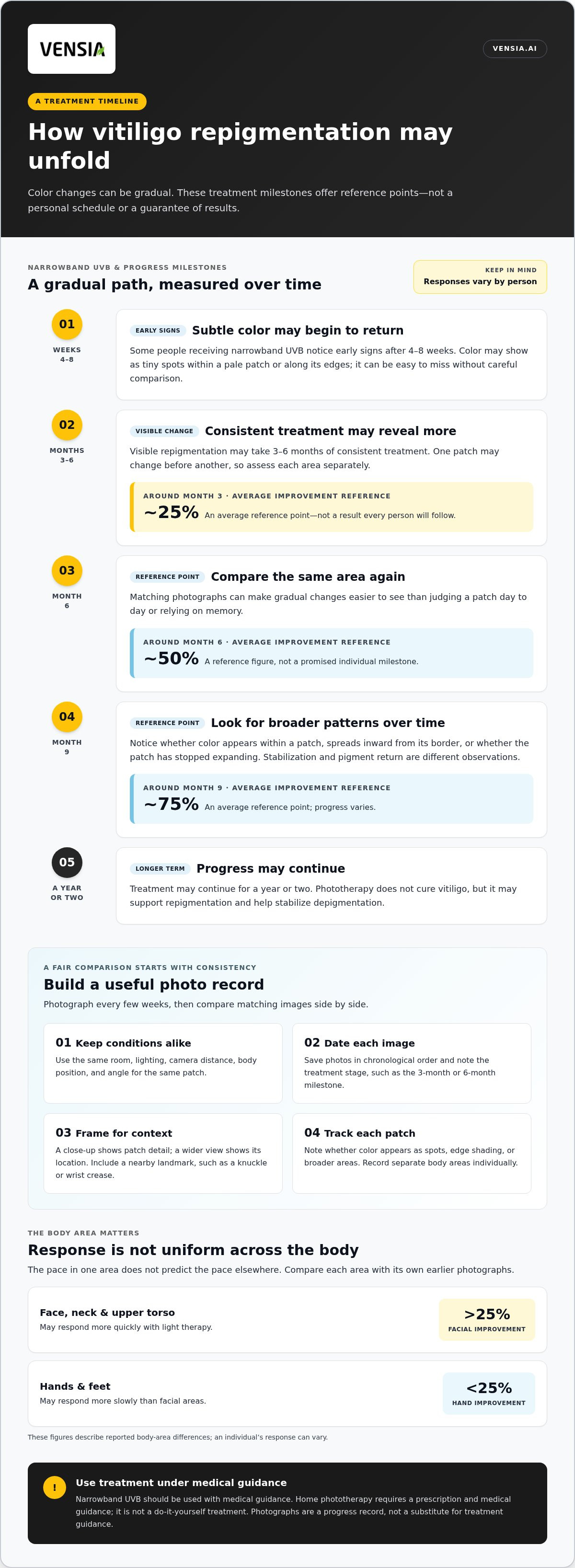
Treatment milestones are visible changes assessed across defined points in a treatment timeline. They help you compare progress consistently instead of judging a single day’s appearance. Average improvement is about 25% at 3 months, 50% at 6 months, and 75% at 9 months. These figures offer reference points, not a schedule every person will follow.
Use photographs to track changes, keeping in mind that lighting and skin tone can affect how a patch looks. A faint spot of returning color, for example, may be easier to see in side-by-side images than in a mirror.
Repigmentation timelines during treatment
Repigmentation timelines describe how changes may emerge during treatment, from early signs to broader areas of color. Some people receiving narrowband UVB phototherapy notice early signs after 4-8 weeks; visible repigmentation may take 3-6 months of consistent treatment.
Progress can continue for a year or two. Compare photographs taken at similar intervals to see gradual changes, rather than expecting each new image to show a clear difference.
For useful comparisons, make each photo session as consistent as possible. Use the same room, lighting, camera distance, and body position. Photograph the same patch from the same angle, then save each image with its date. A close-up can show patch detail, while a wider view shows its location.
- Use a dated folder to keep images in chronological order.
- Include a nearby skin landmark, such as a knuckle or wrist crease, for orientation.
- Record the treatment stage beside each image, such as the 3-month or 6-month milestone.
- Compare matching photographs side by side, rather than relying on memory.
Look for changes in patch borders, small spots of color, or color spreading inward. A single image can mislead if sunlight, shadows, or camera settings differ. If a patch looks lighter in one photograph, check the lighting and angle before interpreting that as treatment progress.
Risks and side effects vary by treatment method, so light therapy and topical medicines have different safety considerations. Narrowband UVB should be used under medical guidance. Home phototherapy requires a prescription and medical guidance, so it isn’t a do-it-yourself treatment. Follow directions for prescribed medicines and report unexpected skin changes to your treating professional.
Use photographs as a progress record, not as a substitute for treatment guidance. If an image shows a change between milestones, note when it appeared and which area it affects. Dated comparisons can make gradual changes easier to discuss during treatment reviews and help distinguish a lasting pattern from differences in lighting or camera position.
Timing of early repigmentation signs
Early repigmentation can begin as small changes within a pale patch. Narrowband UVB phototherapy can produce early signs after 4-8 weeks for some people.
Topical corticosteroids and calcineurin inhibitors don’t follow one fixed repigmentation timetable. Track changes in the treated area over time, since visible progress varies.
Ruxolitinib cream also has no single visible-response timeline for everyone. Look for gradual changes in treated patches rather than expecting color to return immediately.
Without treatment, vitiligo can remain stable or change, and spontaneous pigment return has no dependable schedule. A patch’s appearance alone can’t predict when it might change.
Early color return may appear as tiny spots within a pale patch or along its border. For example, a cheek patch might show scattered brown dots before color spreads across a wider area. These spots can be easy to miss without careful comparison.
Narrowband UVB treatment plans often involve multiple sessions per week for several months. The therapy is dermatologist-directed and aims to stimulate melanocytes, the cells involved in pigment production. Early signs may be subtle, so compare the same patch rather than judging progress across different body areas.
Separate pigment changes from differences caused by lighting. A patch can look darker in warm indoor light than beside a window. Check the same spot under consistent conditions, and note whether color appears within the patch, around its edges, or both.
- Record the date and treatment being used beside each observation.
- Note whether new color appears as dots, edge shading, or broader areas.
- Track separate patches individually, such as one on the face and another on an arm.
- Compare changes across treatment visits instead of relying on daily impressions.
Progress can also mean a patch stops expanding, not just that color returns. Stabilization and repigmentation are different observations, so record them separately. If a patch changes after a treatment adjustment, note when and where. This creates a clearer account without assuming every new mark signals pigment recovery.
Early signs offer a reference point, not a measure of final coverage. Photographs and written notes can help make subtle changes easier to discuss during treatment reviews. For a topical skincare option related to vitiligo, explore vitiligo skincare options.
Variation in repigmentation by body area
Vitiligo doesn’t respond evenly across the body. With light therapy, the face, neck, and upper torso may respond more quickly than the hands or feet. A changing facial patch therefore doesn’t predict the pace of change elsewhere. Assess each area separately instead of using one patch to measure progress across your body.
Facial vitiligo tends to improve by more than 25%, while hands tend to improve by less than 25%. These figures describe different body-area response patterns, not a promise for an individual patch. They also don’t mean every facial area will respond alike. For example, progress on the face and fingertips may differ during the same treatment period.
Hands and feet can be slower to show pigment return. Fingertips may take up to a year to repigment. Palms and soles can be more resistant to therapy, take a long time to respond, and may not completely resolve. A pale area on a palm doesn’t automatically mean another body area has stopped responding.
Location matters when comparing visible changes. A small area on the face may respond while a patch on a hand changes little. This difference can feel discouraging, but responses vary by site. Record each patch’s location and appearance separately, so progress on the face doesn’t overshadow slower change on the feet.
Keep a simple body-area record alongside dated photographs. Group observations by location, such as the face, neck, upper torso, hands, fingertips, feet, palms, and soles. For each area, note whether color appears, the patch edge changes, or its appearance stays stable. This helps distinguish “no visible change here” from “no progress anywhere.”
- Compare the same site across treatment periods, such as a facial patch with earlier images of that patch.
- Keep hand and fingertip observations separate; these areas can respond differently.
- Record palms and soles individually, since both may be resistant to treatment.
- Describe visible changes plainly, such as “new color at the edge” or “no clear change.”
When assessing treatment progress, consider both the location and the pattern. A facial response may appear sooner, while fingertips can take up to a year. Palms and soles may remain incompletely repigmented. These differences help set realistic expectations for each site and make comparisons more meaningful than judging every patch against the fastest-changing area.
For example, if color appears on the face while a sole remains pale, document both outcomes rather than combining them into one overall judgment. Separate records for each location show what is changing and where progress remains slow. Differences between body areas are part of the pattern to track, not a reason to treat every patch as identical.
Continuing treatment to maintain pigment
Visible pigment return doesn’t mean vitiligo has been cured. Phototherapy can support repigmentation and help stabilize depigmentation for some people, but it manages the condition rather than curing it. When a patch looks more even, improvement is a treatment milestone, not proof that the underlying condition has ended.
Narrowband UVB phototherapy is dermatologist-directed and aims to stimulate melanocytes, the cells involved in pigment production. Treatment plans often include multiple sessions per week for several months. Follow the plan as directed so progress can be assessed over time, rather than judging results over a brief period or changing the schedule independently.
Maintenance means paying attention to two separate outcomes: pigment returning and depigmentation becoming stable. A facial patch might show new color while another patch stops changing. Record each result separately to make treatment reviews more useful and avoid treating one visible improvement as the only measure of progress.
- Follow the prescribed schedule for narrowband UVB or topical medicines.
- Record treatment sessions and changes in each affected area.
- Note whether a patch gains pigment, stays stable, or continues changing.
- Discuss treatment changes with the professional directing your care.
Photographs taken every few weeks can support this record. Compare the same patch under similar lighting, and note the date and treatment stage. For example, label an image “left forearm, current treatment plan” rather than relying on memory. A series of dated images can show gradual shifts that one photograph cannot capture.
Not every patch follows the same course. The face, hands, and feet can respond differently, and palms or soles can remain difficult areas. Keep location-specific notes when reviewing progress to distinguish a slow response in one area from changes elsewhere.
Home phototherapy requires a prescription and medical guidance; it isn’t a do-it-yourself treatment. Don’t increase sessions or change a prescribed medicine based only on a photograph. Instead, bring dated observations to your next treatment review. This gives your treating professional a clearer record of pigment changes, stable patches, and areas still progressing.
Because vitiligo has no known cure, ongoing management focuses on the treatment plan and its observed effects. Visible improvement can be encouraging, but it doesn’t mean treatment should stop. Keep your schedule, records, and reviews aligned so decisions account for both repigmentation and stabilization.
How long does vitiligo repigmentation take with treatment?
The question of how long vitiligo repigmentation takes has no single answer. Treatment response varies, and visible changes can continue developing over a year or two. With consistent phototherapy, visible repigmentation often appears after 3-6 months, while some people see larger areas fill in or patches stabilize after 6-12+ months.
These timelines describe different stages, not a guaranteed sequence. Early color, broader coverage, and stabilization are distinct observations. A patch can show small changes before a larger area fills in, while another may remain stable. Tracking each outcome separately gives a clearer picture than relying on one overall impression.
Average improvement reaches about 25% at 3 months, 50% at 6 months, and 75% at 9 months. Average improvement plateaus after about 9 months. These milestones help frame treatment reviews, but they don’t mean every person’s progress will follow the same curve. Changes can continue beyond the point where improvement slows.
Phototherapy plans often involve multiple sessions per week for several months. Consistency matters when assessing the course: missed or irregular sessions make it harder to compare progress with the intended plan. Keep a record of sessions and changes, then review the pattern over time.
- At 3 months, compare images and notes with the starting point.
- At 6 months, record whether color has spread or patches have stabilized.
- At 9 months, assess whether improvement continues or has slowed.
- Beyond 9 months, keep tracking any ongoing changes within the treatment plan.
A plateau means average improvement slows after about 9 months; it doesn’t establish that every patch has reached its final appearance. Some people may continue treatment for a year or two. The distinction matters: slower progress can call for a careful review of the treatment course, rather than assuming that all pigment recovery has ended.
For a useful review, bring dated photographs and session notes together. Include the treatment period, areas showing color return, and patches that appear stable. For example, a record at 6 months can show whether change is limited to one patch or visible across several. These details support a clearer discussion of progress and next steps.
Repigmentation remains gradual, and continued treatment is part of managing progress, not proof of a cure. If you’re exploring topical skincare alongside your routine, explore vitiligo skincare options.
VENSIA: VENSIA Anti Vitiligo Cream
VENSIA Anti Vitiligo Cream offers a topical skincare option for people seeking care focused on vitiligo. Consider it when exploring skincare options alongside a treatment plan, while keeping its role distinct from dermatologist-directed phototherapy. Repigmentation timelines depend on the treatment being used, and this cream shouldn’t be presented as a guaranteed way to restore pigment or replace medical treatment.
When comparing skincare options, focus on what each product is intended for. VENSIA Anti-Pigmentation Cream is a separate option for concerns such as dark spots and uneven skin tone. Choose according to the skin concern you want to address, and keep expectations grounded in the product’s stated purpose.
Visit VENSIA to explore its skincare options.
Choose a thoughtful next step for your skin
Knowing how long vitiligo repigmentation takes can help set realistic expectations. Your next step can focus on what you need from skincare today. Keep medical treatment decisions separate from cosmetic care, and choose products for their stated purpose rather than expecting a cream to replace treatment or guarantee pigment return.
VENSIA offers VENSIA Anti Vitiligo Cream, alongside its Anti Pigmentation Cream for dark spots and uneven skin tone. Its Niacinamide Marshmallow Body Lotion is described as moisturizing and soothing for dry, rough skin. These options address different skincare concerns, so consider which one best fits your routine.
For help exploring VENSIA’s product options, contact VENSIA to discuss your options. A considered next step can keep your skincare choices clear and aligned with your needs.
Frequently Asked Questions
What Can Affect Results?
Body location and treatment consistency can shape the progress you observe. A facial patch may change while a hand patch responds more slowly. The treatment approach matters too: narrowband UVB phototherapy is designed to stimulate melanocytes, while other treatments follow different plans. Keep separate notes for each area and record whether the change is pigment return, stabilization, or continued depigmentation.
What affects how quickly vitiligo repigments?
The affected body area and treatment schedule both influence the pace of visible change. With light therapy, the face, neck, and upper torso may respond more quickly than the hands or feet. Phototherapy plans often involve multiple sessions per week over several months. Track a facial patch and a hand patch separately instead of treating one area’s progress as a forecast for another.
How long does narrowband UVB phototherapy take to show results for vitiligo?
Some people notice early signs after 4-8 weeks, while visible repigmentation may take 3-6 months of consistent phototherapy. Narrowband UVB is dermatologist-directed and aims to stimulate melanocytes, supporting gradual color return. Treatment plans commonly involve multiple sessions per week for several months. Record the treatment period and changes in specific patches, so subtle early signs don’t get confused with differences in lighting.
Which body areas repigment fastest or slowest in vitiligo?
The face, neck, and upper torso may respond more quickly to light therapy than the hands or feet. Facial vitiligo tends to improve by more than 25%, while hands tend to improve by less than 25%. Fingertips can take up to a year to repigment. Palms and soles may resist therapy, respond very slowly, and may not completely resolve, so assess these sites separately.
How much repigmentation can be expected after 6 or 12 months of vitiligo treatment?
Average improvement is about 50% at 6 months. By 9 months, average improvement is about 75%, and it plateaus after about 9 months. At 12 months, some people may see larger areas fill in or patches stabilize as treatment continues. These milestones describe averages and treatment patterns, not a precise forecast for each patch. Compare the same areas over time.
Does vitiligo repigmentation last after treatment stops?
Repigmentation should not be treated as proof that vitiligo has been cured or that pigment will remain unchanged after treatment stops. Phototherapy may support repigmentation and help stabilize depigmentation, but vitiligo has no known cure. If you’re considering changing or stopping a treatment plan, discuss that decision with the professional directing your care, rather than relying on a patch’s current appearance alone.
What are the risks and side effects of treatments used to repigment vitiligo?
Risks and side effects vary by treatment method, and light therapy and topical medicines have different safety considerations. Use narrowband UVB under medical guidance, follow directions for prescribed medicines, and report unexpected skin changes to your treating professional.


