

Cream for Dark Spots and Wrinkles: How to Choose in 2026
What if one cream could fit into a routine for both uneven tone and visible lines, without promising to erase either? A cream for dark spots and wrinkles may be positioned for both concerns, but broad “brightening” and “anti-aging” claims don’t tell you what to expect or whether a formula will suit your skin. Choose by the product’s stated purpose and directions, not by the promise of an overnight transformation.
This guide explains what a targeted cream may realistically do, what to compare on product labels, and how sun protection and a consistent routine can support your skincare goals. You’ll also find practical ways to introduce a product thoughtfully and monitor how your skin tolerates it. VENSIA Anti Pigmentation Cream is positioned for dark spots, fine lines, wrinkles, and age spots. It may suit shoppers looking to address both concerns with one product, provided its directions and suitability information fit their routine. The right choice is one you can use comfortably and consistently.
Key Takeaways
- Learn why dark spots and fine lines are different concerns, and what a targeted cream may realistically address.
- Compare a cream for dark spots and wrinkles by its stated concerns, directions, skin compatibility, and fit with your routine.
- Set realistic expectations: a product’s claims don’t guarantee the same visible change for every concern or person.
- Build a practical routine with gentle cleansing, use as directed, moisturizing, daytime sun protection, and one new leave-on product at a time.
- See how VENSIA Anti Pigmentation Cream is positioned for dark spots, fine lines, wrinkles, and age spots, and who its listing says it suits.
What a Cream for Dark Spots and Wrinkles Can, and Cannot, Address
Wanting to soften the look of spots and fine lines without building a complicated routine is understandable. A cream for dark spots and wrinkles is intended to address two concerns that may appear together, but they are different skin changes. One product cannot promise identical results for both. Understanding the difference helps you set sensible expectations before choosing a cream.
Dark spots are areas of increased pigmentation; fine lines and wrinkles are visible changes in skin texture. Pigmentation concerns involve skin color, while lines appear as creases or textural variation. A cream may be positioned to improve the appearance of either concern over time, but “targets” or “addresses” does not mean it will remove every mark or reverse every visible line.
Why dark spots and wrinkles are different skin concerns
Melanin is the pigment that gives skin its color. When it becomes more concentrated in certain areas, or is distributed unevenly, darker patches or spots may become visible. This is broadly known as hyperpigmentation. Different factors can contribute to its appearance, so a spot’s look alone doesn’t establish its cause.
Fine lines are changes in the skin’s surface and texture. They can look different from one person to another, and no single cause explains every line. Sun exposure can influence both pigmentation and visible signs of aging, but a darker spot and a crease are distinct concerns. That’s why a broad promise to address both deserves a closer look at the product’s stated purpose and directions.
What to expect from a topical cream
Read skincare claims as descriptions of intended appearance-related benefits, not as a diagnosis or guarantee. A cream may be formulated or positioned to improve the look of spots, lines, or both with continued use. It cannot promise complete removal, prevent every new mark, or replace assessment of a skin change that needs medical attention. Results and tolerance vary with the concern, the product, how it’s used, and individual skin circumstances.
Use a product consistently according to its label, without assuming that early or gradual change means it has failed. Keep expectations measured: improvement may be subtle, and one concern may appear to respond differently from another. If a mark is sudden, changing, painful, or otherwise concerning, seek assessment from a qualified health professional rather than relying on a cosmetic cream. A new or unusual spot should not be treated as a routine pigmentation concern without that assessment.
How to Evaluate a Cream for Dark Spots and Wrinkles
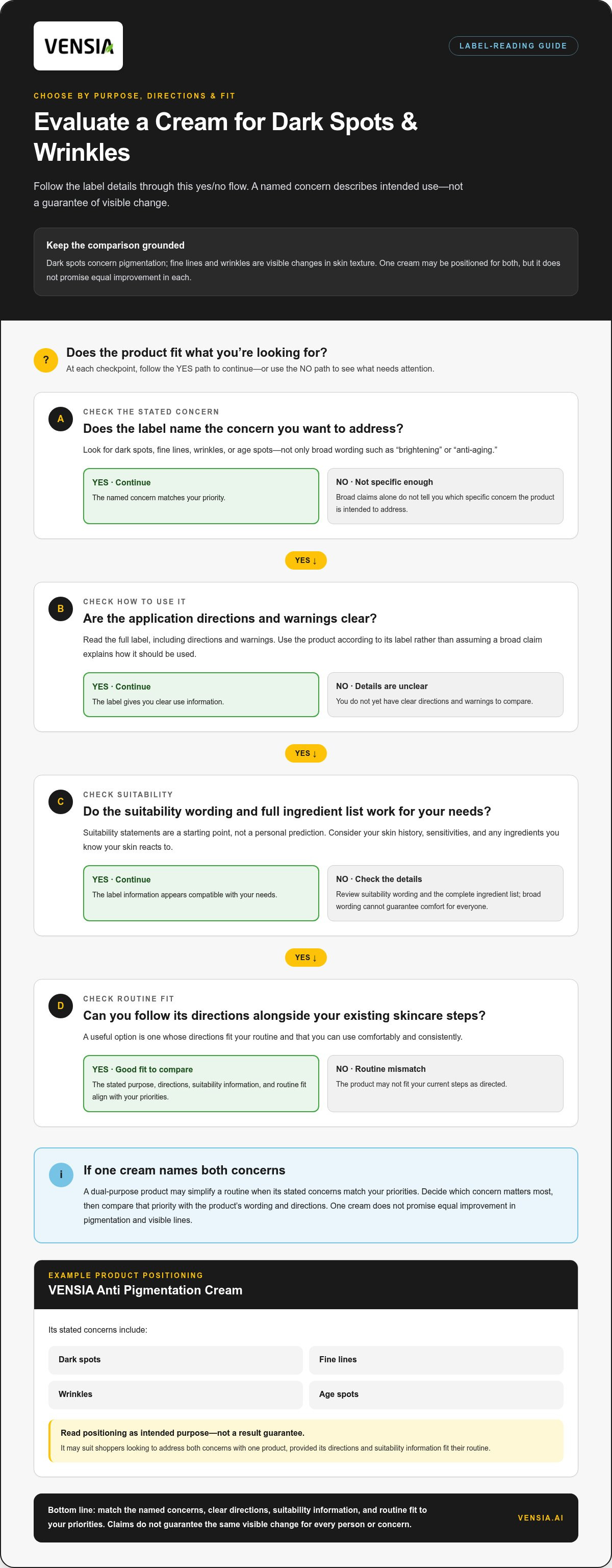
A useful comparison starts with the label, not the size of the promise. When choosing a cream for dark spots and wrinkles, look for clear information about which concerns the product names, how to use it, who it is intended for, and how it fits with products you already use. These details help you decide whether a cream matches your priorities without assuming a broad claim guarantees a particular result.
Use this checklist to compare options:
| What to check | What to look for |
|---|---|
| Stated concern | Does the label name dark spots, fine lines, wrinkles, or age spots? |
| Product directions | Are application instructions and warnings clear? |
| Skin compatibility | What does the label say about suitability, and does the full ingredient list work for your needs? |
| Routine fit | Can you follow the directions alongside your existing skincare steps? |
Which claims and label details deserve attention?
Read the full label, including directions, warnings, suitability wording, and the complete ingredient list. Check whether the product explicitly names your concern instead of relying only on broad terms such as “brightening” or “anti-aging.” Those phrases describe general positioning, not proof of a specific outcome. A named concern tells you what the product is intended to address, but not how much visible change you’ll see.
Suitability statements are a starting point, not an individual prediction. For example, a product described for all skin types cannot guarantee the same comfort or results for every person. Your skin history, sensitivities, other products, and consistency of use can all affect your experience. If you know your skin reacts to a particular ingredient, check the complete list rather than relying only on broad suitability wording.
Can one cream suit both concerns?
Yes, a dual-purpose product can simplify a routine if its stated concerns match what you want to address. But one cream does not promise equal improvement in pigmentation and visible lines. Decide which concern matters most, then compare that priority with the product’s wording and directions. For more context on pigmentation-focused care, explore this dermatological skincare guide for dark spots.
Quick checklist: Match the named concerns, clear directions, suitability information, and routine fit to your priorities. Don’t choose on broad claims alone.
VENSIA Anti Pigmentation Cream is one product to compare against these criteria. Its stated concerns include dark spots, fine lines, wrinkles, and age spots. Treat that positioning as a guide to the product’s intended purpose, not a guarantee of results.
Common Misconceptions About Dark-Spot and Wrinkle Creams
A product that names two concerns can sound like a complete solution, but a label doesn’t promise that both will improve equally. A cream may be positioned for dark spots and wrinkles while your experience differs by concern, skin, and how consistently you use it. Treat claims as information about a product’s intended purpose, not a forecast of your personal results.
It’s also a mistake to assume that a product described as suitable for all skin types will work comfortably for everyone. That wording doesn’t rule out individual sensitivity. Your skin may respond differently because of personal sensitivities, existing products, or other circumstances. Read the directions and warnings, and stop use if you experience an unexpected reaction.
Does a higher number of promised benefits mean better results?
No. A longer list of concerns doesn’t establish how effective a product will be for any one of them. Words such as “brightening” or “anti-aging” can describe broad product positioning, but they don’t explain the likely degree of visible change. Focus on practical details: which concerns the label names, how the product should be used, its suitability wording, warnings, and full ingredient list.
Then compare those details with your needs and tolerance. If uneven tone is your main priority, look for a clear statement about dark spots or pigmentation. If visible lines matter more, check whether fine lines or wrinkles are named. Dramatic language can’t replace clear directions or tell you how your skin will respond.
Why patience and sun protection still matter
Skincare changes aren’t always immediate, and there’s no fixed schedule that applies to everyone. Use a product as directed and consistently rather than applying more often in the hope of speeding up results. Changing several products at once can also make it harder to tell what your skin is responding to. Keep expectations measured, and reassess whether the product fits your routine and feels comfortable to use.
Daytime sun protection is a complementary step, not a guarantee that spots or lines will disappear. Broad-spectrum sunscreen helps protect skin from both UVA and UVB rays; follow its label for application and reapplication. Consistent sun protection can support a skincare routine, especially when uneven pigmentation is a concern.
For a practical way to think through product purpose and routine choices, explore this guide to targeted skincare for skin discoloration. Keep one principle in mind: product claims don’t diagnose the cause of a mark. If a spot changes, appears suddenly, hurts, or otherwise concerns you, seek assessment from a qualified health professional instead of relying on a cosmetic cream to identify or treat it.
How to Build a Simple Routine Around a Targeted Cream
A routine is easier to follow when each step has a clear role. If you’re adding a cream for dark spots and wrinkles, keep the surrounding care simple and let the product label guide when and how you apply it. Avoid introducing several new products at once. A steady, comfortable routine is more useful than a complicated one you can’t maintain.
Cleanse gently, apply products according to their labels, moisturize, and finish your daytime routine with sun protection. The exact order can vary with product texture and directions, so use this sequence as a practical framework, not a substitute for the label.
- Cleanse gently: Start with clean skin and avoid scrubbing, which can add unnecessary irritation.
- Apply the targeted cream: Follow its directions for where and how to apply it. Don’t use it more often or in a larger amount than instructed.
- Moisturize: Add a moisturizer as needed to keep your routine comfortable.
- Protect skin during the day: Use broad-spectrum sunscreen as directed. Sun protection complements a targeted cream and has a different role in your routine.
Where should a targeted cream fit?
Product order can depend on whether a formula is light or rich, as well as its directions. If you use other leave-on products, read their labels and avoid guessing about combinations or timing. Keep daytime sun protection in mind as a separate step: a targeted cream is used for its stated skincare purpose, while sunscreen helps protect exposed skin from UVA and UVB rays.
How to track tolerance and progress
Write down when you start the cream and note any other routine changes. This simple record can help you connect a reaction or change in comfort with a product, especially if you introduce only one new leave-on product at a time. Continue only as directed, and stop using it if irritation develops.
Look for gradual patterns rather than checking your skin repeatedly throughout the day. Occasional notes about comfort and appearance can be more useful than relying on memory. Don’t increase application to try to accelerate visible change. If irritation persists or a mark itself becomes concerning, seek advice from a qualified health professional.
For broader context on setting expectations for skincare, see this overview of cream expectations during the first 90 days. It concerns a different skin topic, so use it only as general perspective, not as a timeline or prediction for a dark-spot or wrinkle cream.
Keep your approach manageable: follow the label, make one change at a time, and monitor how your skin tolerates the routine. If a targeted option fits your needs, VENSIA Anti Pigmentation Cream is positioned for dark spots, fine lines, wrinkles, and age spots.
Choosing VENSIA Anti Pigmentation Cream for Both Concerns
If you want one product positioned for visible spots and signs of aging, VENSIA Anti Pigmentation Cream is a targeted option to consider. Its stated concerns are dark spots, fine lines, wrinkles, and age spots. The product is listed in a 30 g size and described as suitable for women, men, and all skin types.
That positioning can help you decide whether the product matches your priorities. It isn’t a promise that every concern will improve equally or that each person will see the same results. Treat the named concerns as a description of the product’s intended focus, then use the label and directions to decide whether it fits your routine.
Who may consider this targeted cream?
This option may suit someone looking for a single cream whose stated purpose includes both uneven-looking spots and visible lines or wrinkles. Before choosing, consider which concern you most want to address, whether you prefer a simpler routine, and whether the product’s directions work with your usual skincare habits. A dual-concern product may be convenient, but convenience alone doesn’t establish how your skin will respond.
The listing’s suitability wording is a general guide, not a prediction of your individual outcome. Skin can vary in sensitivity and response, even among people who fall under the same broad skin-type description. If a mark is changing, unexplained, painful, or otherwise concerning, seek assessment from a qualified health professional rather than treating it as an ordinary dark spot.
What to do before adding it to your routine
Read the current product directions and full label before use. Check how the cream is meant to be applied, review any warnings, and consider its instructions alongside the products already in your routine. When introducing it, make it the only new leave-on product for the time being. This makes it easier to notice how your skin tolerates the change.
Follow the stated directions rather than applying more or using it more often in pursuit of faster results. Keep your routine steady, and note when you start and any changes in comfort. If irritation develops, stop use. Continue daytime sun protection as part of your routine, and keep expectations measured: a product’s stated concerns don’t guarantee a particular degree or timing of visible change.
If its stated focus aligns with your priorities, Explore VENSIA Anti Pigmentation Cream. Review the label and choose a routine you can follow consistently.
Choose a Skincare Step You Can Sustain
Your next step doesn’t need to be a shelf full of products. Choose a cream for dark spots and wrinkles by how well its stated purpose fits your priorities and whether its directions work for your everyday routine. A thoughtful choice leaves room for realistic expectations: skincare is a gradual practice, not a promise of a particular result.
Decide what you want to focus on, follow the product label, and keep the rest of your routine steady while you assess how your skin responds. If a mark changes or causes concern, seek professional assessment rather than relying on a cosmetic product to explain it. These simple decisions can help make your routine more manageable and intentional.
Explore VENSIA Anti Pigmentation Cream if you’re looking for a targeted product positioned for dark spots, fine lines, wrinkles, and age spots. Review its label and directions, then choose a routine you can maintain.
Frequently Asked Questions
Is there a cream that works for both dark spots and wrinkles?
Yes, some products are positioned for both concerns, but that doesn’t mean every person will see the same effect on spots and lines. Compare the label with your main priority and check that the directions fit your routine. A cream for dark spots and wrinkles is a cosmetic option, not a way to identify why a mark appeared. Seek professional assessment for a changing or unexplained mark.
Can one cream remove dark spots and wrinkles completely?
No topical cream should be treated as a guaranteed way to remove every spot or wrinkle. A product may be designed to improve the appearance of named concerns, but outcomes can vary. Be cautious of language promising complete or immediate transformation. If you’re unsure whether a mark is an ordinary pigmentation concern, or it changes over time, have it assessed rather than relying on cosmetic skincare alone.
How long does a cream for dark spots and wrinkles take to work?
There isn’t one timeline that applies to every product or person. Your experience can depend on the concern, your skin, and whether you follow the directions consistently. Avoid using short-term promotional promises as a personal deadline. If you track changes, compare your skin under similar lighting and conditions, and note routine changes that could affect your observations.
What ingredients should I look for in a cream for dark spots and wrinkles?
Start with the complete ingredient list and the product’s stated purpose rather than searching for one ingredient that suits everyone. Check for ingredients you already know your skin doesn’t tolerate, and consider whether the directions fit alongside your other products. Ingredient names alone don’t guarantee a particular result. If you have persistent concerns or sensitive skin, ask a qualified professional for guidance that accounts for your situation.
Can I use a dark-spot and wrinkle cream every day?
Use it daily only if its specific label directs you to do so. Application frequency can differ, so don’t infer a schedule from the product category or apply extra in an attempt to accelerate results. If you notice irritation, stop using the cream. Keep sunscreen as a separate daytime step, following its own directions, rather than assuming a targeted cream provides sun protection.
Should I use a separate cream for dark spots and wrinkles?
Not necessarily. One product positioned for both concerns may suit someone who prefers a simpler routine, while a product with a narrower purpose may better match another person’s priority. Before layering separate creams, check each label for directions and warnings, and consider how your skin tolerates leave-on products. More steps don’t automatically mean better results, and combining products can make it harder to identify what caused a reaction.


