

Vitiligo Cream: What to Expect in the First 90 Days
Ninety days is a checkpoint, not a verdict. If you’re wondering what the vitiligo cream first 90 days may look like, visible repigmentation isn’t guaranteed within that time. Skin can look different under changing light or after sun exposure, so early results can be difficult to judge.
It’s understandable to hope for a clear sign that a cream is working, or to worry that no visible change means it has failed. This guide offers practical ways to set expectations, track skin changes consistently, and decide when to discuss your progress with a clinician. It also explains how skincare products differ from clinician-guided treatments. VENSIA Anti Vitiligo Cream is a skincare product to use according to its labeling, not a replacement for medical care.
We’ll treat the first three months as an observation period, with steps to compare changes safely and fairly. You’ll also see why prescription options, such as ruxolitinib cream for eligible patients, may require a longer assessment period. The goal is steady, informed evaluation, not a guaranteed deadline for results.
Key Takeaways
- Use the vitiligo cream first 90 days as a period to observe and document changes, not as a deadline for repigmentation.
- Build a reliable baseline with photos taken from a similar distance and in consistent lighting, and store them privately.
- At the 30- and 60-day checkpoints, review routine consistency and tolerability without treating an unchanged appearance as proof of success or failure.
- At day 90, compare your records carefully and consider what questions or concerns need medical attention.
- Understand the difference between skincare support, such as VENSIA Anti Vitiligo Cream, and clinician-guided medical treatment.
Vitiligo Cream: What the First 90 Days Can, and Cannot, Tell You
It’s understandable to look for a visible sign that a cream is making a difference. But changes in skin color aren’t guaranteed within a fixed three-month window. The vitiligo cream first 90 days are best treated as an observation period, not a promise of repigmentation.
Repigmentation means pigment returns to areas where it was lost. Whether or when this happens can vary. A change in appearance may also reflect lighting, sun exposure, or other everyday factors, so appearance alone can’t establish that a product is treating vitiligo.
Why vitiligo cream results vary from person to person
Vitiligo can affect different areas of the body, and individual responses to medical treatment aren’t identical. The condition’s causes, diagnosis, and classification are described in this overview of Vitiligo. Since people and affected areas differ, a single timeline can’t predict what one person will see. No visible change during the first three months doesn’t, by itself, prove that a treatment has failed. An apparent change doesn’t prove effectiveness either.
Why 90 days matters: It offers a practical point to review your routine and observations, but it cannot guarantee or rule out repigmentation.
What a skincare cream can and cannot establish
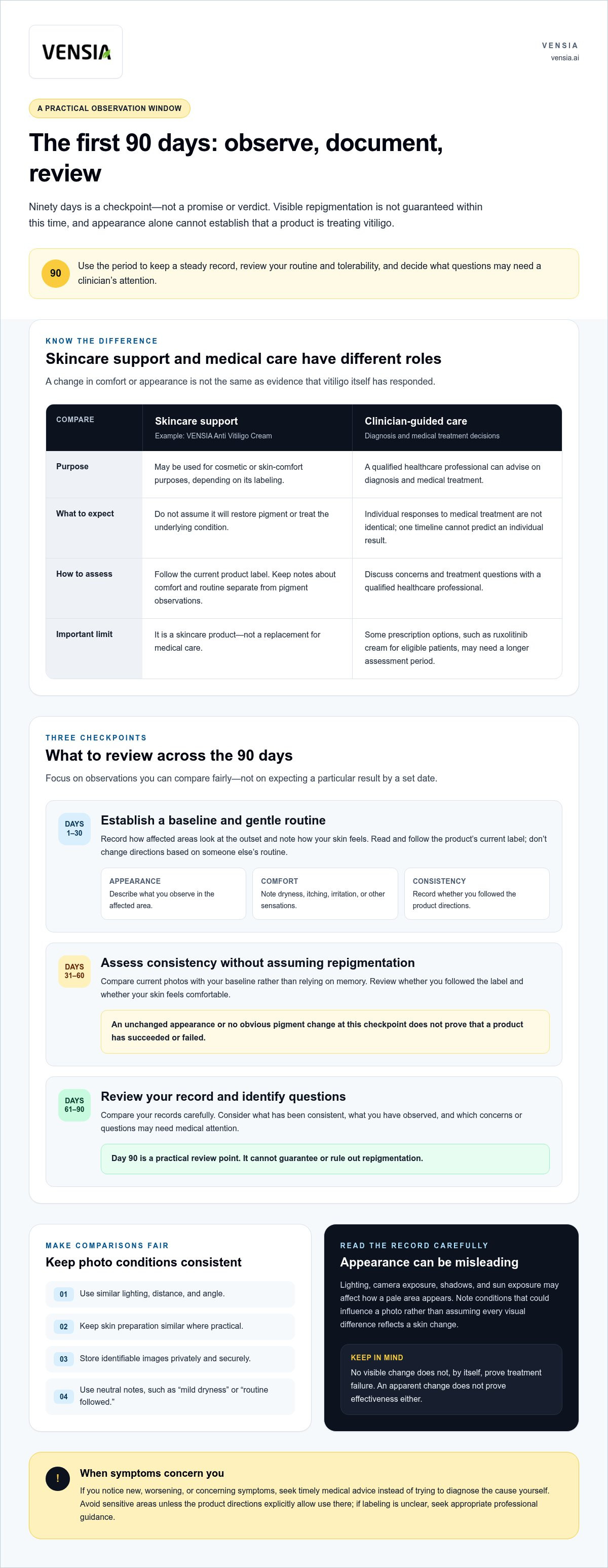
Skincare support and medical treatment have different purposes. A skincare cream may be used for cosmetic or skin-comfort purposes, depending on its labeling. Those purposes are not the same as restoring pigment or treating the underlying condition. A change in comfort or appearance doesn’t confirm that vitiligo itself has responded.
VENSIA Anti Vitiligo Cream is a skincare product. Use it according to its current label and evaluate it as part of your skincare routine, without assuming it will restore pigment or replace diagnosis and clinician-guided care. Speak with a qualified healthcare professional about diagnosis or medical treatment decisions.
For more context on assessing a product without assuming a disease-related outcome, read the VENSIA Anti Vitiligo Cream repigmentation guide. Separate what you can observe, such as comfort or appearance, from evidence that would be needed to establish a medical treatment effect. That distinction makes the first 90 days more useful and keeps expectations grounded.
Days 1-30: Establish a Gentle Routine and a Reliable Baseline
The first month is for setting a baseline and building a routine you can follow. Record how the affected areas look at the outset and note how your skin feels. If you’re evaluating the vitiligo cream first 90 days, keep observations about comfort and routine separate from changes in pigment. This makes your record more useful without turning each day into a test of whether a cream is working.
How to document skin changes consistently
Choose a photo schedule you can maintain, such as a baseline image followed by pictures at planned intervals. Daily checking can make small, ordinary variations feel more significant. For each photo, use similar lighting, distance, angle, and skin preparation where practical. Shadows or camera exposure can change how a pale area appears, so note those conditions rather than assuming every visual difference reflects a change in the skin.
Store images somewhere private and secure, especially if they show identifiable areas of your body. Add brief, neutral notes to each photo. For example, record “mild dryness” or “routine followed” rather than judging whether the area looks better or worse. Track these separately:
- Appearance: what you observe in the affected area.
- Comfort: dryness, itching, irritation, or other sensations.
- Consistency: whether you followed the product directions.
How to introduce a cream cautiously
Read and follow the product’s current label. Different creams may have different directions, so don’t add applications or change how you use a product based on someone else’s routine. Avoid sensitive areas unless the product directions explicitly allow use there. If the labeling is unclear, seek appropriate professional guidance rather than guessing.
Keep the rest of your routine steady where practical, so you can better notice how your skin responds. Don’t treat comfort, dryness, or a temporary appearance difference as proof of pigment restoration. For an overview of medical options, the American Academy of Dermatology explains that dermatologists have treatments for vitiligo. A skincare product and clinician-guided treatment have different roles. You can also read this vitiligo skincare routine guide for broader routine considerations.
Pay attention to how your skin feels. If you notice new, worsening, or concerning symptoms, seek timely medical advice rather than trying to diagnose the cause yourself. To explore skincare options, you can explore VENSIA skincare products and follow each product’s labeling.
Days 31-60: Assess Consistency Without Assuming Repigmentation
At the midpoint, shift your focus from “Can I see a difference?” to “What can I reliably record?” Review whether you’ve followed the product label and whether your skin feels comfortable. Days 31-60 are a checkpoint for consistency, tolerability, and questions, not a promised result. Stable appearance or no obvious pigment change at this stage doesn’t prove that a product has succeeded or failed.
Which changes are useful to record at the midpoint?
Compare your current photos with your baseline rather than relying on memory. Describe observations neutrally, such as whether an area appears unchanged or whether you notice a difference in its edges. Photos taken in different light can make skin tones look different, so treat visual impressions as observations, not evidence of cause.
Keep a brief record of:
- How consistently you followed the product’s directions.
- Any dryness, itching, irritation, or other discomfort, and when it occurred.
- Changes in lighting, sun exposure, or other skincare that might affect how the area looks or feels.
Don’t change several parts of your routine at once if you’re trying to understand what may be affecting your skin. If discomfort is new, worsening, or concerning, seek medical advice rather than guessing at its cause. Timelines and outcomes vary, and interpreting a response requires clinical context.
How to compare creams and other treatment approaches
Separate cosmetic skincare from medical treatment. A skincare product may be used for cosmetic or comfort purposes according to its labeling. That doesn’t establish that it treats vitiligo or restores pigment. Evaluate VENSIA Anti Vitiligo Cream as a skincare product and follow its label, without assuming a repigmentation effect. For general guidance on cosmetic care for uneven tone, see this dermatological skincare guide for dark spots.
Clinician-guided options have different purposes and are chosen in light of a person’s diagnosis and circumstances. In the United States, as of October 2026, ruxolitinib 1.5% cream is the only FDA-approved topical treatment specifically for repigmentation in nonsegmental vitiligo, for patients aged 12 and older. It’s a prescription treatment, and a response may take longer than this midpoint. The National Institute of Arthritis and Musculoskeletal and Skin Diseases provides an overview of treatments for vitiligo. A skincare product and a prescribed treatment shouldn’t be judged by the same expectations.
Use this midpoint to organize your notes and questions, not to make a definitive call from one photo or one week of change. Your record can help make a later review more grounded and support a more informed conversation about next steps.
Days 61-90: Review Your Record and Decide What Needs Attention
Day 90 is a useful moment to pause, review your notes, and decide what questions remain. It isn’t a universal endpoint for treatment. If you see no visible change, that alone doesn’t prove a cream has failed. The vitiligo cream first 90 days can help you understand your routine and document what you observe, but it can’t determine the cause of a change or predict an individual treatment outcome.
Compare your baseline with follow-up photos taken under similar conditions. If the lighting, angle, distance, or skin preparation differed, interpret the images cautiously. Consider missed applications and changes in sun exposure or other skincare, too. A single photograph or isolated patch isn’t enough to diagnose progress.
A practical 90-day review checklist
Bring your records together before deciding what to do next. Keep the review factual and separate what you noticed from what you think it means.
- Routine: How consistently did you follow the product label?
- Tolerability: Did you record dryness, irritation, or other discomfort?
- Appearance: What changed, if anything, in comparable photos? Note when images or routines weren’t consistent.
- Questions: Do you understand your diagnosis, treatment goals, and the realistic timeline for any clinician-guided treatment?
These notes can help you have a more focused discussion with a qualified healthcare professional. Ask how your diagnosis and any changes in the affected areas shape your options, and what signs or timeframe should guide a future review. Don’t start, stop, or change a medical treatment based solely on a short-term photo comparison.
When to seek medical guidance sooner
You don’t need to wait until day 90 if you experience irritation, an unexpected reaction, or a rapidly changing skin concern. A healthcare professional can assess what’s happening, clarify the diagnosis, and discuss appropriate treatment choices. Cosmetic skincare can be part of a personal routine, but it shouldn’t be relied on to diagnose vitiligo or manage its progression.
Keep expectations clear when reviewing a skincare product: VENSIA Anti Vitiligo Cream is a skincare product, and repigmentation shouldn’t be assumed. If you’re considering it for skincare support, explore VENSIA Anti Vitiligo Cream and use it according to its current labeling. Base medical decisions on professional guidance, not a deadline or a single visual comparison.
Choosing Your Next Step: Skincare Support, Medical Care, or Both
After reviewing your notes from the vitiligo cream first 90 days, decide what you need the product to do. Skincare products and medical treatments have different purposes. You may use skincare as part of your routine while also seeking medical care, but cosmetic products shouldn’t replace diagnosis or clinician-guided treatment for vitiligo.
| Option | Purpose | Who guides the choice |
|---|---|---|
| Skincare product | Supports a cosmetic or skin-comfort routine, according to its labeling. It shouldn’t be assumed to restore pigment or treat vitiligo. | You, by reviewing the product label and considering comfort and tolerability. |
| Medical treatment | Addresses vitiligo through a treatment plan informed by diagnosis and individual circumstances. | A qualified healthcare professional. |
| Both | Combines a skincare routine with clinician-guided care, while keeping their purposes distinct. | You and your healthcare professional, with product use following its label. |
Questions to consider when evaluating a vitiligo cream
Before adding a cream to your routine, read its ingredient list, directions, warnings, and stated skincare purpose. Check that the directions fit a routine you can follow, and pay attention to how your skin tolerates the product. If irritation or discomfort occurs, follow the label’s warnings and seek appropriate medical advice when needed.
Keep claims in perspective. Marketing language isn’t proof of clinical repigmentation, and a change in comfort or appearance doesn’t establish that vitiligo has responded. Focus on what you can assess: whether the routine feels manageable, whether you can follow the directions, and whether your skin remains comfortable.
How VENSIA fits into a considered skincare routine
VENSIA Anti Vitiligo Cream is a skincare product to use according to its current labeling and evaluate based on your experience with it. Follow the directions and warnings on the product, and keep expectations aligned with its stated purpose. Seek professional guidance for questions about diagnosis, skin changes, or medical treatment options.
Choose the next step that matches your needs: skincare support, a conversation with a healthcare professional, or both. To review VENSIA Anti Vitiligo Cream as a skincare option, Explore VENSIA Anti Vitiligo Cream.
Make Your Next Step a Well-Informed One
The vitiligo cream first 90 days are best used to build a consistent routine, record skin changes under comparable conditions, and review what you’ve observed. Visible repigmentation isn’t guaranteed in that window, and no change doesn’t automatically mean a treatment has failed. Photos and notes can help you recognize patterns, but they can’t replace professional assessment.
Keep skincare and medical care in their proper roles. Evaluate a skincare product by its label, intended purpose, and how your skin tolerates it. For questions about diagnosis, changes in your skin, or treatment choices, speak with a qualified healthcare professional. VENSIA Anti Vitiligo Cream is a skincare product, not a promise of pigment restoration.
If you’d like to review the product details as part of a considered skincare routine, explore VENSIA Anti Vitiligo Cream. Take your time, keep useful records, and move forward with clear expectations. Explore VENSIA Anti Vitiligo Cream as part of your skincare routine.
Frequently Asked Questions
How long does vitiligo cream take to show results?
There isn’t one timeline for every cream or every person. Outcomes depend on the type of product, whether it’s a clinician-guided treatment, and individual factors such as affected areas. Some prescription treatments may require months of use before their response can be assessed. Review treatment directions with your healthcare professional, and don’t assume a cosmetic skincare product has a repigmentation effect.
What should I expect during the first 30 days of using vitiligo cream?
Use the first month to establish a baseline, follow the product label, and notice how your skin feels. Record dryness, itching, irritation, or other discomfort separately from changes in appearance. If you take photos, use similar lighting, distance, and angle. The first 30 days don’t guarantee visible pigment changes. If a reaction is concerning or worsening, seek medical advice instead of trying to diagnose the cause yourself.
Can vitiligo cream repigment skin within 90 days?
Some people may notice changes within three months while using a medical treatment, but repigmentation isn’t guaranteed in that period. The response depends on the treatment and individual circumstances, and visible changes can be difficult to assess from photos alone. The phrase vitiligo cream first 90 days describes an observation window, not a promised deadline. Don’t assume a skincare cream restores pigment.
What if I see no change after 90 days of using a vitiligo cream?
No visible change at 90 days doesn’t, by itself, prove that a treatment has failed. Review how consistently you followed its directions and whether your comparison photos used similar lighting and angles. If the cream is part of a medical treatment plan, discuss your observations and next steps with the healthcare professional guiding your care. Don’t change or stop prescribed treatment solely because of one photo or a short-term assessment.
Is a skincare cream the same as a medical treatment for vitiligo?
No. A skincare product may support a cosmetic or skin-comfort routine according to its label, but that doesn’t establish that it treats vitiligo or restores pigment. Medical treatments are selected in the context of a diagnosis and a person’s health needs, with guidance from a qualified healthcare professional. VENSIA Anti Vitiligo Cream is a skincare product; its name alone doesn’t establish a clinical repigmentation effect.
How can I track changes in vitiligo patches over time?
Take occasional photos on a consistent schedule rather than checking repeatedly each day. Keep the distance, angle, lighting, and skin preparation as similar as practical, and store images privately. Add neutral notes about appearance, comfort, and how consistently you followed product directions. Record factors such as different sun exposure or other skincare. Compare a series of images, not a single photo, and avoid interpreting visual differences as proof of treatment response.
When should I ask a healthcare professional about vitiligo treatment?
Seek professional advice if you need a diagnosis, notice rapidly changing skin concerns, experience an unexpected or worsening reaction, or want to understand treatment options. A qualified healthcare professional can assess your situation and discuss realistic goals and timelines. You don’t have to wait until day 90 to ask questions. Cosmetic skincare alone shouldn’t be relied on to diagnose vitiligo or manage its progression.


