

Dermatological Skincare for Dark Spots: A 2026 Guide
What if the first step toward fading a dark spot isn’t adding another active, but understanding why it appeared? Sun exposure, acne-related inflammation, and hormonal changes can all leave visible pigmentation, yet similar-looking marks may have different causes. It’s understandable to feel unsure which ingredients to use, how to combine them, or whether a routine might irritate your skin. Dermatological skincare for dark spots works best when it takes the likely pigment pattern into account and includes protection against further darkening.
This 2026 guide explains common patterns of pigmentation and how to build a simple, careful routine. You’ll learn why daily broad-spectrum sunscreen of at least SPF 30 is a foundation of dark-spot care, how to introduce targeted skincare without overwhelming your skin, and why consistency matters more than chasing fast results. You’ll also learn when a spot that changes or looks unusual should be assessed by a healthcare professional. With a clear plan, you can care for uneven-looking skin tone with patience and confidence.
Key Takeaways
- Learn how common pigment patterns may relate to sun exposure, acne-related inflammation, and other causes, without treating appearance alone as a diagnosis.
- See how dermatological skincare for dark spots can combine sun protection, moisturization, and targeted products, with different considerations for each.
- Build a straightforward morning and evening routine, introducing one new targeted product at a time so you can notice how your skin responds.
- Set realistic expectations: consistent care may support a more even-looking tone, but results vary and skincare cannot address every cause of pigmentation.
- Know which changes deserve professional assessment and where targeted skincare such as VENSIA Anti Pigmentation Cream may fit into a routine.
What dark spots can dermatological skincare address?
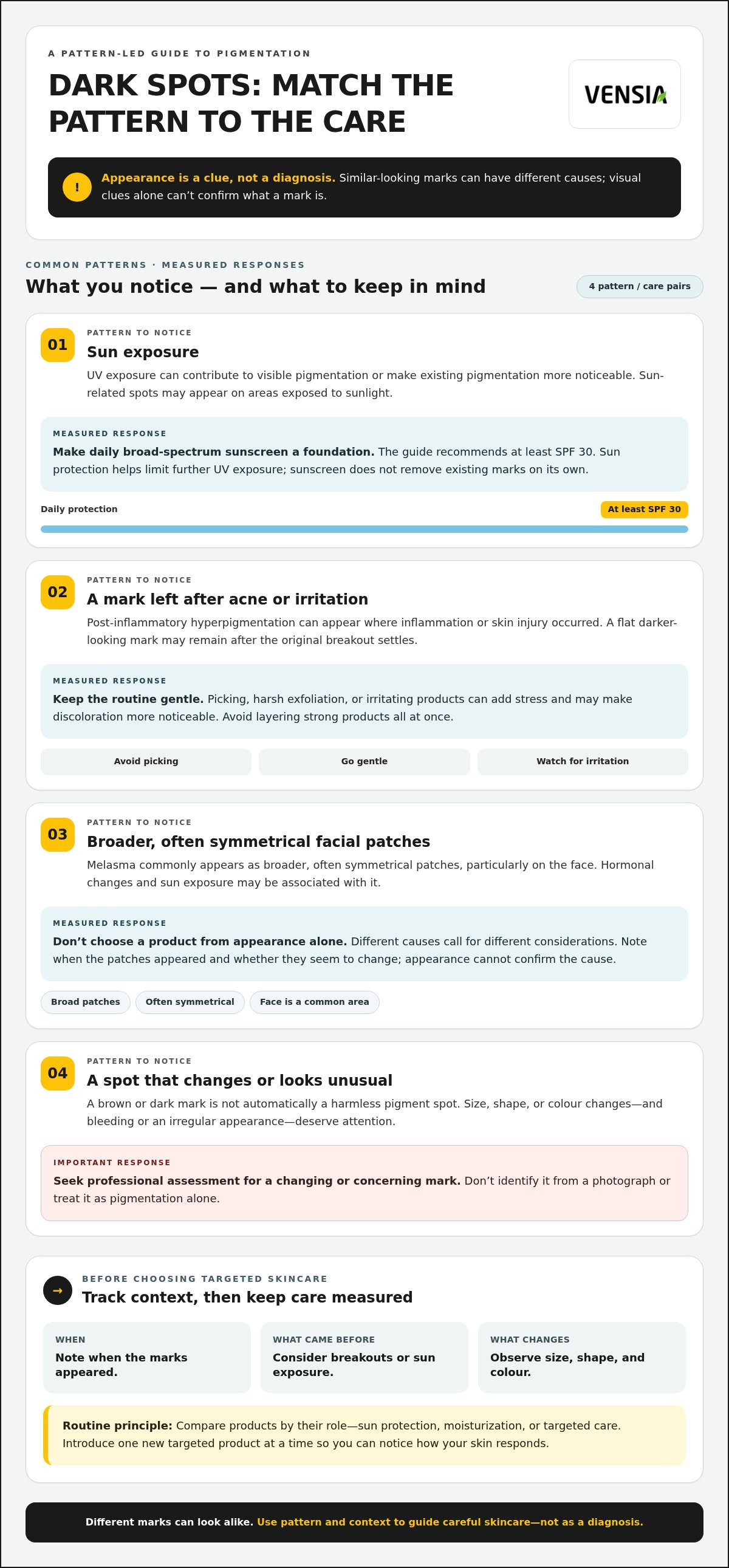
Hyperpigmentation describes areas of skin that appear darker than the surrounding skin. It can follow sun exposure, acne-related inflammation, hormonal changes, or other triggers. The term describes a visible pattern, not its cause. A brown mark isn’t automatically a harmless pigment spot, and appearance alone can’t establish what it is.
A dark spot is a distinct area of darker-looking skin; uneven tone is a broader variation in colour across an area. A spot may stand out on its own, while uneven tone can look more diffuse. For a foundational overview of what dark spots are, see the general classifications and causes of hyperpigmentation.
How do dark spots differ from melasma and post-acne marks?
Melasma commonly appears as broader, often symmetrical patches, particularly on the face, and may be associated with hormonal changes and sun exposure. Post-inflammatory hyperpigmentation (PIH) can develop where inflammation or skin injury has occurred, including after acne. It may look like a flat mark left behind as the original irritation settles. Sun-related spots are another possible pattern, often found on areas exposed to sunlight.
These are general descriptions, not diagnostic tests. Different conditions can look similar, and not every brown, dark, or changing mark is pigmentation. Visual clues alone can’t confirm a cause.
Why identifying the pattern matters before choosing skincare
Different causes call for different considerations. A product intended to improve the look of uneven tone may not address the trigger behind a mark, and irritation from an unsuitable routine can add to visible discoloration. Before choosing an approach, note when the marks appeared, whether they followed breakouts or sun exposure, and whether their size, shape, or colour is changing. This helps you describe what you’re seeing and keep your skincare choices measured.
That context makes dermatological skincare for dark spots more focused than relying on a one-size-fits-all active. If a mark is changing or concerning, don’t assume it’s ordinary pigmentation; seek professional assessment. For an overview of product categories and how they compare, read the pigmentation removal cream comparison guide.
How dark spots form: melanin, inflammation, and sun exposure
Melanin is the pigment that contributes to skin colour. Melanocytes, located in the skin, produce it. If pigment production or distribution changes in an area, that skin may look darker than the surrounding tone. Several triggers can contribute, but no single process explains every mark. Both the skin’s response and the underlying cause matter.
UV exposure can prompt pigment-related responses, making areas of skin look darker or causing existing pigmentation to become more noticeable. Continued exposure may work against efforts to improve uneven tone. Daily broad-spectrum sun protection is therefore a foundation of dermatological skincare for dark spots. Sunscreen helps limit further UV-related effects, but it doesn’t remove existing marks on its own. The American Academy of Dermatology outlines practical dermatological skincare approaches, including considerations for different skin tones.
What role do UV rays and melanin play?
UV light can stimulate melanocytes and increase pigment activity. The visible result varies: some people notice a more diffuse change in tone, while others see distinct spots. Sun exposure is only one possible contributor, so a mark’s appearance or location can’t identify its cause with certainty. Consistent sun protection helps reduce repeated exposure, but it doesn’t replace assessment when a mark is unusual or changing.
Why can acne or irritation leave a dark mark?
Inflammation can influence pigment activity. After acne, for example, the original inflammation may settle while a darker-looking mark remains. In post-inflammatory hyperpigmentation, the skin’s response to inflammation can alter melanin production or distribution, leaving visible colour change after the breakout itself has improved.
Picking at spots, harsh exfoliation, or products that irritate the skin can prolong inflammation or create additional irritation, potentially making discoloration more noticeable. A gentler routine can help avoid adding stress while the skin recovers. If a mark persists, changes, bleeds, or has an irregular appearance, don’t identify it from a photograph or treat it as pigmentation alone. Seek professional assessment for concerning marks.
Understanding these possible pathways can help you choose a measured routine instead of layering strong products at once. If you’re exploring targeted skincare for dark spots and uneven-looking tone, VENSIA skincare includes products for these concerns.
Which dermatological skincare approaches are worth comparing?
Compare products by their role in your routine, not just by their most prominent ingredient. Sun protection helps limit ongoing exposure, moisturization supports comfort, and targeted products are intended to address uneven-looking tone. No single category or active is right for every person or every cause of pigmentation.
| Category | General purpose | Tolerance considerations | Evidence caveats |
|---|---|---|---|
| Broad-spectrum sunscreen | Helps protect skin from ongoing UV exposure that can contribute to visible pigmentation. | Choose a formula you can use consistently; discontinue if it causes persistent irritation. | Protection can help reduce further exposure, but sunscreen alone doesn’t remove existing spots. |
| Moisturizer | Helps maintain skin comfort and supports a routine that’s easier to follow. | Consider texture and any sensitivity to the formula. | Moisturization supports routine comfort; it isn’t itself a guaranteed spot-fading approach. |
| Targeted ingredients | Categories such as vitamin C, niacinamide, retinoids, and exfoliating acids may be used in products for uneven-looking tone. | Some formulas may irritate, especially if introduced together or used too frequently. Start cautiously and follow product directions. | Evidence and suitability vary by ingredient, formulation, concern, and individual. Ingredient names alone don’t prove a finished product’s results. |
How should readers compare brightening ingredients?
Look beyond the ingredient name. Formulation, frequency of use, the rest of your routine, and personal tolerance can all affect whether a product is suitable. The American Academy of Dermatology summarizes dermatologist recommendations for hyperpigmentation. Ingredient or medical claims should be supported by appropriate evidence, and general information about an ingredient isn’t proof of a particular brand’s results. Check the product’s ingredient list and directions rather than assuming it contains a familiar active.
When is a targeted cream different from a full routine?
A targeted cream is one part of care, not a substitute for gentle cleansing, moisturization, and sun protection. Keep the routine manageable. Adding several strong actives at once can make it harder to identify what’s irritating your skin, so introduce one new targeted product at a time and pay attention to how your skin responds.
For focused product guidance, explore the anti-pigmentation cream guide for all skin types. VENSIA Anti Pigmentation Cream is a skincare option for dark spots and uneven-looking tone, not a medical treatment or a guaranteed result. Use it as part of a careful, consistent routine for dermatological skincare for dark spots.
How to build a careful routine for dark spots
A steady routine is easier to assess and maintain than a crowded shelf of active products. For dermatological skincare for dark spots, begin with the basics, protect skin from further sun exposure, and add targeted care cautiously. The framework below is general guidance, not a personalized treatment plan.
What can a simple morning and evening routine include?
Keep each routine focused. In the morning, cleanse gently if needed, moisturize, then apply broad-spectrum sunscreen with at least SPF 30. In the evening, cleanse and moisturize, adding a targeted product only if it suits your skin and its label directions. Product order can vary, so follow the instructions.
- Morning: Gentle cleansing as needed, moisturizer, and broad-spectrum sunscreen.
- Evening: Cleanser, moisturizer, and a suitable targeted product used according to its label.
- As you begin: Introduce one new targeted product at a time. Avoid starting several potentially irritating actives together.
How can readers reduce irritation and protect progress?
Read the full product label and introduce a new product gradually, using it only as directed. Consider patch testing on a small area first. This can help you notice a reaction, but it can’t guarantee that irritation won’t occur elsewhere or later. Avoid applying multiple new products at once, so it’s easier to identify what your skin may not tolerate.
If you develop significant irritation, stop using the product. If discomfort persists or you’re unsure what to do next, seek professional guidance. Don’t try to push through a reaction by adding more active products, since further irritation may make a careful routine harder to maintain. For additional safety-focused steps, see this dark-spot removal guide.
Patience matters. Visible changes can take time, and results differ based on the cause of the mark, the product, and individual skin response. A routine may help support a more even-looking tone, but it can’t guarantee that every spot will fade or address every cause. Keep sun protection consistent and review your routine if your skin becomes uncomfortable or a mark changes.
If you’re looking for targeted skincare to complement the basics, VENSIA Anti Pigmentation Cream is an option for dark spots and uneven-looking tone. Use it as directed, alongside sun protection and a manageable routine, rather than as a guaranteed or medical treatment.
When to seek advice and where VENSIA skincare fits
Skincare can support the appearance of uneven tone, but it can’t identify what caused a mark. Some marks need professional assessment rather than another product. Notice whether a spot is new, changing, or showing features that seem unusual for your skin.
Which changes should not be treated as a routine skincare concern?
Seek professional evaluation if a mark changes in size, shape, colour, or border, bleeds, feels different, or otherwise concerns you. Don’t assume a new or changing mark is ordinary pigmentation, even if it looks similar to other spots. Photos can help you keep track of changes, but they can’t confirm a diagnosis. Don’t use a topical product as a substitute for assessment of a concerning mark.
These signs aren’t a diagnosis. They’re reasons to get a qualified assessment instead of relying on skincare alone. If a mark is persistent or you’re uncertain about its appearance, professional guidance can help clarify what kind of care may be appropriate.
How can VENSIA fit into a realistic dark-spot routine?
Once a mark is understood to be an appropriate skincare concern, a targeted product may be one part of a simple routine. VENSIA Anti Pigmentation Cream is a skincare option for dark spots and uneven-looking tone. It isn’t a medical treatment, and results aren’t guaranteed. Use it according to its product label, and keep daily sun protection in your routine to help limit further sun-related darkening.
With dermatological skincare for dark spots, consistency and a manageable routine matter more than layering multiple products or expecting an overnight change. Individual responses vary, and topical skincare can’t address every cause of a dark mark. If a spot changes or becomes concerning, pause the routine and seek professional assessment rather than trying additional products.
If you’re exploring targeted skincare for uneven-looking tone, explore VENSIA skincare as one option within a careful routine. For a closer look at the cream, discover VENSIA Anti Pigmentation Cream.
Build a Steady, Skin-Conscious Plan
Dark spots can have different causes, from sun exposure to marks left after inflammation, so understanding the pattern is a better starting point than reaching for the strongest active. A simple routine built around sun protection and moisturizer can support skin comfort, while a targeted product may complement those basics. Introduce new skincare gradually, follow label directions, and give your skin time to respond.
Keep expectations realistic: visible changes vary by person and cause, and topical skincare can’t address every mark. If a spot is new, changing, bleeding, irregular, or otherwise concerning, seek professional assessment rather than relying on a skincare routine to identify it.
Effective dermatological skincare for dark spots is thoughtful and consistent, not rushed. VENSIA offers targeted anti-pigmentation cream for dark spots and uneven-looking skin tone. Explore it as one skincare option alongside daily sun protection and patience: Explore VENSIA skincare.
Frequently Asked Questions
Can dermatological skincare fade dark spots?
Some skincare products may help improve the appearance of certain kinds of dark spots, but results depend on the cause, product, and individual skin response. Sun protection can help limit further darkening, while targeted products may complement a simple routine. Skincare can’t diagnose a mark or address every cause of pigmentation. If a spot is new, changing, or unusual, seek professional assessment rather than relying on a fading product.
How long can skincare take to improve the appearance of dark spots?
Visible changes can take time, and there’s no single timeline that applies to everyone. The cause and depth of pigmentation, product formulation, consistency, and how your skin tolerates a routine can all affect what you notice. Follow product directions and maintain sun protection, but avoid expecting a quick or guaranteed result. If a mark persists or changes, seek professional advice instead of simply adding more active products.
What is the difference between melasma and post-inflammatory hyperpigmentation?
Melasma often appears as broader patches, commonly on the face, while post-inflammatory hyperpigmentation (PIH) can leave a darker-looking mark where inflammation or injury, such as acne, occurred. These descriptions are general patterns, not a way to diagnose yourself. Different concerns can look alike, and a mark’s appearance alone can’t confirm its cause. If you’re unsure what you’re seeing, or it’s changing, seek professional evaluation before choosing targeted skincare.
Is sunscreen necessary when using a dark-spot cream?
Yes. Daily broad-spectrum sunscreen of at least SPF 30 helps protect against UV exposure that can contribute to pigmentation or make existing spots look darker. Apply it as directed and use it consistently, including while using a dark-spot cream. Sunscreen helps limit further exposure, but it doesn’t remove existing spots by itself. Sun exposure without protection may work against efforts to improve the appearance of uneven tone.
Can I use multiple dark-spot ingredients at the same time?
It’s more cautious to introduce one new targeted product at a time rather than starting several active ingredients together. Ingredients such as retinoids or exfoliating acids may irritate some people, and layering products can make it harder to identify what caused a reaction. Follow each product’s label, observe how your skin responds, and don’t increase use beyond the directions. Seek professional guidance if you’re unsure how products fit with other treatments.
What should I do if a dark spot changes or becomes irritated?
If a spot changes in size, shape, colour, or border, bleeds, or otherwise concerns you, seek professional assessment rather than treating it as routine pigmentation. Don’t rely on a photograph or skincare product to diagnose it. If a product causes significant irritation, stop using it. If irritation persists or you’re uncertain about the mark, seek professional guidance before restarting or adding other targeted products.
Is VENSIA Anti Pigmentation Cream suitable for all skin types?
VENSIA describes its skincare range, including its anti-pigmentation cream, as designed for all skin types. That doesn’t mean every person will respond in the same way or that irritation is impossible. Read and follow the product label, and consider patch testing before adding it to your routine. Use it as a skincare option for dark spots and uneven-looking tone, not as a medical treatment or a guaranteed result.


