

Herbal cream for vitiligo: choosing ingredients and using them safely
A herbal cream for vitiligo may fit into a skin-care routine, but herbal treatments alone rarely match standard medical therapies. There is no cure for vitiligo, although treatment can improve symptoms and slow its progression.
It’s understandable to look for a plant-based option, especially when caring for sensitive, depigmented skin. But “natural” doesn’t automatically mean effective or irritation-free, and ingredients that reduce pigmentation may conflict with repigmentation goals.
This guide explains what evidence says about herbal creams and natural approaches, which ingredients call for caution, and how to think about safe application. You’ll also learn why the complete ingredient list matters and when to treat a topical cream as supportive skin care, not a replacement for prescribed treatment.
Key Takeaways
- Review the full ingredient list: some botanicals, including licorice and kojic acid, may inhibit melanin production and conflict with repigmentation goals.
- Consider safety beyond the skin: ginkgo can interact with blood-thinning medicines, while some herbal ingredients have been linked to liver concerns.
- Use topical products according to their directions, and pay attention to how often you apply them and how much skin you cover.
- Separate evidence from promises: small studies of natural approaches don’t establish a cure or show that herbal treatments replace standard care.
- Assess U.S. regulatory claims carefully, and understand what VENSIA Anti Vitiligo Cream offers before deciding whether it fits your skin-care routine.
1. Serious side effects and safety warnings
“Herbal” describes an ingredient’s origin, not its safety. A cream or supplement can still cause unwanted effects, interact with medicine, or irritate skin. Before applying a herbal cream for vitiligo, read its complete ingredient list, including botanical names such as Psoralea corylifolia, also called Bakuchi. Topical products and oral supplements carry different risks, so evidence about one does not automatically apply to the other.
Some concerns relate specifically to supplements. Ginkgo biloba can affect platelet activity, and combining it with anticoagulant medicine may lead to hemorrhaging. People taking anticoagulant or antiplatelet drugs, or preparing for surgery, should not add ginkgo casually. Long-term use of Bakuchi has been associated with clinically significant liver injury in case reports. High-dose green tea extract capsules have also rarely been linked to liver injury in susceptible people.
Other examples depend on personal health history. Oral khellin used with UVA exposure has been associated with elevated liver enzymes in some patients. People with vitiligo and autoimmune thyroiditis should carefully monitor seaweed supplements because some patients are extremely sensitive to iodine. These examples concern supplements or oral treatment, not evidence that every topical botanical carries the same risks.
How do herbal options compare with prescription vitiligo treatments? Herbal monotherapy rarely matches the effectiveness of standard medical therapies. A herbal cream for vitiligo may be a skin-care choice, but it should not replace a prescribed plan without professional guidance.
How much do these creams cost in the United States? There is no standard price for every product. Brand, ingredients, formulation, and package size affect the cost, so compare the full ingredient list and quantity rather than treating price as evidence of effectiveness.
Can a topical herbal product cause photosensitivity or worsen vitiligo? Some ingredients may irritate skin or affect melanin production, which can conflict with a repigmentation goal. If burning, swelling, or a rash develops, stop applying the product and note where the symptoms appeared.
Should I consult a dermatologist before using a herbal cream for vitiligo? Yes, particularly if you take anticoagulant or antiplatelet medicine, have autoimmune thyroiditis, or use other vitiligo treatments. Share the cream’s ingredient list and your supplement routine so potential interactions and skin sensitivities can be considered alongside your existing care.
2. Application frequency and body-surface-area limit
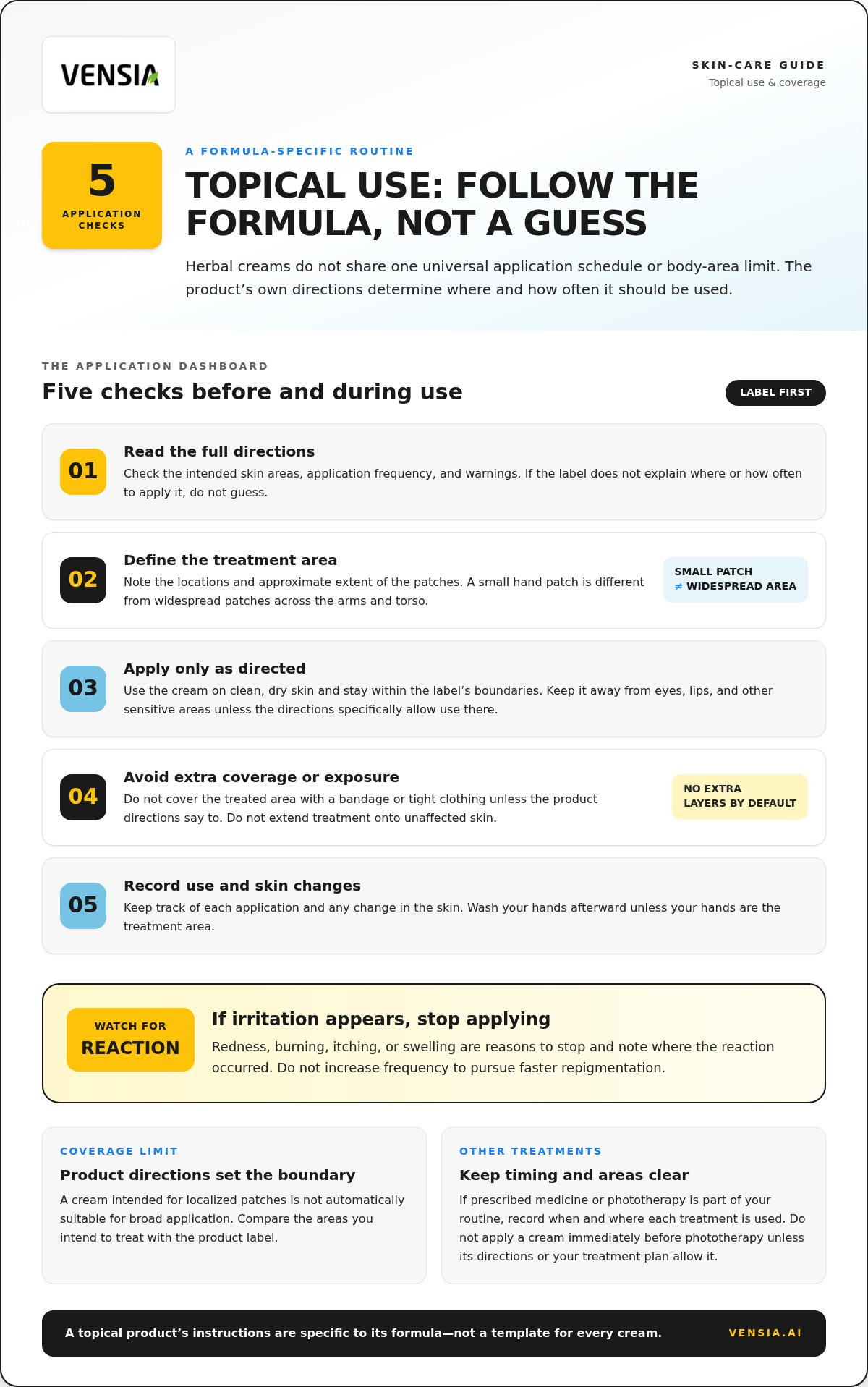
There is no single application schedule or body-surface-area limit for every herbal cream. Directions depend on the formula, its ingredients, and the area it is designed to cover. Follow the product label rather than borrowing instructions from another cream or increasing use to pursue faster repigmentation. If the label does not explain where or how often to apply the cream, do not guess.
Start by identifying the treatment area. A small patch on the hand, for example, differs from widespread patches across the arms and torso. Note the locations and approximate extent before applying anything. That record helps you follow the same boundaries each time and notice whether irritation appears beyond the treated skin.
Use a simple application routine:
- Read the label for the intended skin areas, frequency, and warnings.
- Apply only to clean, dry skin within the directions.
- Keep the cream away from eyes, lips, and other sensitive areas unless the label specifically allows use there.
- Wash your hands after application, unless your hands are the treatment area.
- Record each application and any change in the skin.
Do not cover a treated area with a bandage or tight clothing unless the product directions say to. Covering skin can change how a topical product sits against it, while extra layers can increase exposure without establishing better results. If redness, burning, itching, or swelling develops, stop applying the cream and note where the reaction occurred.
Body-surface-area limits matter because a cream intended for localized patches is not automatically suitable for broad application. The relevant limit comes from the product directions and ingredients, not a universal rule for all botanicals. If vitiligo affects several body regions, map the intended areas and compare them with the label before use. Do not extend treatment to unaffected skin just to simplify the routine.
Coordinate topical use with other care. If prescribed medicine or phototherapy is part of your routine, keep a clear record of when and where each treatment is used. Do not apply a cream immediately before phototherapy unless its directions or your treatment plan allow that timing. This makes it easier to distinguish a skin reaction from changes associated with the other treatment.
For any topical product, including skin-care product information, use the directions for that specific formula. A cream marketed for pigmentation concerns isn’t automatically intended for vitiligo patches or broad-body use. Keep its label accessible, follow its stated application boundaries, and avoid changing frequency or coverage based on another person’s routine.
3. Herbs and skincare ingredients that may inhibit pigmentation
Ingredient choice matters when the goal is repigmentation. Tyrosinase helps drive melanin production, so ingredients that inhibit this enzyme may work against that aim. A product marketed for dark spots or even skin tone may therefore suit a different pigmentation concern than vitiligo. The stated purpose on a label does not establish whether its ingredients support repigmentation in affected areas.
Bacopa monnieri is one ingredient to recognize by name. It can inhibit tyrosinase and suppress melanin production, which may conflict with efforts to restore pigment. This does not mean every product containing Bacopa will affect everyone in the same way. It does make the ingredient worth discussing before adding it to a vitiligo skin-care routine.
Licorice extracts and glabridin also inhibit tyrosinase. They are often used in products for pigmentation concerns, but that purpose can differ from supporting repigmentation. Check the ingredient list for both “licorice” and “glabridin”; a product’s front label may emphasize brightening or a more even tone without clarifying the ingredient’s mechanism.
Other ingredients identified as potential conflicts include kojic acid, aloesin, and paper mulberry extracts. These may inhibit melanin synthesis. Their presence does not prove that a cream will worsen vitiligo, but it raises a practical question: is the formula designed to reduce pigment or support its return? These are different skin-care goals.
Use this label-reading process before applying a new topical product:
- Read the full ingredient list, not only the product name or front-label claims.
- Look for Bacopa monnieri, licorice extracts, glabridin, kojic acid, aloesin, and paper mulberry.
- Note whether the product is promoted for brightening, dark spots, or reducing pigmentation.
- Compare that purpose with your goal for the affected skin, such as supporting repigmentation.
- Share the ingredient list with the clinician managing your vitiligo treatment.
A product can suit one concern and be poorly matched to another. For example, a cream designed to reduce dark spots may contain ingredients that inhibit melanin, while vitiligo care may focus on restoring pigment. These terms describe different goals, not a diagnosis or proof that an ingredient will change the course of the disease.
Keep the names handy when comparing formulas. If an ingredient’s role is unclear, pause before applying it broadly, especially alongside other topical medicine. Matching a formula’s purpose to your treatment goal helps avoid choosing a pigmentation-reducing product when repigmentation is the priority.
5. Natural approaches and vitiligo cure questions
There’s no cure for vitiligo, but treatment can improve symptoms and slow disease progression. Natural approaches may interest people seeking gentle support, yet herbal monotherapy rarely matches standard medical therapies. That distinction helps set realistic goals: a botanical cream or supplement shouldn’t be treated as a replacement for a prescribed plan.
What treatments for vitiligo are recommended by dermatologists? Dermatologists may recommend standard medical therapies based on a person’s vitiligo and treatment plan, including prescribed topical medicine or phototherapy. The choice depends on factors such as the affected areas and whether patches are stable or changing.
Evidence for natural options varies. A small study reported repigmentation in 86% of people with stable vitiligo after 3 months of topical aloe vera treatment. That finding concerns a small study group and stable patches; it doesn’t establish aloe as a cure or show that every aloe product produces the same result.
Ginkgo biloba has also been studied as a supplement. A pilot clinical trial associated standardized ginkgo, taken at 60 mg twice a day for 12 weeks, with significant improvement in vitiligo severity and area. A cited review suggests 120 milligrams daily for several months is typically safe for vitiligo. These are different reported regimens, not instructions to combine or independently start them.
Other natural approaches have narrower evidence. Polypodium leucotomos may help some people tolerate UV exposure and may add benefit in some phototherapy contexts, but it doesn’t replace phototherapy. A 1999 study found that piperine, the main alkaloid in black pepper, stimulated mouse melanocyte proliferation. A mouse finding does not demonstrate that applying black pepper to human patches restores pigmentation.
Turmeric also calls for careful interpretation. One study cited in the research found that patients with acute vitiligo who ate turmeric did not respond to pseudocatalase treatment; those who stopped eating it responded, and their vitiligo improved. This treatment context does not establish a general dietary rule for everyone with vitiligo.
Use evidence as a guide, not as a reason to change treatment on your own. Before adding a supplement or topical product, record its name, ingredients, and intended use. Discuss those details alongside current medicine and phototherapy, since combining approaches can affect how a plan is followed and assessed.
Keep the immune system in perspective: vitiligo involves immune processes, but a “natural” label does not show that an herb changes those processes or restores pigment. Do not stop or change prescribed treatment without consulting a healthcare professional. If you’re considering aloe, ginkgo, or Polypodium leucotomos, discuss the specific product and its role in your existing care plan.
5. Are herbal vitiligo creams FDA approved in the United States?
There is no single approval answer for every herbal cream sold for vitiligo. A product’s name, botanical ingredients, or “natural” wording does not by itself establish FDA approval. Evaluate the specific product and claim rather than assuming all herbal creams share the same regulatory status.
Read the package closely. “FDA approved,” “FDA registered,” and “made in an FDA-registered facility” are different phrases, not interchangeable evidence of approval for treating vitiligo. A registration statement, for example, does not independently show that the finished cream has FDA approval for repigmentation. Look for a clear product-specific claim and supporting details, not just an FDA reference in promotional text.
Next, compare the intended use with the claim. A cream marketed for dark spots or even skin tone addresses a different stated concern from a cream promoted for vitiligo. Check whether the label names vitiligo, describes the intended use, and provides application directions. Cosmetic wording alone does not demonstrate that a product is an approved vitiligo treatment.
Use these steps to assess an FDA-related claim:
- Identify the exact product name and manufacturer shown on the package.
- Copy the exact FDA wording, such as “approved” or “registered.”
- Check whether that wording refers to the finished product, a facility, or another aspect of production.
- Match the stated use to vitiligo treatment, rather than general skin care or dark-spot care.
- Keep the label and ingredient list so you can discuss the product with the professional managing your care.
Ingredients matter separately from approval language. For example, kojic acid, licorice, or aloesin may inhibit melanin synthesis, which can conflict with a repigmentation goal. An FDA status claim does not tell you whether a formula’s ingredients suit vitiligo, how often to apply it, or whether it belongs alongside prescribed medicine.
Be cautious with broad claims such as “FDA certified,” “FDA listed,” or “FDA compliant” when no product-specific explanation accompanies them. Those phrases alone do not establish FDA approval to treat vitiligo. Do not treat a seal, a seller’s description, or a botanical ingredient list as proof of treatment effectiveness. Approval language and clinical evidence are separate questions.
For a practical next step, review vitiligo skin-care options alongside the product’s stated use and ingredient list. Keep your current treatment plan in view; don’t stop or change prescribed care based on a marketing claim or herbal label.
VENSIA: VENSIA Anti Vitiligo Cream
VENSIA Anti Vitiligo Cream is an option for readers considering a topical product specifically named for vitiligo. Review its ingredient list and directions to understand its intended use and how it fits your skin-care routine. Apply it only as directed, and keep your prescribed treatment plan unchanged unless your healthcare professional advises otherwise.
Choose a product based on its stated purpose, not simply because it is described as natural. When comparing creams, consider whether each is intended for vitiligo or for concerns such as dark spots and uneven skin tone. These goals are not interchangeable.
For product information, visit vensia.ai.
Choose your next step with care
Your next step can be simple: decide what you want a topical product to do, then match that purpose to your broader skin-care plan. A herbal cream for vitiligo should be considered in the context of your individual goals, ingredient preferences, and ongoing care, not as a stand-alone promise of change.
If you’re exploring a product made specifically for vitiligo, VENSIA Anti Vitiligo Cream is one option to review. Take time to understand its stated use and directions, and keep your treatment decisions grounded in the guidance you already receive for your skin. A thoughtful choice can help you move forward with more clarity and confidence.
For questions about VENSIA’s offerings, contact VENSIA with your questions. Take the next step at a pace that feels right for you, with care and confidence.
Frequently Asked Questions
Can herbal remedies help with vitiligo?
Some natural approaches may offer supportive care, but evidence varies by ingredient and preparation. A study of an extract or supplement does not prove that a cream containing a similar plant will have the same effect. Check whether research examined topical use, oral use, or another treatment combination. Note the product and your goal so you can discuss whether it belongs in your wider care plan.
How can someone improve vitiligo naturally?
Use natural approaches as additions to a consistent care plan, not replacements for prescribed treatment. A practical starting point is to record patch locations and photograph them under similar lighting. This helps distinguish visible changes from differences in lighting or skin tone. Before adding a supplement or topical product, write down its ingredients and intended use, then discuss how it fits with current care.
Is it possible to cure vitiligo permanently?
There is no established permanent cure for vitiligo. Treatment can improve symptoms and slow progression, but pigmentation changes may vary across affected areas. Clarify what improvement means for you, such as a change in one patch or better skin comfort. That gives you a useful way to discuss progress rather than relying on broad promises of complete or permanent reversal.
Can topical herbal products treat or reverse vitiligo?
A topical herbal product may be used as skin care, but it should not be assumed to reverse vitiligo. A herbal cream for vitiligo can vary in ingredients, purpose, and supporting evidence. A product aimed at dark spots may not match a repigmentation goal. Keep prescribed care in place, and assess a cream by its stated use and ingredient list, not simply its “natural” label.
What evidence supports botanical creams for vitiligo?
Evidence for a particular herb does not automatically establish that a finished cream works. To assess a claim about a herbal cream for vitiligo, look for research on the same ingredient, preparation, application method, and vitiligo type. Check whether a study measured repigmentation, skin comfort, or another outcome. Laboratory findings and testimonials may raise questions, but they do not establish that a topical product produces the same effect in people.
Which herbal ingredients are commonly used in vitiligo creams?
Formulas may include botanicals such as aloe, neem, or green tea, though ingredients vary. Read the full label, since a plant name alone does not explain its purpose or suitability for your goal. Also distinguish topical ingredients from supplements made from the same plant. Evidence and safety information for an oral supplement cannot simply be applied to a cream used on the skin.
What side effects can botanical creams cause?
Possible problems include irritation or an allergic skin reaction, even with plant-derived ingredients. Follow the product label when testing a small area, and watch for discomfort before broader use. Keep creams away from broken skin, eyes, and mucous membranes. Supplements carry separate interaction risks, so do not assume a topical product and an oral herbal remedy have identical safety considerations.
How can I choose a safe topical product?
Choose by intended use and the complete ingredient list, not by “natural” wording alone. Check the directions for application areas and frequency, and do not use a product outside those directions. If you have known sensitivities, perform a patch test as directed. Keep the package available when discussing it with the professional overseeing your care, especially if you also use other topical products or supplements.


