

Niacinamide for Body Hyperpigmentation: How It Fades Dark Spots
Niacinamide for body hyperpigmentation may help fade dark spots by reducing the transfer of pigment to skin cells. Concentrations around 4-5% have the strongest clinical evidence for hyperpigmentation, and visible changes may begin after 4-6 weeks of consistent use. Pairing it thoughtfully with other brightening ingredients can support a more complete routine.
It makes sense to want care that targets uneven tone without adding unnecessary irritation, especially when marks follow breakouts, bites, or friction. Niacinamide is a versatile skincare ingredient, but the overall formula and how your skin responds matter: a higher concentration isn’t automatically better, and each ingredient has a different role.
Here, you’ll learn how niacinamide works, which concentration to consider, and what to know about using it on melanin-rich skin. We’ll also explain how it can fit alongside other brightening ingredients, so you can build a body-care routine with clear, realistic expectations.
Key Takeaways
- Niacinamide may help soften the look of dark spots by limiting pigment transfer, with visible changes often taking consistent use.
- Concentrations around 4-5% have strong evidence for addressing uneven tone; higher strength isn’t automatically more effective.
- Learn why niacinamide can suit melanin-rich skin and how to introduce it without making your routine unnecessarily harsh.
- Pair brightening ingredients thoughtfully, since each supports skin tone in a different way and combinations can affect tolerability.
- Recognize common causes of body discoloration, including post-inflammatory marks, and understand which concerns may respond to topical care.
What Makes Niacinamide Effective for Dark Spots and Hyperpigmentation?
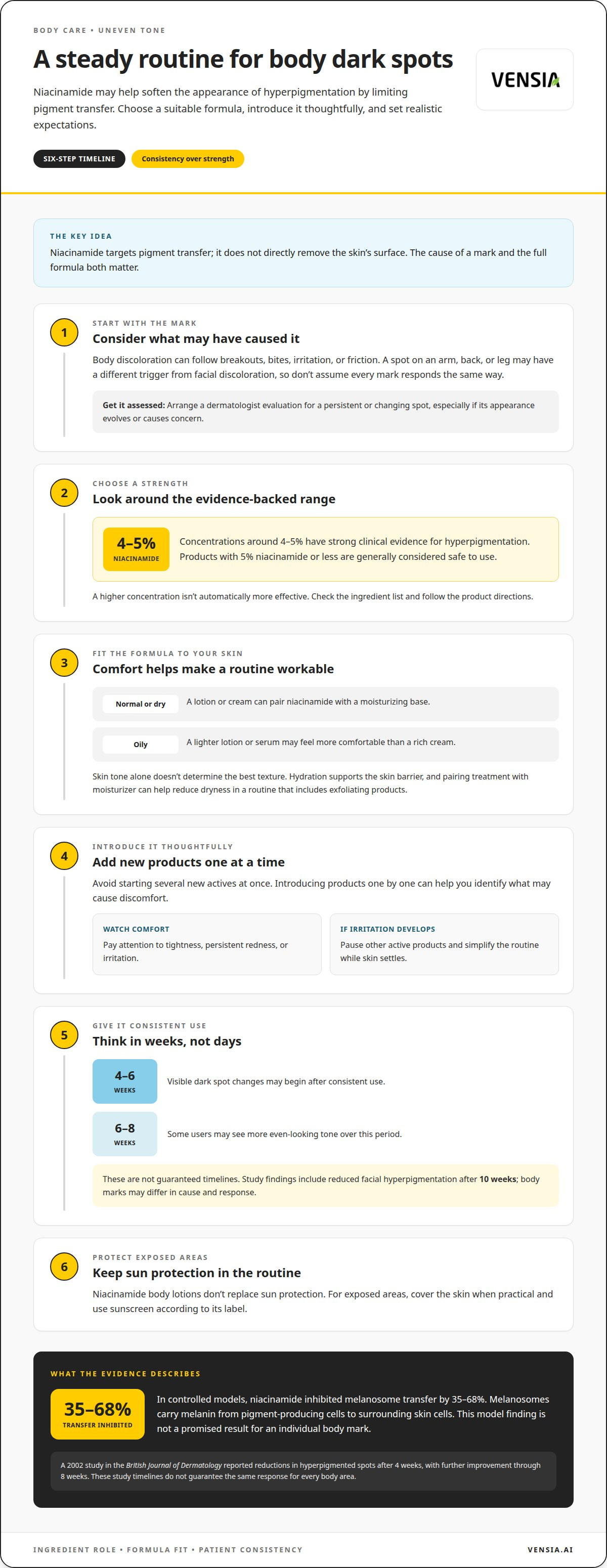
Niacinamide may help improve the appearance of dark spots by limiting pigment transfer within the skin. For niacinamide for body hyperpigmentation, the likely cause of the mark and the product’s full formula help set realistic expectations.
Pigment Transfer and Spot Fading
Melanosomes carry melanin, the pigment that gives skin its color, from pigment-producing cells to surrounding skin cells. Niacinamide can reduce this transfer, helping lessen the appearance of dark spots without directly removing the skin’s surface. In controlled models, it inhibited melanosome transfer by 35-68%. This may matter when a mark remains after irritation or a breakout has settled.
Clinical evidence includes 4-5% niacinamide, a range associated with strong evidence for hyperpigmentation. A double-blind, vehicle-controlled trial found reduced facial hyperpigmentation after 10 weeks of consistent use. That finding concerns facial skin; body marks may differ in cause and response, so niacinamide for body hyperpigmentation should be considered in the context of the affected area.
Treating Spots and Uneven Skin Tone
Dark spot products address different processes, so look at the active ingredients rather than relying on a product label. Niacinamide targets pigment transfer, while retinol can support skin renewal. Combining actives without considering irritation can complicate your routine, particularly when friction or inflammation contributes to uneven-looking skin.
Facial and body concerns can look similar, but a spot on the arm, back, or leg may have a different trigger from facial discoloration. Consider the affected area and likely cause rather than assuming one product suits every mark. For niacinamide for body hyperpigmentation, follow the product directions and introduce new skincare products carefully.
Fading takes consistency. Visible dark spot changes may begin within 4-6 weeks, while some users may see more even tone after 6-8 weeks. A 2002 study in the British Journal of Dermatology found reductions in hyperpigmented spots after 4 weeks, with further improvement through 8 weeks. These timelines describe study findings, not a guaranteed schedule for every body area.
For a niacinamide body product, look for niacinamide in the ingredient list and a formula suited to the area and routine. US prices vary by product format, size, and formulation, so there isn’t one cost that applies to every product.
Niacinamide body lotions don’t replace sun protection. For exposed areas, cover the skin when practical and use sunscreen according to its label.
Arrange a dermatologist evaluation for a persistent or changing spot, especially if its appearance evolves or causes concern. A professional can assess whether the mark may be post-inflammatory pigmentation or needs a different evaluation.
Is niacinamide safe for melanin-rich skin?
Niacinamide can fit into skincare routines for different skin tones, including deeper tones. Product strength, the surrounding formula, and your skin’s hydration needs all shape how comfortable it feels.
Using Niacinamide for Uneven Skin Tone
Niacinamide is a topical ingredient used to address the appearance of uneven tone and dark marks. For skin with post-inflammatory discoloration, a suitable formula can target visible tone concerns while supporting everyday skincare. Products with 5% niacinamide or less are generally considered safe to use. A balanced routine also matters: harsh or irritating products can add redness and make existing concerns harder to manage.
Considerations for Deeper Skin Tones
People with IV through VI Fitzpatrick skin types are identified as a group for whom niacinamide may be especially effective. This makes ingredient choice relevant for deeper skin tones, where uneven tone and lingering marks can be a key concern. Choose a formula that fits the affected area and your routine, rather than assuming a stronger product will improve the appearance faster.
Comfort matters as much as the active ingredient. For normal or dry skin, a lotion or cream can pair niacinamide with a moisturizing base, addressing dryness alongside tone concerns. Choose a formula that leaves your skin comfortable after application; tightness or persistent redness may mean your routine needs simplifying.
For oily skin, a lighter lotion or serum may feel more comfortable than a rich cream. Niacinamide’s role doesn’t change with a product’s texture, but the base affects how it feels on skin. If a heavy formula feels greasy on your back or chest, a lighter option may be easier to use consistently.
Hydration supports the skin barrier, the outer layer that helps limit moisture loss and protect against everyday irritants. Pairing a treatment with moisturizer can help reduce dryness in a routine that includes exfoliating products. Avoid starting several new actives at once; introducing them one at a time helps you identify what may cause discomfort.
Deeper skin tones still vary in oiliness, dryness, and sensitivity, so skin tone alone can’t determine the best product texture. Start with a niacinamide formula at 5% or less, then pay attention to changes in comfort, redness, and the appearance of the treated area. If irritation develops, pause other active products and simplify the routine while the skin settles.
For body care, VENSIA Niacinamide Marshmallow Body Lotion 200 ML is described as moisturizing, improving dryness, soothing rough skin, and offering gentle exfoliation. Its all-skin-types positioning may make it relevant when uneven tone occurs alongside rough or dry-feeling body skin.
Niacinamide concentration
Concentration helps you compare niacinamide products, but a higher percentage isn’t automatically more effective. For pigmentation, evidence and your skin’s tolerance both matter.
Effective Niacinamide Concentrations
A 4-5% formula sits in the concentration range with the strongest clinical evidence for hyperpigmentation. Niacinamide’s effect on melanosome transfer appears to peak around this range, making it a practical starting point for uneven skin tone. The percentage tells you how much niacinamide the formula contains, not how quickly a spot will fade.
Studies have also used 10% niacinamide to examine pigment transfer and visible pigmentation reduction. That doesn’t mean 10% will outperform a lower concentration in everyday use. One study found that 4% niacinamide improved pores, roughness, and unevenness after 8 weeks, illustrating that concentration and the skin concern being measured both matter.
Concentration and Product Safety
Concentration can influence comfort as well as performance. Products above 5% don’t appear to offer proportionally greater hyperpigmentation benefits, and may increase sensitivity risk for some skin types. Irritation can interfere with a consistent routine, so choosing a level your skin tolerates is more useful than pursuing the strongest label.
Consider the full formula, too. A body product may combine niacinamide with moisturizing or exfoliating ingredients, changing how it feels on your skin. If you already use retinol or another active, adding several products at once makes it harder to identify what may cause dryness or redness.
To patch test a niacinamide body product, apply a small amount to a discreet area of skin and follow the product label. Observe the area for irritation before applying it more widely. Stop using it if discomfort or redness develops.
Use the product as directed rather than applying more often to compensate for a lower concentration. Follow the label for frequency, and consider how the product fits with the rest of your routine. Consistent use makes it easier to assess comfort and changes in skin texture.
When introducing a new product, avoid changing other active ingredients at the same time. For example, keep your usual moisturizer consistent while testing a niacinamide formula. This makes it easier to identify a reaction to one product rather than several changes made at once.
Choose based on both the concentration and your skin’s needs. A 4-5% product offers a well-supported range for pigmentation concerns; texture, other ingredients, and how your skin responds help determine whether it fits your routine. A higher percentage alone doesn’t establish a better match.
Combining niacinamide with other brightening ingredients
Combining ingredients can address more than one skin concern, but it can also change how a routine feels. Choose each product for a clear purpose, such as adding hydration alongside tone care, rather than layering products simply to make your routine stronger.
Hyaluronic acid is a hydrating ingredient that can complement niacinamide in skincare. A notable difference from using the combination may appear by about 4 weeks; after 8 weeks, users should notice more hydrated, smoother, and toned skin. These time points describe reported results, not a guaranteed schedule for every person or body area.
Vitamin C is another brightening ingredient often considered alongside niacinamide. A 2025 clinical study reported an 80% reduction in acne when niacinamide and vitamin C were used together. That finding concerns acne, not dark spot fading, so it shouldn’t be treated as proof that this combination removes body pigmentation by the same amount.
Ingredient roles matter. Niacinamide may reduce pigment transfer, while a hydrating ingredient such as hyaluronic acid supports moisture. Exfoliating ingredients work differently by encouraging surface renewal. Introducing several actives at once can make irritation harder to trace.
- For hydration: pair niacinamide with hyaluronic acid when dryness is part of the concern.
- For vitamin C: treat combination claims cautiously, since the cited 2025 result measured acne, not pigmentation.
- For exfoliation: avoid adding multiple new active products to the same routine at once.
Build a combination gradually. Keep your established moisturizer steady, add one new ingredient, and observe how your skin responds before introducing another active. This sequence helps you identify a possible source of irritation if redness or discomfort develops. It also keeps your routine easier to maintain on areas such as the arms, chest, or legs.
Hydroquinone offers a useful comparison, but it isn’t simply another ingredient to layer into a routine. In a study of melasma, 4% hydroquinone was more effective than 4% niacinamide. That comparison applies to melasma, not every body mark, and it shows why ingredient evidence should be matched to the condition studied.
Brightening is about choosing a considered combination, not an ingredient contest. Select products for distinct purposes, introduce changes separately, and interpret evidence in light of the concern studied. Research on acne, melasma, or hydration doesn’t establish the same outcome for every dark spot.
What causes body hyperpigmentation, and which types may respond to niacinamide?
Body hyperpigmentation describes areas that appear darker than nearby skin, often after irritation or injury. The trigger matters because niacinamide’s evidence is most relevant to pigment left after inflammation.
Post-inflammatory hyperpigmentation, or PIH, can follow an insect bite, topical irritant, burn, or papulosquamous disorder. The National Center for Biotechnology Information identifies these as possible causes of PIH. For example, a lingering mark where a bite healed may reflect pigment changes following local inflammation.
PIH can develop after the original irritation settles, leaving a spot that looks darker than surrounding skin. A 2025 randomized controlled trial found that niacinamide significantly reduced PIH compared with placebo. This finding makes niacinamide relevant to marks linked with inflammation, though it doesn’t establish the same response for every cause of discoloration.
Consider what happened before a mark appeared: a skin injury or irritation occurs, inflammation follows, and discoloration remains. A spot after a burn and a mark after a topical irritant can both fit this pattern, though their triggers differ. Understanding the likely trigger can help distinguish a post-inflammatory mark from a concern that needs a different approach.
- After an insect bite: the mark may follow inflammation at the bite site.
- After a topical irritant: the skin may retain discoloration after the irritation has passed.
- After a burn: a darker area can remain where the injury occurred.
- With a papulosquamous disorder: the underlying skin condition can be associated with PIH.
Not every dark area has the same cause, and a familiar-looking mark doesn’t prove its origin. Note whether it followed an event, such as a bite or product irritation, and whether the trigger is still present. If irritation continues, addressing that trigger matters alongside any plan for the discoloration it leaves.
Niacinamide is a reasonable ingredient to consider for post-inflammatory marks, given the 2025 trial finding. That evidence concerns PIH, not every form of body hyperpigmentation or every underlying skin disorder. A persistent or changing spot deserves attention to its cause, rather than being treated as ordinary leftover pigmentation.
For care focused on dark spots and uneven tone, explore targeted pigmentation care as one option for your routine.
VENSIA: VENSIA Niacinamide Marshmallow Body Lotion 200 ML - Moisturizing, Improving Dryness, Rough Skin Soothing, Organic Vitamin C, Gentle Exfoliating, All Skin Types
VENSIA Niacinamide Marshmallow Body Lotion 200 ML - Moisturizing, Improving Dryness, Rough Skin Soothing, Organic Vitamin C, Gentle Exfoliating, All Skin Types is a body-care option for skin that feels dry or rough alongside uneven tone. Its listed features include niacinamide, organic vitamin C, moisturizing, soothing rough skin, and gentle exfoliation.
VENSIA Niacinamide Marshmallow Body Lotion may suit a routine when you want body care that combines niacinamide, moisturizing care, and gentle exfoliation. Niacinamide may support a routine focused on the appearance of dark spots, while moisturizing care addresses dryness. Keep expectations realistic: individual results vary.
For questions about this body lotion or its fit for your routine, contact VENSIA.
Choose a Routine You Can Sustain
Choose body care that fits the concern you want to address and feels manageable in everyday use. A thoughtful approach to niacinamide for body hyperpigmentation considers the product’s purpose, its full formula, and how it fits with the rest of your skincare. Avoid turning a focused routine into a long list of new products; consistency and comfort make it easier to assess how your skin responds.
VENSIA offers VENSIA Niacinamide Marshmallow Body Lotion for moisturizing and rough-skin care, as well as VENSIA Anti-Pigmentation Cream for dark spots and uneven tone. These products have different formats and stated purposes, so choose according to the care you’re seeking.
For help considering which VENSIA skincare option fits your routine, contact VENSIA for skincare advice. A steady, considered routine is a practical place to begin.
Frequently Asked Questions
What Is Niacinamide?
Niacinamide is an ingredient used in topical skincare products, including serums, creams, and body lotions. A product’s formula determines its concentration, texture, and other ingredients, so products containing niacinamide can suit different routines. For body care, a lotion can be convenient for larger areas such as the arms or legs. Check the product directions and ingredient list to understand how it fits your routine.
How does niacinamide help with body hyperpigmentation?
Niacinamide can reduce the transfer of pigment to surrounding skin cells, which can help improve the appearance of dark marks. It’s most relevant when discoloration remains after inflammation, such as a mark following a healed insect bite. A 2025 randomized controlled trial found reduced post-inflammatory hyperpigmentation compared with placebo. That result concerns post-inflammatory marks, not every cause of discoloration on the body.
What concentration of niacinamide is effective for body hyperpigmentation?
A concentration around 4-5% has the strongest clinical evidence for hyperpigmentation. Products with 5% niacinamide or less are generally considered safe to use. A higher percentage isn’t automatically a better choice: concentrations above 5% don’t appear to provide proportionally greater pigmentation benefits and may raise sensitivity risk for some skin types. Read the product label, since some formulas don’t state the exact percentage.
How often should you apply niacinamide to the body, and how long until results appear?
Niacinamide can be used once or twice daily, following the directions for the specific body product. Consistent use matters more than applying extra product. Visible dark spot fading may begin within 4-6 weeks, while a broader change in tone can take longer. A useful way to assess progress is to note the treated area’s appearance under similar lighting, rather than judging it day to day.
Is niacinamide safe for sensitive skin, and what side effects can occur?
Products with 5% niacinamide or less are generally considered safe to use, but sensitive skin can react to a product’s overall formula. Redness, irritation, or discomfort can occur, particularly if several active products are introduced together. Patch test a small area according to the product directions before broader use. If irritation develops, stop applying the product and simplify the routine until the skin feels comfortable.
Can niacinamide be combined with vitamin C, retinoids, azelaic acid, or exfoliating acids?
These ingredients can have different roles, but combining them doesn’t guarantee stronger brightening. A study reporting an 80% acne reduction with niacinamide and vitamin C measured acne, not pigmentation. Evidence for a combination should match the concern being treated. To keep a routine manageable, introduce one new active at a time; this makes it easier to identify which formula causes irritation.
How does niacinamide compare with other treatments for body hyperpigmentation?
Niacinamide works through pigment transfer, while other ingredients can act differently. In a study of melasma, 4% hydroquinone was more effective than 4% niacinamide. That comparison applies to melasma, not every type of body discoloration. Treatment choice depends on the cause of the mark, the area involved, and the formula’s suitability. Avoid assuming that results for one condition predict results for another.
Which body areas and skin tones can be treated with niacinamide?
Niacinamide products can be used on body areas named in their directions, such as arms, legs, or the trunk. Evidence from facial studies doesn’t automatically establish the same results for every body area. Niacinamide is identified as especially effective for Fitzpatrick skin types IV through VI, and products with 5% or less are generally considered safe. Skin tone alone doesn’t determine which formula or texture feels comfortable.


