

Skin repigmentation treatment at home: safe options to consider
A home remedy can irritate skin without restoring its color. The safest approach to a skin repigmentation treatment at home is to identify whether a patch is darker or lighter, protect the skin, and patch-test any new remedy; stop using it if irritation develops. Home care can support skin protection, but pigment changes may need dermatologist-led assessment and treatment.
It’s understandable to look for a gentle skin repigmentation treatment at home, especially when a change in skin tone feels concerning. But dark patches and areas of lost pigment have different causes, and irritating ingredients can make dark marks worse. This guide explains how to approach home remedies more safely, which commonly suggested options have limited evidence, and why vitiligo treatment and ongoing care may affect repigmentation and pigment loss. You’ll also learn when to seek medical advice instead of continuing a home routine.
Key Takeaways
- Patch-test a home remedy on a small area first, and stop if irritation appears; irritated skin can develop worse hyperpigmentation.
- Tell darker patches from areas of lost pigment before choosing a routine, since the causes and appropriate care differ.
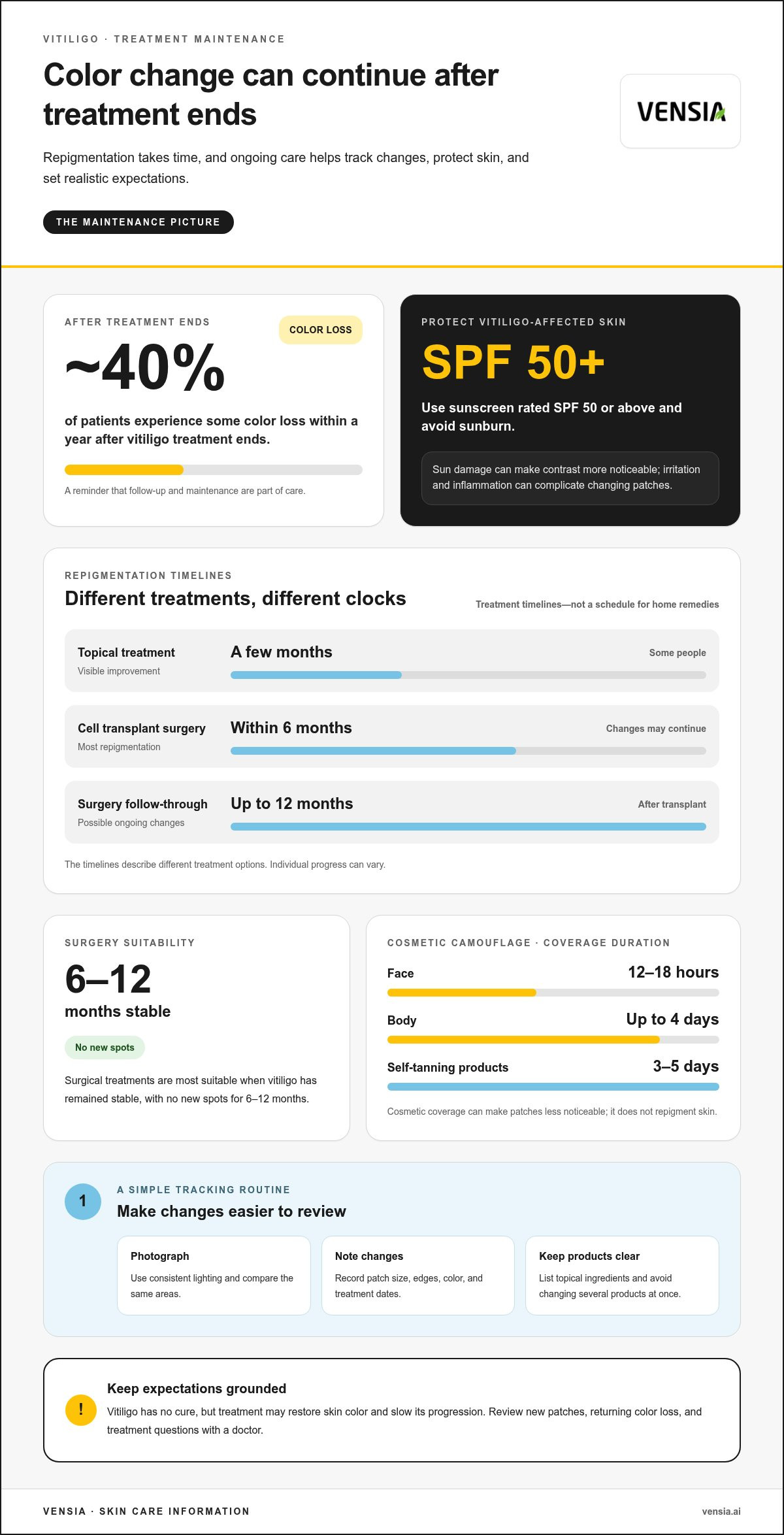
- Plan for ongoing vitiligo care: about 40% of patients experience some color loss within a year after treatment ends.
- Avoid using sunlamps bought for home treatment; they’re less effective than hospital phototherapy and may not be safe.
- Protect vitiligo-affected skin from sun damage with sunscreen rated SPF 50 or above.
2. Home remedy safety and patch testing
Before applying a home remedy, identify whether the patch is darker or lighter than the surrounding skin. Hyperpigmentation means excess melanin darkens an area; vitiligo causes pigment loss. The same topical remedy may not suit both concerns. White sun spots can also resemble vitiligo, while pityriasis alba may cause pale patches, especially in children. A doctor can assess persistent changes and possible underlying causes.
Patch-test each new remedy before applying it to a larger area. Put a small amount on a discreet patch of skin, then watch for burning, redness, itching, swelling, or tenderness. Don’t apply it to broken or inflamed skin. Stop and rinse the area if irritation appears. This matters because irritation can worsen hyperpigmentation, particularly for people with darker skin tones.
Apple cider vinegar deserves extra caution. Its acetic acid may act like a mild chemical peel, but direct evidence that it treats hyperpigmentation is limited. If you try it, dilute it with water in a 1:1 ratio, test a small patch, and rinse it off thoroughly. Stop immediately if your skin stings or becomes red. Avoid treating a stronger reaction as proof that the remedy is working.
Natural ingredients can also cause reactions. Lemon juice can irritate skin, and frequent sun exposure is a major cause of dark spots. Combining an acidic remedy with sun exposure may leave skin more irritated and uneven. Try one new ingredient at a time, and avoid layering several home remedies on the same patch. That makes it easier to identify what caused a reaction.
- Choose a single remedy: Don’t combine vinegar, lemon, and exfoliating products in one routine.
- Keep a record: Note the ingredient, application area, and any reaction so you can identify a trigger.
- Stop for warning signs: Seek medical help for skin that is red, itchy, painful, hot, bleeding, or producing pus.
Do vitamins, supplements, or natural remedies help skin repigmentation? Vitamins and supplements aren’t established as a stand-alone way to restore pigment, and evidence doesn’t support ginkgo biloba for vitiligo. People with vitiligo who limit sun exposure should consider a daily vitamin D supplement containing 10 micrograms, but that’s not a substitute for treatment.
Persistent pigmentation or patches linked to a medical condition need assessment, not repeated experiments with cosmetics. A doctor may use your medical history, a skin examination, a biopsy, or blood tests to investigate possible causes. Careful patch testing can reduce avoidable irritation, but it can’t diagnose the cause of a change in skin color.
3. Treatment maintenance and color loss
Vitiligo repigmentation takes time. Some people notice visible improvement after a few months of topical treatment, while surgical cell transplants follow a longer timeline. Most repigmentation after transplant surgery occurs within 6 months, and changes may continue for up to 12 months. These timelines describe different treatment options, not a schedule for home remedies.
Color can fade after treatment stops. Within a year after vitiligo treatment ends, about 40% of patients experience some color loss. This makes follow-up and maintenance part of care, rather than optional extras. Vitiligo has no cure, but treatment may restore skin color and slow its progression. New patches or returning color loss are useful details to record and share during medical review.
Keep a simple record of changes. Photograph the same areas in consistent lighting, and note any changes in patch size, edges, or color. Record when you start or stop treatment, and list each topical ingredient you use. This can help distinguish treatment effects from differences caused by lighting or surrounding skin tones. Don’t change several products at once, because that makes reactions and progress harder to interpret.
Camouflage can support appearance while treatment continues, but it doesn’t repigment skin. Vitiligo camouflage creams can last for 12 to 18 hours on the face and up to 4 days on the body. Their coverage fades with wear, so follow the product’s directions and reapply as needed. Self-tanning products offer another cosmetic option, with coverage lasting 3 to 5 days. These choices can make patches less noticeable without changing the underlying condition.
Maintenance also means protecting treated and untreated skin from irritation and sun damage. Use sunscreen rated SPF 50 or above on vitiligo-affected skin, and avoid sunburn. A burn can make contrast more noticeable, while inflammation can complicate the appearance of changing patches. Keep a consistent skin-care routine and avoid adding harsh ingredients when skin feels sensitive.
Review changes with a doctor, especially if new patches appear or existing areas expand. For surgery, stability matters: surgical treatments are most suitable when vitiligo has remained stable, with no new spots for 6-12 months. A record of photographs and treatment dates can help clarify whether the condition is changing. For cosmetic support between treatment reviews, explore skin care for uneven tone.
There is currently no cure for vitiligo, though treatments may restore skin color and slow disease progression. Think of ongoing care as supporting these aims over time, rather than expecting a permanent resolution. When reviewing progress, consider visible color changes and whether the condition appears to be advancing. Don’t judge either from a single observation. A treatment that restores some color may still be worthwhile, even if it doesn’t restore all affected skin. A change in appearance alone doesn’t explain its cause. Keep expectations grounded in the purpose of care, and discuss questions about ongoing treatment, fading, or new changes with a doctor. Results and the course of vitiligo may vary, so use this information to make informed decisions about continuing care.
4. Which at-home treatments can help repigment vitiligo patches?
Most kitchen remedies promoted online haven’t been shown to repigment vitiligo. Green tea, aloe vera, milk, and black tea may feature in skincare routines, but applying them doesn’t establish that pigment returns. Vitiligo involves pigment loss, so a remedy suggested for dark spots may address a different concern. Keep that distinction in mind when considering a skin repigmentation treatment at home.
Green tea is sometimes used as a cooled compress. One suggested method steeps a tea bag in boiling water for 3 to 5 minutes, then cools it before application. Another suggests placing a wet tea bag on a pigmented area for a few minutes each day. Research in people is needed to determine whether green tea changes skin pigmentation. These routines shouldn’t be treated as established vitiligo treatment.
Aloe vera instructions often recommend applying pure gel before bed and rinsing it off the next morning. Some suggest repeating this daily until skin tone improves. These directions describe a home remedy, not proof of pigment restoration. When considering a skin repigmentation treatment at home, distinguish soothing or moisturizing care from treatments intended to address vitiligo.
Black tea water is sometimes suggested as a home remedy, but this preparation should not be treated as an established way to restore pigment. A suggested routine applies it twice daily for about 4 weeks. This is a home method, not evidence that black tea restores pigment. Never apply hot liquid to skin, and stop if a remedy causes irritation.
Some home routines involve applying milk or yogurt to spots. Suggestions include using milk-soaked cotton pads twice a day or repeating applications daily for a few weeks or months. These approaches don’t establish that dairy repigments vitiligo. Coconut oil and tea tree oil may support skin condition and texture, but they won’t restore pigment.
Topical ingredients can serve different purposes. Retinoids promote cell turnover and may help even pigmentation or reduce the appearance of white spots. That cosmetic effect isn’t the same as restoring pigment affected by vitiligo. Ginkgo biloba has no evidence supporting its use for vitiligo, so don’t rely on it as a repigmentation remedy.
For confirmed vitiligo, commonly prescribed treatments include topical corticosteroids and calcineurin inhibitors, such as tacrolimus, used under dermatologist supervision. A dermatologist can match care to the diagnosis and affected areas. Keep home routines focused on gentle skin care, rather than claims that a natural ingredient can reverse pigment loss.
5. Does home UVB phototherapy work for vitiligo, and what devices are FDA-cleared?
Sunlamps bought for home light therapy aren’t recommended for vitiligo. They’re less effective than hospital phototherapy and may not be safe. A lamp marketed for home use shouldn’t be treated as a substitute for medically supervised treatment. Choosing a home light device requires care, and it should not replace medically supervised treatment.
Phototherapy uses ultraviolet A (UVA) or ultraviolet B (UVB) light from a special lamp. For vitiligo, narrowband UVB is used to stimulate pigment production. It’s described as most effective for widespread or symmetrical vitiligo, where patches affect larger or corresponding areas. Even with clinic-based treatment, noticeable changes may take several months.
Narrowband UVB is typically administered at a clinic 2-3 times a week. That schedule is a clinical treatment pattern, not directions for operating a home lamp. Treatment involves selecting the light type and managing exposure. A device label alone doesn’t provide that individualized approach or establish that unsupervised use is suitable.
Before pursuing light therapy, have new or changing pale patches assessed. Vitiligo is one cause of pigment loss, but white sun spots and pityriasis alba can also create pale areas. A clinician can assess the skin and determine whether phototherapy suits the diagnosis and pattern. This matters because treatment aimed at vitiligo won’t necessarily address another cause of light patches.
Keep these distinctions in mind when considering a device:
- Home sunlamp: Not recommended for vitiligo because it may be unsafe and is less effective than hospital phototherapy.
- Clinic narrowband UVB: Used to stimulate pigment, typically 2-3 times a week, with results that may take several months.
- UVA or UVB lamp: These are types of light used in phototherapy; the label alone doesn’t establish a suitable treatment plan.
Don’t try to recreate clinic treatment by increasing exposure or using a sunlamp more often. There’s no safe home dose, schedule, or model recommendation provided here. Unsupervised experiments can expose skin to light without the assessment and oversight involved in clinic treatment. If you’re considering treatment, discuss the diagnosis, affected areas, and stability of the patches with a dermatologist.
Protect vitiligo-affected skin outdoors with sunscreen rated SPF 50 or above. This helps reduce sunburn and long-term damage, which matter whether or not phototherapy forms part of care. Home light devices and sunlight aren’t interchangeable with supervised narrowband UVB. For vitiligo, the evidence-backed distinction is between an unsupervised home sunlamp and clinic-administered treatment.
5. Can sunlight or tanning beds help repigment skin, and what are the risks?
Sunlight isn’t a dependable way to restore pigment in vitiligo patches. Vitiligo involves pigment loss, while frequent sun exposure is a main cause of dark spots. Tanning may darken surrounding skin and make pale areas more noticeable. It can also expose pigment-deficient skin to sunburn and long-term damage. Deliberately increasing sun exposure doesn’t replace controlled treatment.
Tanning beds aren’t the same as dermatologist-led phototherapy. A tanning bed exposes skin to ultraviolet light, but it isn’t a supervised vitiligo treatment plan. Sunlamps bought for home light therapy aren’t recommended for vitiligo because they’re less effective than hospital phototherapy and may not be safe. Don’t use a tanning bed or home lamp to imitate clinic light treatment.
For vitiligo, narrowband UVB phototherapy is typically administered at a clinic 2-3 times a week. It stimulates pigment production and is described as most effective for widespread or symmetrical vitiligo. Noticeable results may take several months. This is a specific clinical approach, not an instruction to spend longer outdoors or increase tanning sessions.
Protect pale patches outdoors. People with vitiligo are advised to use sunscreen with SPF 50 or above to help protect against sunburn and long-term damage. Apply sunscreen before outdoor exposure, cover vulnerable areas with clothing, and seek shade when direct sunlight is strong. These steps protect skin; they don’t repigment patches.
Use changes in your skin as a reason to reassess your routine. If a patch becomes red, painful, or irritated after sun exposure, stop tanning and protect the area. If new or expanding pale patches appear, have them assessed rather than treating them with sunlight. Vitiligo can affect areas such as the face, hands, and genital areas, where sun protection may need practical planning.
Keep the purpose of each option clear:
- Natural sunlight: Don’t increase exposure to try to repigment vitiligo; protect affected skin with SPF 50 or above.
- Tanning beds and home sunlamps: Don’t treat them as substitutes for clinic phototherapy.
- Clinic narrowband UVB: This supervised treatment stimulates pigment and may take several months to show noticeable results.
For care beyond sun protection, explore a topical vitiligo care option as part of a skin-care routine, not as a replacement for medical assessment or supervised phototherapy.
Applying yogurt or milk to skin spots twice a day may help some people improve them. This is separate from repigmenting vitiligo: the possibility of improvement in skin spots doesn’t make sunlight or tanning beds a dependable way to restore pigment. Keep these approaches distinct, and don’t increase sun exposure or use a tanning bed based on this possibility. Protect pale patches outdoors, regardless of whether you apply yogurt or milk to spots.
For hyperpigmented skin, seek medical help if the area is red, itchy, painful, hot to the touch, or has bleeding or pus discharge. These symptoms warrant medical attention rather than relying only on a topical application. This advice concerns hyperpigmented skin; it doesn’t change the guidance to protect vitiligo patches from sun exposure or use supervised clinic phototherapy for treatment.
VENSIA: VENSIA Anti Vitiligo Cream
VENSIA Anti-Vitiligo Scar Removal Cream is a topical skincare option for readers seeking care focused on vitiligo. A product name alone doesn’t establish that a cream can restore pigment, so treat it as part of personal skincare, not a replacement for dermatologist-directed treatment. New, spreading, or changing pale patches need medical assessment to identify their cause and guide care.
For dark spots and uneven tone, VENSIA also offers VENSIA Anti-Pigmentation Cream. VENSIA Niacinamide Marshmallow Body Lotion is designed to moisturize and soothe dry, rough skin. These products address distinct skincare concerns, so choose according to the issue you want to address. Keep sun protection and any treatment plan recommended by your healthcare professional in place.
To explore VENSIA’s skincare offerings, visit vensia.ai.
Choose a thoughtful next step for your skin
If you’re considering a skin repigmentation treatment at home, let your next step be guided by what your skin needs, not pressure to try every remedy. Note what you’ve applied, what changes you’ve observed, and what support you’re looking for. This gives you a clearer starting point for decisions about your routine and suitable skincare.
VENSIA offers skincare options for vitiligo, pigmentation concerns, and dry or rough skin. Consider the concern you want to address, then explore the product that best matches it. Keep your routine measured, and seek medical guidance for new or changing patches.
Contact VENSIA to discuss your options and take a calm, informed step toward skin care that feels right for you.
Frequently Asked Questions
What are the side effects and risks of at-home vitiligo treatments?
At-home remedies can irritate skin, and inflammation can worsen dark marks, especially on darker skin tones. Acidic ingredients such as apple cider vinegar can cause stinging or redness; stop using them if a reaction appears. Home sunlamps also carry safety concerns and aren’t recommended for vitiligo. Avoid applying remedies to broken skin, and don’t combine several new ingredients at once, as that can make it harder to identify the cause of a reaction.
When should someone see a dermatologist before treating depigmented skin at home?
See a dermatologist before starting a home routine if pale patches are new, spreading, or difficult to distinguish from other skin conditions. Vitiligo, white sun spots, and pityriasis alba can all cause pale areas. A dermatologist can examine the pattern and consider your health history to identify the cause. Arrange medical assessment promptly if affected skin becomes painful or hot, or develops bleeding or pus.


