

Vitiligo Cream Irritation: What to Stop and When to Call
New burning, a rash, or worsening redness is a reason to pause and reassess a vitiligo cream, not to push through the discomfort. If you’re wondering what to do if a vitiligo cream irritates your skin, stop using the suspected product for now and contact the clinician who recommended it before restarting or changing how you use it.
It’s understandable to worry that stopping treatment could interrupt progress. But irritation can have different causes: some active treatments can inflame or sting the skin, and other products layered on top may contribute. The right response depends on your symptoms and the product involved.
This guide explains what to stop, which symptoms need prompt medical advice, and how to patch test new skin products more carefully. You’ll also learn what to discuss at follow-up so you can review side effects and decide on a safer next step for your skin.
Key Takeaways
- Pause a product that seems to trigger irritation, and discuss whether to restart or adjust it with the clinician who recommended it.
- Some vitiligo treatments can cause burning, redness, or skin changes; note what you used and how your skin reacted.
- Patch test new camouflage and skincare products, and favor fragrance-free options to help identify potential triggers.
- Follow-up helps assess both treatment response and side effects, including possible skin thinning from topical steroids.
- Contact a dermatologist when irritation persists, worsens, or raises concerns about your treatment plan.
Cosmetic ingredients and products that may cause irritation or skin problems
A cream can cause irritation even when it targets pigment. Topical monobenzone, which is used to depigment skin, can cause redness and irritation. Prescription treatments can also affect skin differently from ordinary moisturizers. The active ingredient, strength, application area, and other products used nearby all matter. A reaction doesn’t automatically mean every product for vitiligo will cause the same response. It does mean the product deserves a closer look.
Topical corticosteroids can cause side effects, including skin thinning, stretch marks, and acne. The risk can rise with overuse, so the treatment plan matters. Pimecrolimus and tacrolimus are calcineurin inhibitors used for vitiligo. They can cause burning, pain, or irritation where applied. These effects relate to specific active treatments, not every cream or ointment. Check the label for the product name and active ingredient. If a prescribed treatment causes a reaction, discuss it with the clinician who recommended it.
Cosmetics can complicate the picture. Camouflage products may feel more irritating on already inflamed skin, making it harder to tell whether the treatment, makeup, or both contributed. Fragrance, vitamin ingredients, and botanical extracts may appear on cosmetic labels, but an ingredient’s presence alone doesn’t prove it caused a reaction. Keep the packaging, and write down the product name and full ingredient list. Note where you applied it and what changed afterward. Those details can help distinguish a product reaction from irritation caused by rubbing or another exposure.
Repeated friction, cuts, or irritation may be followed by new vitiligo patches in some people. Avoid scrubbing an affected area or rubbing it repeatedly with a towel. Choose gentle cleansing, and pause nonessential products on irritated skin. Don’t add several new cosmetics at once. Changing one product at a time makes it easier to identify a possible trigger. This is especially useful when creams, camouflage makeup, and moisturizers overlap on the same patch.
- Active treatment: Check whether the label names monobenzone, a corticosteroid, pimecrolimus, or tacrolimus.
- Cosmetic products: Record the name and ingredients of camouflage, cleanser, and moisturizer.
- Application: Note the affected area and whether redness, burning, or itching followed.
These examples help explain what to do if vitiligo cream irritates skin: identify the product and its purpose before changing treatment. Don’t assume a moisturizer, vitamin ingredient, or “gentle” label rules out a reaction. If a prescribed cream appears responsible, contact the treating clinician before restarting it or changing how you use it.
Follow-up for treatment response and side effects
Follow-up helps assess whether a vitiligo treatment is working and how it affects your skin. The timing and review depend on the treatment, your symptoms, and changes in affected areas.
Monitoring Treatment Side Effects
Monitoring means reviewing both skin changes and treatment effects over time. After one month of topical steroid treatment, a GP follow-up appointment is scheduled to assess effectiveness and side effects. This check matters because steroids can cause skin thinning, streaks, or lines. Overuse can increase the risk, so report changes rather than adjusting the application yourself.
Bring clear details to your appointment. Note the product name, where you applied it, and when symptoms began. Describe any burning, stinging, inflammation, or visible skin changes. These details help connect a possible reaction with the topical treatment. If side effects occur, treatment may need to stop. Discuss that decision with the clinician who recommended it.
Response can take time, so improvement and irritation need separate attention. Topical corticosteroids may take a few months to show results. Calcineurin inhibitors, including tacrolimus and pimecrolimus, may also take a few months to begin working. A slow response alone doesn’t explain new burning or inflammation. Record both pigment changes and discomfort to make your review more useful.
When to Contact a Dermatologist
Contact a dermatologist when irritation continues, worsens, or appears alongside a treatment-related skin change. This is especially important with topical steroids, since skin thinning and streak-like lines can develop. Report any burning, stinging, or inflammation that concerns you. A dermatologist can review the treatment and its effects, including whether you should pause it.
Follow-up can continue after the first review. A GP may check for vitiligo improvement after another month or two. If steroid treatment has helped slightly, it may continue with breaks every few weeks. Those decisions depend on the response and side effects, not pigment changes alone. Share any new symptoms before continuing a treatment that seems to irritate your skin.
Treatment type also shapes what to report. Redness, itching, and burning after narrow-band ultraviolet B therapy usually clear within a few hours. If symptoms persist beyond that pattern, contact the treating clinician. For topical steroids, ask about any thinning or streaks. For calcineurin inhibitors, report burning or pain. These examples help distinguish expected effects from reactions that need review.
Keep the product packaging and a short symptom record for the visit. If you’re considering VENSIA Anti Vitiligo Cream, include its ingredient information in that treatment discussion before adding it to your routine.
Patch testing new products
Patch testing helps you assess a new cosmetic before using it more broadly. People with vitiligo are advised to patch test new camouflage products and prioritize fragrance-free options. Choose the exact product you plan to use, such as a camouflage cream, rather than testing a different item from the same range. A small test area can help reveal a local reaction before the product reaches several affected patches.
Keep the test simple and controlled. Apply a small amount to a limited area of skin, following the product’s directions. Avoid testing several new products at once. If redness, itching, burning, or swelling appears, stop using the tested item and note where and when the reaction began. A written record can help a dermatologist assess whether the product may be involved.
Fragrance-free camouflage is a practical starting point, but the label alone can’t predict your individual response. Read the ingredient list and keep the packaging. If you also use moisturizer, cleanser, or makeup, introduce one new cosmetic at a time. This makes it easier to identify which change came before a reaction, rather than confusing several new products with one another.
A home product check isn’t the same as a clinical evaluation. If reactions keep returning, a dermatologist can assess your skin and consider whether contact dermatitis may explain the symptoms. Mention your vitiligo diagnosis, the products you tested, and any treatment changes. Vitiligo is an autoimmune disease, but that diagnosis alone doesn’t identify which cosmetic caused irritation.
Keep prescribed treatment separate from cosmetic testing. Don’t use a home patch test to change how you apply topical medicines, including calcineurin inhibitors such as tacrolimus or pimecrolimus. Ask the prescriber how to handle a suspected reaction to those medicines. Also mention phototherapy in your product history, since it’s useful context when discussing skin symptoms and new cosmetics.
- Choose one item: Test the camouflage product you intend to use.
- Keep the test limited: Follow the product directions and avoid adding other new cosmetics.
- Record the response: Note the product, test location, and any visible or felt changes.
- Seek assessment: Share recurring reactions and your product record with a dermatologist.
Patch testing is a way to approach new cosmetics thoughtfully, not a guarantee against irritation. Fragrance-free camouflage and a clear record of product use can make follow-up more informative. If a tested cosmetic causes symptoms, stop using it and bring its packaging and your notes to the next clinical discussion.
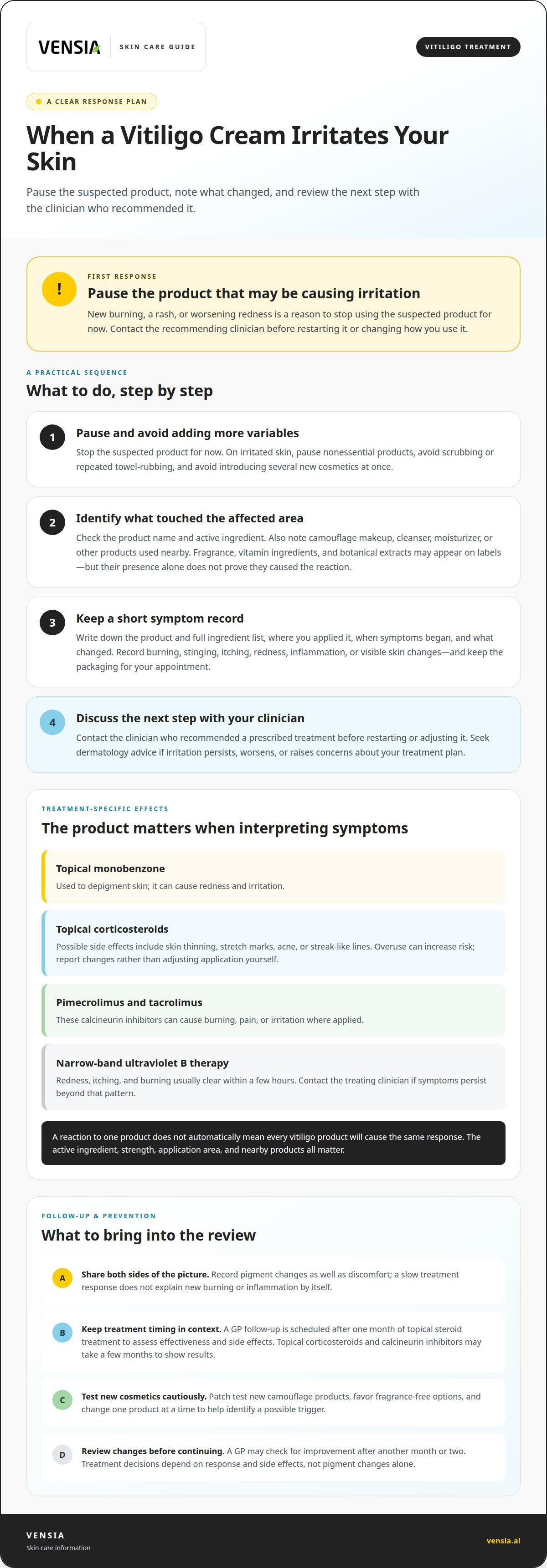
Responding to skin irritation
If a topical cream irritates your skin, stop using the suspected product and contact the clinician who recommended it before restarting. Depending on your treatment and symptoms, they may discuss alternatives such as calcineurin inhibitors, topical calcipotriene, or narrow-band UVB phototherapy.
Using more topical steroid than prescribed can increase side effects, including skin thinning. Follow the prescribed directions, and ask before applying it to a sensitive area or changing the amount.
Start by noting the product name, application area, and symptoms. Burning, stinging, or inflammation can occur with topical steroids; tacrolimus and pimecrolimus can also cause burning or irritation. A suspected reaction may call for a treatment change. Don’t compensate by applying less, more, or another cream without discussing the plan with the prescriber.
Protect irritated skin from extra friction. Repeated rubbing, cuts, or irritation may be followed by new vitiligo patches in some people. Avoid scrubbing the area or adding multiple cosmetics while symptoms are present. If the skin is inflamed, camouflage products may feel more irritating, so pause them until you have guidance on resuming use.
Ask the clinician about alternatives in the context of your diagnosis, affected area, and previous treatment response. Options used for vitiligo include topical calcineurin inhibitors, topical calcipotriene, and narrow-band UVB therapy. Each has its own application approach and possible effects. A switch should take the reaction into account, rather than treating all creams as interchangeable.
Sun protection also matters on depigmented skin. The American Academy of Dermatology advises broad-spectrum, water-resistant sunscreen with SPF 30 or higher for people with vitiligo. Reapply every two hours, or more often when swimming or sweating, according to the American Academy of Dermatology. Sunscreen helps protect affected areas from sunburn; it doesn’t replace advice about an active treatment reaction.
- Pause: Stop the suspected irritant and avoid adding new products.
- Record: Note symptoms, treatment name, and application area.
- Discuss: Ask about treatment changes before restarting or switching.
- Protect: Use sun protection on depigmented skin.
Some treatment effects have a known pattern. Redness, itching, or burning after narrow-band UVB therapy usually clears within a few hours. Persistent or worsening symptoms need attention, especially if a topical steroid is associated with thinning or streak-like skin changes. Contact the treating clinician to discuss what to do next.
When should you contact a dermatologist about irritation from vitiligo treatment?
Contact a dermatologist when irritation persists, worsens, or returns after each application. Redness, itching, burning, and inflammation can occur with topical vitiligo treatments. Skin thinning or streak-like lines during corticosteroid use also need review. These changes can affect whether treatment should continue, pause, or change.
Seek advice about the specific treatment involved. Topical steroids can cause thinning, especially with overuse, and may need monitoring. If side effects develop, stopping treatment may be necessary. Don’t restart or change the amount without discussing it with the prescriber. This is particularly important when the medicine was prescribed for a defined treatment period.
For a clearer discussion, bring the product packaging and a brief symptom record. Include the application area, when you used the treatment, and when symptoms appeared. Record whether irritation followed every application or began after another product. For example, a new camouflage cosmetic or moisturizer may be relevant. These details help the dermatologist assess possible triggers alongside your vitiligo diagnosis.
Follow-up also considers whether treatment is helping. After one month of topical steroid treatment, a medical follow-up appointment is scheduled to assess effectiveness and side effects. A healthcare provider may check for improvement after another month or two. Topical corticosteroids and calcineurin inhibitors may take a few months to show effects. Share both skin changes and irritation, even if pigment improvement is gradual.
- Contact the prescriber: Report persistent or worsening redness, itching, burning, or inflammation.
- Describe visible changes: Mention thinning, streaks, or lines during steroid treatment.
- Bring useful details: Record the treatment, application area, symptoms, and other products used.
- Discuss next steps: Ask whether to pause, stop, or adjust the treatment.
Symptoms after narrow-band UVB therapy follow a different pattern. Redness, itching, or burning usually clears within a few hours after treatment. Contact the treating clinician if symptoms persist or become more concerning. For any treatment, explain how symptoms change over time rather than relying on a single observation.
If a topical product is irritating your skin, prioritize a treatment discussion before trying another cream. For product details, review vitiligo cream information as part of that conversation.
Burning, stinging, or skin inflammation known as contact dermatitis are possible side effects of topical steroids used for vitiligo. One fingertip unit of topical steroid is enough to treat an area of skin twice the size of an adult's hand.
Specialist medical guidance notes that a primary care physician may refer a person to a dermatologist if vitiligo affects more than 10% of their body. Expert dermatologists may discuss topical medication to depigment remaining skin when vitiligo covers more than 50 percent of a person's skin and other topical or light therapies have not repigmented it. Certain calcineurin inhibitors may be used off-label for treating vitiligo according to regional clinical guidelines. In related studies, about 76% of people treated with oral corticosteroids for rapidly spreading vitiligo regained some pigment.
VENSIA: VENSIA Anti Vitiligo Cream
VENSIA Anti Vitiligo Cream is an option for people exploring skincare focused on vitiligo. If another cream has irritated your skin, first pause and discuss the reaction with the clinician who recommended it. Don’t assume a different product will suit irritated skin or use it as a replacement for prescribed treatment.
Once you’re ready to consider a skincare product, review its label and directions before use. Keep track of any reaction and discuss concerns with a healthcare professional, especially if irritation persists or worsens. A careful, informed approach can help you decide whether this product fits your routine.
For questions about VENSIA Anti Vitiligo Cream, contact VENSIA.
Choose your next skincare step with care
Knowing what to do if vitiligo cream irritates your skin can help you make your next treatment decision more deliberately. Give your skin time to settle, and discuss treatment changes with the professional who understands your care. A new cream isn’t automatically the right replacement, especially while irritation is active. Focus on a routine you can discuss clearly and use thoughtfully.
When you’re ready to explore skincare options, consider how a product fits your needs and current treatment plan. VENSIA offers targeted skincare, including VENSIA Anti Vitiligo Cream. For questions about VENSIA products, contact VENSIA for support. Take the next step at a pace that feels informed and manageable, with your skin’s comfort guiding the conversation.
Frequently Asked Questions
What should you do immediately if vitiligo cream causes skin irritation?
Stop applying the suspected cream and contact the clinician who recommended it before using it again. If product remains on your skin, follow its label directions for removal rather than scrubbing the area. Keep the container or take a clear photo of its ingredient list. Note when you applied it and when symptoms began; those details can help distinguish the cream from other recent changes in your routine.
Which symptoms of irritation from vitiligo cream require urgent medical care?
Seek urgent medical care for severe or rapidly worsening symptoms, especially swelling of the face, lips, tongue, or throat, or difficulty breathing. Don’t wait for a routine treatment follow-up if breathing is affected. For a worsening skin reaction without those symptoms, contact a healthcare professional promptly and describe the affected area, the cream used, and how quickly the reaction is changing.
How can you tell whether irritation from vitiligo cream is a normal side effect or an allergic reaction?
You can’t reliably identify the cause from redness or itching alone. Burning, stinging, and inflammation can occur with some treatments, while a reaction may also relate to an ingredient or another product. Note whether symptoms appear after each application, spread beyond the treated area, or follow a new cosmetic. Share that timeline and the product label with a healthcare professional for assessment.
Should you stop, reduce, or change the dose of a vitiligo cream if your skin becomes irritated?
Don’t reduce the amount, apply it less often, or substitute another cream without advice from the prescriber. If irritation starts, pause the suspected product and ask the clinician who recommended it what to do before restarting. This is especially important for prescribed treatments with a specific schedule. For a cosmetic product, follow its label and avoid applying it to broken skin, eyes, or mucous membranes.
What can soothe irritated skin caused by vitiligo cream, and which products should you avoid?
Keep your routine simple while you seek advice: avoid adding new cosmetics, exfoliants, or fragranced products to the irritated area. Don’t layer camouflage makeup over inflamed skin if it stings. A clinician or pharmacist can help identify a gentle product that fits your treatment and skin. Check labels carefully, and don’t assume a product is suitable just because it is marketed for sensitive skin.
How long does irritation from vitiligo cream usually last after stopping treatment?
There isn’t one reliable duration for every cream reaction. The time it takes to settle can depend on the product, your skin’s condition, and how extensive the irritation is. Track whether redness, itching, or discomfort is improving, unchanged, or worsening after you stop. Contact a healthcare professional if symptoms persist, intensify, or concern you; seek urgent care for severe symptoms.


