

How to apply skincare in the correct order for dark spots
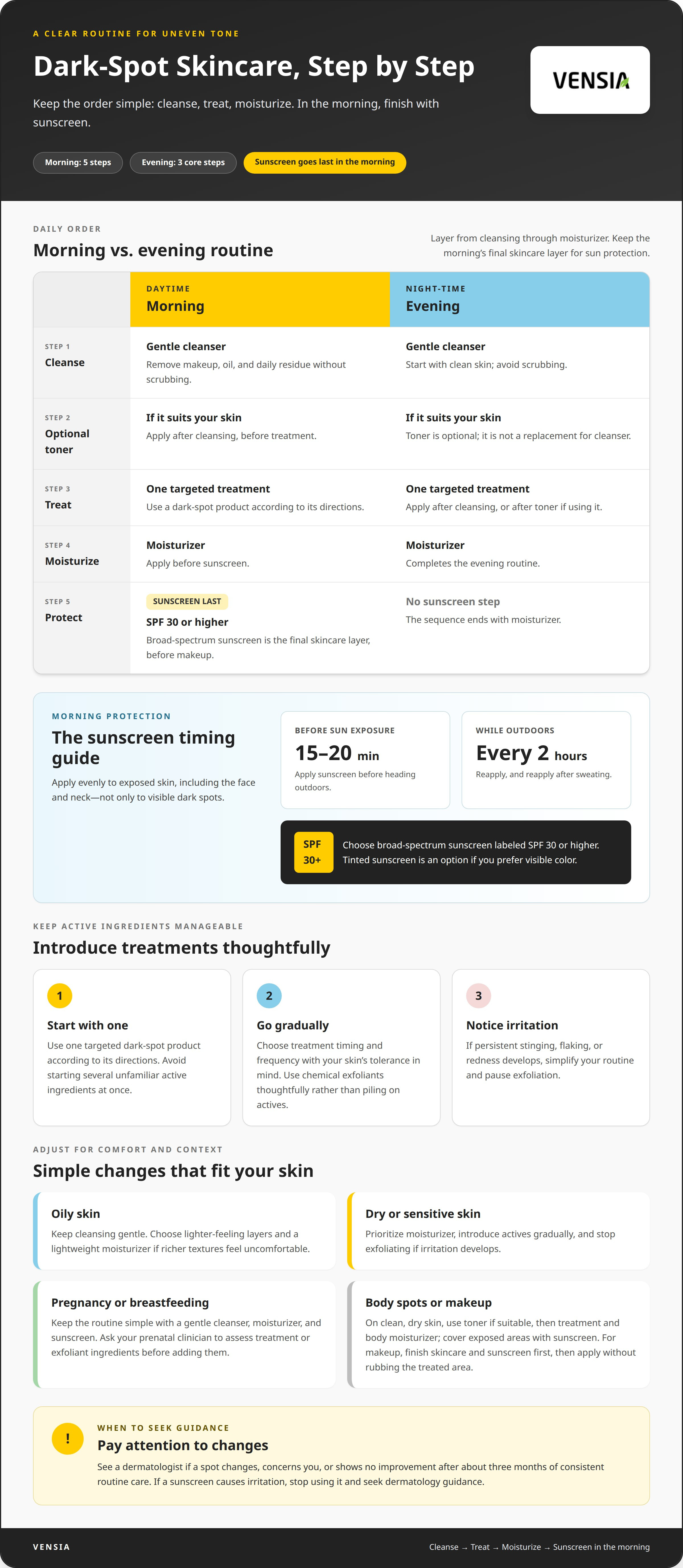
The correct skincare order for dark spots is straightforward: cleanse, apply a targeted treatment, moisturize, then finish your morning routine with sunscreen. At night, cleanse, apply your treatment, and moisturize. Sunscreen goes last in the morning, over your other skincare layers.
If you’re unsure where to fit a serum, cream, or exfoliant, you’re not alone. Order matters, but adding more products or applying them all at once isn’t the goal. A steady routine gives each layer a clear place and helps you care for uneven tone without overwhelming your skin.
Here, you’ll learn a simple morning and evening sequence, where dark-spot treatments and exfoliants fit, and how to introduce active ingredients thoughtfully. You’ll also see why daily sunscreen is an essential final step and how to keep your routine clear, consistent, and easy to follow.
Key Takeaways
- Layer skincare from lighter products to moisturizer, and keep your morning routine’s final step for sunscreen.
- Choose treatment timing and frequency with your skin’s tolerance in mind; introduce new products gradually.
- Use chemical exfoliants thoughtfully, and adjust use if persistent stinging, flaking, or redness develops.
- Consistent sun protection supports dark-spot care. Learn how to apply and reapply it as part of your routine.
- VENSIA Anti Pigmentation Cream is a targeted option for dark spots and uneven skin tone.
What is the simplest skincare routine for dark spots?
Start with a simple routine: cleanse, use a toner if it suits your skin, apply a targeted treatment, and moisturize. In the morning, finish with sunscreen. Consistency matters more than layering several strong products.
During pregnancy or breastfeeding, keep your routine simple with a gentle cleanser, moisturizer, and sunscreen. Ask your prenatal clinician to assess any treatment or exfoliant ingredient before adding it.
See a dermatologist if a spot changes, concerns you, or shows no improvement after about three months of consistent routine care. They can assess its cause and discuss options such as retinoids or hydroquinone when appropriate.
Build the Four-Step Routine
Begin with four repeatable steps, then observe how your skin responds before adding another product. A gentle cleanser removes residue; toner follows cleansing; a targeted treatment comes next; moisturizer completes the basic sequence. In the morning, sunscreen is the final protective layer. Avoid layering several unfamiliar active ingredients at once, so irritation is easier to trace.
- Cleanse. Use a gentle cleanser to remove makeup, oil, and daily residue without scrubbing.
- Apply toner. If toner suits your skin, use it after cleansing. A Glow Toner would fit here as a toner category, not in place of cleanser.
- Use targeted treatment. Apply one dark-spot product according to its directions, rather than combining several new actives.
- Moisturize. Seal the routine with moisturizer. In the morning, apply sunscreen after skincare and before makeup.
Adapt the Routine to Skin Concerns
Adjust your routine to your skin’s texture and comfort, not to a fixed number of products. For oily skin, choose lighter-feeling layers and don’t add multiple treatments simply because spots remain visible. If dryness or sensitivity appears, simplify your routine and pause exfoliation. After an inflammatory breakout, avoid picking, as irritation can leave marks and complicate tone care.
- For oily skin: Keep cleansing gentle, and use a lightweight moisturizer if richer textures feel uncomfortable.
- For dry or sensitive skin: Prioritize moisturizer, introduce actives gradually, and stop exfoliating if irritation develops.
- For body spots: Use the same order on clean, dry skin: toner if suitable, targeted treatment, then body moisturizer. Cover exposed areas with sunscreen.
- For makeup wearers: Complete skincare and sunscreen first, then apply makeup without rubbing the treated area.
Applying sunscreen as the final morning step
Make sunscreen the last skincare layer each morning, after moisturizer and before makeup. Choose SPF 30 or higher, then time application and reapplication around sun exposure.
Choose Broad-Spectrum or Tinted Sunscreen
Choose a broad-spectrum sunscreen labeled SPF 30 or higher, and check that the label suits your intended use. Tinted sunscreen is another option if you prefer a product with visible color. Apply it evenly rather than only over individual dark spots, since exposed skin needs coverage too. If a sunscreen causes irritation, stop using it and seek guidance from a dermatologist.
- Finish skincare first. Apply moisturizer before sunscreen so the sunscreen remains the final skincare layer. Keep the order consistent each morning.
- Check the label. Select SPF 30 or higher and look for the broad-spectrum wording. Choose a tinted formula if its finish works better for your daily routine.
- Cover exposed skin. Apply sunscreen across areas exposed to daylight, including the face and neck. Don’t limit application to spots that already look darker.
- Allow time before exposure. Apply sunscreen 15 to 20 minutes before sun exposure. This gives you time to apply it before heading outdoors.
- Apply it before makeup. Let sunscreen be the final skincare layer, then put makeup on afterward. Avoid treating foundation as a replacement for sunscreen.
Apply Sunscreen Daily and Reapply
Use SPF 30 or higher every day as part of your morning routine, including days with errands or outdoor plans. Reapply every two hours while outdoors or after sweating. A single morning application won’t cover a full stretch outdoors, so plan a fresh application when either condition applies. Keep sunscreen accessible with the items you take outside.
- Make daily use automatic. Place sunscreen beside your moisturizer, then apply it after your morning skincare. This fixed order makes the last step easier to remember.
- Set a reapplication cue. While outdoors, reapply every two hours. After sweating, reapply rather than relying on the earlier layer.
- Include treated areas. Cover skin with dark spots as well as surrounding exposed skin. Consistent application supports a routine focused on uneven tone.
- Watch your skin’s response. If a formula causes irritation, stop applying it and ask a dermatologist for advice. Comfort and regular use both matter in a workable routine.
For a targeted product alongside daily sun protection, explore VENSIA Anti Pigmentation Cream as part of your dark-spot care routine.
Chemical exfoliation with AHAs and BHAs
Use chemical exfoliants on a measured schedule rather than combining them with every active ingredient in one routine. Vitamin C, retinol, azelaic acid, and exfoliating acids may each have a place, but introduce them gradually and separate stronger combinations to help limit irritation.
- Choose an acid for your skin concern. Mandelic acid is an AHA found in toners and other exfoliating formulas. Start two to three nights a week, then observe your skin’s response. For oily skin, salicylic acid is a BHA option you can use two to three times a week. Follow the product directions, and don’t start both acids at once.
- Place toner after cleansing. Cleanse first, then apply an exfoliating toner if it contains an acid you’re using. Toner is a product format, not automatically an exfoliant, so check the ingredients. If you use retinol at night, apply toner in the morning or every other night rather than layering unfamiliar active ingredients together.
- Increase use only when your skin tolerates it. Many people can gradually work up to nightly mandelic acid use over four to six weeks. If stinging, flaking, or redness lasts more than a day, reduce mandelic acid to once weekly. Don’t increase use while irritation persists.
- Separate exfoliation from other active treatments. A practical starting pattern is vitamin C in the morning and retinol before bed, with exfoliating acids on selected nights instead of the same night as retinol. Azelaic acid can be used twice daily if your skin tolerates it. Avoid introducing all four ingredients together, since irritation can make it harder to identify the cause.
- Protect skin after exfoliation. Chemical exfoliation can leave skin more vulnerable to irritation, so keep the rest of your routine simple. Apply moisturizer after the exfoliant and use sunscreen in the morning. Sun exposure can work against efforts to even skin tone, so exfoliation isn’t a substitute for sun protection.
- Track changes before adjusting. Make one routine change at a time, such as adding mandelic acid on two nights a week. Note persistent redness, stinging, or flaking, and reduce use if these continue beyond a day. This helps distinguish a product reaction from the effects of cleansing or another active ingredient.
Should I use a dark spot treatment in the morning or at night?
Use vitamin C serum in the morning and retinol serum before bed. In the evening, cleanse, apply your chosen treatment, then moisturize; layer retinoids cautiously and avoid combining them with an exfoliating acid in the same routine.
- Choose one targeted serum for your main concern. Match the product to your pigmentation concern and follow its directions. Niacinamide spot treatments can be used daily. Azelaic acid can be used twice daily if your skin tolerates it. Introduce one new product at a time so you can identify which formula suits your skin.
- Reserve vitamin C for your morning routine. Apply vitamin C serum after cleansing and before moisturizer and sunscreen. This keeps it in a consistent daytime sequence. If the serum causes irritation, pause it rather than adding another active ingredient to address the reaction.
- Introduce retinoids gradually at night. Start retinoids two nights a week, after cleansing and before moisturizer. Apply them to clean skin, and use exfoliating acids on different nights. If your skin becomes irritated, simplify your routine instead of increasing retinoid use.
- Use hydroquinone cautiously as a spot treatment. Begin applying it every three days. If there’s no irritation after two weeks, increase use to every other day. Follow the product directions, and don’t combine it with several unfamiliar treatments at once.
- Keep the evening order simple. Cleanse to remove makeup and daily residue, apply one selected dark-spot treatment, then moisturize. On nights without retinoids, choose another treatment only if your skin tolerates it. Avoid applying several active formulas together simply because each targets pigmentation.
- Choose eye cream for a separate concern. An eye cream is optional, not a required dark-spot step. Caffeine in eye cream can temporarily tighten puffy under-eyes within 20 minutes, but that effect addresses puffiness rather than facial pigmentation.
- Approach an at-home peel as exfoliation. Don’t use a peel on the same night as retinoids or other exfoliating acids. Check its directions, keep the rest of your routine gentle, and stop if irritation develops. An at-home peel isn’t a substitute for a targeted treatment or consistent sun protection.
- Separate treatments when your concerns overlap. For example, use vitamin C in the morning, retinoids on selected evenings, and azelaic acid at another time if tolerated. This schedule makes irritation easier to notice and keeps your routine manageable.
Morning skincare order for dark spots
Build your morning routine from cleansing to sunscreen, placing treatment formulas between those steps. For hyperpigmentation care, a clear sequence helps you apply products without layering every active ingredient at once.
Apply vitamin C before niacinamide when both formulas have similar textures; if one is thinner, apply it first. Follow each product’s directions, and introduce one new ingredient at a time.
- Cleanse gently. Start with a cleanser that removes overnight residue without scrubbing. If your skin feels tight after cleansing, avoid applying a strong exfoliating formula straight away. A comfortable first step makes it easier to follow your morning routine consistently.
- Apply toner if it belongs in your routine. Use toner after cleansing and before serums. Wait 60 seconds after toner before applying another product. Skip toner if it adds irritation or duplicates an exfoliating ingredient already in your formulas.
- Layer vitamin C serum. Apply vitamin C in the morning, before moisturizer and sunscreen. Wait about 60 seconds before the next skincare layer. This gives the serum time to settle, instead of immediately mixing it with another formula.
- Add niacinamide if you use it. Apply niacinamide after vitamin C when both serums have similar textures. If one formula is thinner, apply it first. Niacinamide spot treatments can be used daily, but introduce the ingredient gradually if it’s new to your routine.
- Use one targeted treatment at a time. Choose a treatment for your main concern, such as uneven skin tone or a dark spot. Avoid layering several new active ingredients in one morning; if irritation appears, you won’t know which one caused it.
- Moisturize before sunscreen. Apply moisturizer after serums for a comfortable finish. Let it settle before sunscreen, especially if your formulas tend to pill. Adjust the amount of moisturizer to how your skin feels rather than adding extra active ingredients.
- Finish with sunscreen. Make sunscreen the last skincare layer before makeup. Keep this order every morning, including days when you’re mostly indoors, and reapply according to your outdoor exposure.
- Keep the routine steady. Give your skin time to respond before changing several steps. Dark spots may take months to fade, depending on their cause and persistence. Compare progress at eight weeks rather than judging changes each morning.
For a targeted addition to your routine, explore dark-spot care options suited to concerns about uneven tone.
VENSIA: VENSIA Anti Pigmentation Cream | Removes Dark spots , Fine Lines, Wrinkles & Ageing Spots Suitable for Women/Men - All Skin Types - 30 gm| Even Skin Tone - Pigmentation removal
VENSIA Anti Pigmentation Cream | Removes Dark spots , Fine Lines, Wrinkles & Ageing Spots Suitable for Women/Men - All Skin Types - 30 gm| Even Skin Tone - Pigmentation removal is a targeted option for concerns about dark spots and uneven skin tone. Its product description also names fine lines, wrinkles, and ageing spots, and states suitability for women and men across all skin types.
Consider VENSIA Anti-Pigmentation Cream as a dedicated pigmentation product in a consistent skincare routine. It is Ayurvedic, vegan, herbal-powered, non-greasy, fast-absorbing, and lightweight. Follow the product directions and avoid layering several new active ingredients at once. Keep sunscreen as the final step in your morning routine.
For questions about VENSIA Anti Pigmentation Cream, contact VENSIA.
Make Your Next Skincare Step a Thoughtful One
Your routine should support your skin’s needs, not become a source of pressure. As you follow the correct skincare order for dark spots, focus on one practical next step: decide which concern matters most, then keep your routine centered on it. Care you can follow consistently is more useful than a shelf full of formulas competing for attention.
Give yourself room to adjust. Skin can respond differently as its needs change, so pay attention to comfort and how products fit together. If you want to explore a targeted option for pigmentation or discuss which VENSIA offering aligns with your skincare goals, contact VENSIA.
Steady, considered care can help you feel more confident in your routine. Start with the next step that feels right for your skin.
Frequently Asked Questions
Can sunscreen help prevent dark spots from getting darker?
Daily sunscreen helps limit sun exposure that can deepen the appearance of dark spots. Choose SPF 30 or higher and apply it to exposed skin, not only the marks themselves. For example, include your cheeks, forehead, and neck in your application. Sunscreen supports a pigmentation-focused routine, but it doesn’t replace a targeted treatment or remove the need to protect skin during outdoor activities.
How long does a dark spot routine take to work?
Visible fading can take months, depending on what caused the pigmentation and how persistent it is. Rather than judging a spot each morning, take progress photos every two weeks under consistent lighting and compare them at the eight-week mark. This can make gradual changes easier to notice. If spots show no improvement after about three months of consistent routine care, discuss them with a dermatologist.
What is the correct skincare routine order?
The correct skincare order for dark spots generally moves from cleansing to lighter leave-on products, then moisturizer. In the morning, sunscreen goes over your skincare as the final protective layer; at night, apply your chosen treatment after cleansing and before moisturizer. For example, don’t apply moisturizer beneath a serum if its directions call for clean skin. Follow the product label if it gives a specific sequence.
What is the correct morning skincare order for dark spots?
In the morning, cleanse, apply toner if you use one, then layer serums before moisturizer and sunscreen. If using vitamin C, place it after cleansing and wait about 60 seconds before adding another layer. Makeup comes after sunscreen. Keep the routine consistent on ordinary mornings, too, so treatment and sun protection aren’t reserved only for days with obvious outdoor plans.
How much sunscreen should you apply, and how often should you reapply to prevent dark spots?
Apply sunscreen evenly across all exposed skin, following the product label for application amount. Use SPF 30 or higher, and apply it 15 to 20 minutes before sun exposure. Reapply every two hours while outdoors or after sweating. For instance, if you’re outside through a midday activity, plan to refresh the layer rather than relying on your morning application alone.
How long does it take for dark spot skincare treatments to work?
Dark spot treatments don’t work on the same timetable for every concern. Visible fading may take months, depending on the cause and persistence of pigmentation. Keep a simple record of your routine and take photos every two weeks in similar lighting. Compare them at eight weeks instead of expecting a clear change from one day to the next. Consistency helps you assess your routine more fairly.
What are the risks of irritation or worsening hyperpigmentation from active ingredients?
Active ingredients can cause stinging, redness, or flaking, especially when you introduce several products together. Start one new formula at a time and don’t increase use while irritation continues. If redness, stinging, or flaking lasts more than a day after mandelic acid, reduce use to once weekly. Pause a product that continues to irritate your skin, and seek a dermatologist’s assessment if the concern persists or changes.


